




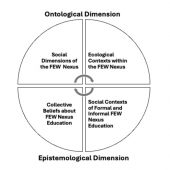
Abstract: Food-Energy-Water (FEW)-Nexus-based education supports understanding complex relationships in FEW systems, promoting socio-ecological systems thinking and decision-making about natural resources and sustainability challenges. Our study centers the perspective of educational practitioners to define and describe FEW-Nexus-based education and identify challenges with FEW-Nexus-based education. Using artifacts from workshops and existing literature, we explored the foundations of an integrated framework for FEW-Nexus-based education. These foundations include ontological and epistemological dimensions, which we used to probe deeply into workshop participants’ responses using directed and thematic content analysis. Thematic analysis resulted in themes within four categories: Ecological Contexts within the FEW-Nexus, Social Dimensions of the FEW-Nexus, Collective Beliefs about FEW-Nexus Education, and Social Contexts of Formal and Informal FEW-Nexus Education.
Continue Reading
Effective sustainability education is constrained, in part, by an inability to consistently define what it is, who it is for, and how it can best address present-day concerns. Often reduced to a set of behaviors with a future orientation for intergenerational security, sustainability loses the immediacy and importance of issues like hunger, homelessness, and the impact of toxic industry practices on real people in real communities, despite the fact that these all represent foundational aspects of sustainability. Critical sustainability harnesses place and community to make connections between equity, ecology and economy explicit. Requiring a deep connection with the socio-ecological landscapes of our experiences, critical sustainability utilizes individual and community identities in working towards resilience. In this paper, we explore the ways that participatory action research (PAR) can leverage place and community to disrupt systems of power and privilege and demonstrate this approach as both effective pedagogy and a powerful orientation toward addressing community-level climate change adaptation. We contend that critical sustainability education requires sincere engagement with place, along with the shared, community-driven knowledge production that is the cornerstone of PAR.
Continue Reading
 Journal of Sustainability Education is licensed under a Creative Commons Attribution License.


