





Abstract: This study examines how integrating the Four-Dimensional Ecology Education (4DEE) Framework into an undergraduate Food–Energy–Water (FEW) nexus case study assignment shaped sustainability learning and systems thinking in an online introductory environmental studies course. Using pre/post surveys (n = 7 matched responses) and content analysis of final projects (n = 21), the study explored patterns in students’ sustainability-related competencies, including ecological understanding, systems reasoning, human–environment interactions, and cross-cutting sustainability themes. Both quantitative and qualitative analyses indicated similar trends, with students reporting increased familiarity across all 4DEE domains, particularly in ecological concepts, human–environment interactions, and sustainability-oriented themes. Content analysis of final projects reflected these same dimensions, including discussion of ecological mechanisms, application of hydrological and climate-related processes, and clearer articulation of relationships between stakeholders and ecosystems. These patterns suggest that explicitly integrating sustainability-oriented ecological framing into assignment design may strengthen students’ conceptual foundations for interpreting FEW nexus challenges. While not designed to establish causality and limited by a small sample size, this course-based reassessment provides descriptive evidence that structured faculty development opportunities can support the design of sustainability-focused assignments that yield conceptually sophisticated student work.
Continue Reading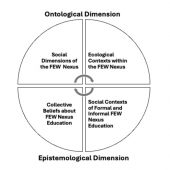
Abstract: Food-Energy-Water (FEW)-Nexus-based education supports understanding complex relationships in FEW systems, promoting socio-ecological systems thinking and decision-making about natural resources and sustainability challenges. Our study centers the perspective of educational practitioners to define and describe FEW-Nexus-based education and identify challenges with FEW-Nexus-based education. Using artifacts from workshops and existing literature, we explored the foundations of an integrated framework for FEW-Nexus-based education. These foundations include ontological and epistemological dimensions, which we used to probe deeply into workshop participants’ responses using directed and thematic content analysis. Thematic analysis resulted in themes within four categories: Ecological Contexts within the FEW-Nexus, Social Dimensions of the FEW-Nexus, Collective Beliefs about FEW-Nexus Education, and Social Contexts of Formal and Informal FEW-Nexus Education.
Continue Reading
 Journal of Sustainability Education is licensed under a Creative Commons Attribution License.


