




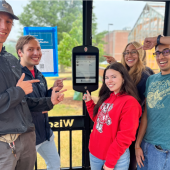
Abstract: Higher education institutions can function as living laboratories for sustainability initiatives that foster innovation and catalyze systemic change. This study examines the educational and professional outcomes of the University of Wisconsin–Madison (UW–Madison) Green Fund, a program using campus as a living laboratory to pilot sustainability initiatives on campus. The Green Fund supports student-initiated projects that address the environmental footprint, social impact, and operating costs of campus facilities. As the campus is utilized to explore sustainable solutions, the university can function as a microcosm for society, allowing for lower risk trials of emerging technologies and processes. A survey was conducted to understand the quantitative and qualitative outcomes of student participation in the Green Fund. The survey questions were aligned with the essential learning outcomes and a leadership framework of the institution. Respondents reported that Green Fund participation benefitted them professionally and academically, including by enhancing their academic and professional confidence, allowing them to explore their interests, and improving their leadership skills. Over 90% of respondents agreed that participating in the Green Fund will make a positive impact at UW–Madison and on their future professional life. In open-response questions, respondents noted the complex, interdisciplinary nature of sustainability as well as their individual interest in sustainability. The results indicate that the Green Fund provides skills and resources that are important for preparing the next generation to address wicked problems locally through serving as a living laboratory for sustainability initiatives. The results also demonstrate how the Green Fund supports campus sustainability and larger institutional sustainability goals, including fostering sustainability education experiences, achieving net-zero emissions, and creating a Zero Waste campus. These findings provide support for other higher education institutions looking to implement or continue a green fund. This work is one of the first to explore the educational and professional outcomes of a campus green fund.
Continue Reading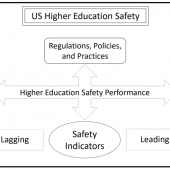
Abstract: Sustainability education in higher education often emphasizes curriculum and student learning, yet institutions also learn through operational practices and assessment systems. This study examines the relationship between campus sustainability engagement and occupational safety outcomes at U.S. higher education institutions using data from the Sustainability Tracking, Assessment and Rating System (STARS) (AASHE, 2025). Institutional characteristics, campus size, and STARS recognition levels were analyzed to assess whether stronger sustainability engagement is associated with lower rates of work-related injuries and illnesses. Findings suggest that institutions with higher sustainability engagement tend to report fewer occupational injuries and illnesses, suggesting a relationship between sustainability engagement and attention to worker safety. From a sustainability education perspective, these results demonstrate how assessment frameworks such as STARS can support institutional learning and sustainability education by linking performance data to planning and continuous improvement (Lozano et al., 2013). Integrating occupational safety into sustainability assessment reinforces safety as a sustainability outcome and illustrates how sustainability education extends beyond the classroom into everyday institutional practice.
Continue Reading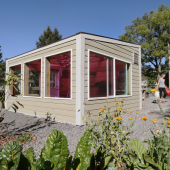
This case study describes a student-led campus sustainability initiative to design and implement a power-generating greenhouse at Allegheny College. The design of the greenhouse was carried out by students in collaboration with professionals in a variety of learning settings including research seminars, independent studies, paid internships, and senior thesis projects. By providing a detailed account of the student-driven design process and structuring the analysis around a framework of documented sustainability competencies, this paper identifies challenges and opportunities for utilizing living labs for sustainability education. Researchers observed that students who contributed to greenhouse development in multiple capacities developed several sustainable competencies. The project also demonstrates the difficulty of engaging students in both the planning and implementation stages of multi-year efforts. While the student-led design process introduced new logistical challenges, deep levels of student commitment and unique student backgrounds were critical to the greenhouse project’s success.
Continue Reading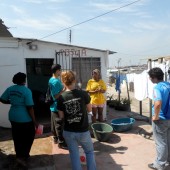
It is widely acknowledged that the sustainability challenges facing the world require new approaches to teaching and learning. At the community level, however, sustainability priorities are context specific, so prescriptions of what and how to teach for sustainability are limiting. In higher education, one innovative approach to sustainability education that acknowledges the limits of conventional coursework involves courses based on “shared action learning” – a process in which students, faculty, and community sponsors share learning experiences while working on sustainability projects for a specific community. Shared Action Learning can be applied in any community context near or far from campus ranging from the very local campus community to distant settlements across the globe. This paper describes the processes, opportunities and challenges of shared action learning through five stages: (1) project impetus, (2) contextual research and project planning, (3) community engagement and project refinement, (4) action, and (5) reflection and reporting. The roles of students, faculty, sponsors, and communities throughout the semester-long shared action learning project are explored through two examples – a course at Clark University in Worcester, MA that focuses on SAL within the college campus community and a Worcester Polytechnic Institute program through which students work on projects with partners in informal settlements in Cape Town, South Africa.
Continue Reading
 Journal of Sustainability Education is licensed under a Creative Commons Attribution License.


