Exploring the Burns Model of Sustainability Pedagogy and Faculty Development: The Impact of Ecological Design on Course Design and Teaching Strategies
Link to the JSE March 2026 Table of Contents
Link to Article PDF
Abstract: This article examines a professional development workshop aimed at introducing faculty to transformative learning approaches for teaching sustainability-related content. The small-scale, exploratory case study used data from surveys and a focus group to gain preliminary insights into faculty’s engagement with the Burns Model of Sustainability Pedagogy after the workshop. Findings revealed a shift in participants’ pedagogical approaches towards problem-based learning, role play, and simulations, and away from didactic lectures. Participants highlighted the model’s potential to enhance learners’ sense of place, illuminate complex problem interconnections, develop critical thinking skills, and question power dynamics. Potential implementation challenges included time constraints, the need for faculty support, and assistance in developing place-based, project-based, and experiential learning experiences. Despite a strong inclination to integrate the model’s components, synthesizing the dimensions proved challenging for participants. The study underscores the necessity for incremental improvements to course design and long-term institutional support to effectively adopt sustainability pedagogy in higher education.
KEYWORDS: faculty development, sustainability pedagogy, transformative learning, pedagogy, andragogy
Introduction
Climate change is one of the inexorable challenges of our time (Rockstrom, 2009; Smith, 2020), and given their responsibility to develop future leaders, Higher Education Institutions (HEIs) are uniquely situated at the epicenter of the climate crisis. In response to the challenges posed by climate change, HEIs have become increasingly committed to ensuring that students develop the requisite knowledge, skills, attitudes, and values that lead to responsible decision making and pro-sustainable behaviors (Adams et al., 2018; Cortese, 2003; Orr, 2004; Miller et al., 2011; Stough et al., 2017). These commitments have resulted in voluntary agreements such as the 1990 Talloires Declaration (United Nations Educational, Scientific and Cultural Organization (UNESCO), 1990) and the 2012 Higher Education Sustainability Initiative, which pledged to integrate sustainability into curricula (University Leaders for a Sustainable Future, n.d.; Adams et al., 2018; UN, 2015). In addition, since 2008, there has been substantial vertical and horizontal growth in interdisciplinary environmental and sustainability degree programs within HEIs (Vincent et al., 2017).
A common assumption shaping the integration of sustainability into the curricula of HEIs is that knowledge acquisition is necessary for learners to develop pro-sustainable behaviors (Carmi et al., 2015; Heeren et al., 2015; Miller et al., 2011; Orr, 2004). However, this “knowledge deficit” (Irwin and Wynne, 1996) is insufficient when trying to explain or modify skills, attitudes, values, and behaviors and has been criticized for not considering non-cognitive factors during the learning process (Ajzen et al., 2011; Carmi et al., 2015; Heeren et al., 2015; Shephard, 2008).
Many HEIs have perpetuated the knowledge deficit assumption by integrating sustainability into curricula through teacher-centered and transmissive learning approaches, in which knowledge and facts are simply transferred to learners (Burns, 2015; Gaard et al., 2017; Miller et al., 2011; Orr, 2004). Transmissive learning approaches are insufficient to deal with the inherent complexities of sustainability, and HEIs cannot assume that transferring knowledge to students will result in pro-sustainable behaviors. (Ajzen et al., 2011; Burns, 2015; Carmi et al., 2015; Gericke and Torbjörnsson, 2022; Miller et al., 2011; Orr, 2004; Silver, 2022). In contrast, transformative learning approaches consider more than cognitive knowledge, are student-centered, and focus on behavioral change. A transformative learning experience occurs when individuals critically examine problematic feelings, recognize issues of discontent, and reintegrate new perspectives into their lives (Mezirow, 2000). Transformative learning experiences result in action-oriented behavior change and enable individuals to embrace their purpose, engage with their values and feelings, and develop into citizens who understand complex systems and can make socially responsible decisions (Mezirow, 2000). A transformative learning experience allows learners to methodically interact with content, deliberately unpack and rebuild their constructed knowledge, and arrive at a more comprehensive worldview (Freire, 2000). Transformative pedagogies are effective approaches to teaching sustainability-related subject matter because they are designed to elicit a change in a learner’s worldview and how they think and act (Rodríguez Aboytes & Barth, 2020; UNESCO, 2017).
The path to a more sustainable future requires learners to engage deeply with sustainability-related issues and utilize their knowledge, skills, values, and attitudes to become changemakers (Burns, 2015; Miller et al, 2011; Orr, 2004; UNESCO, 2017). To uphold their commitment to preparing future leaders and integrating sustainability, HEIs must advance a fundamental shift from transmissive to transformative learning approaches within curricula (Burns, 2015; Gaard et al., 2017; Miller et al., 2011; Orr, 2004; Rodríguez Aboytes & Barth, 2020; UNESCO, 2017). To achieve this shift, faculty must be properly trained to develop transformative approaches that are student-centered, action-oriented, and provide learners with opportunities to critically examine their worldviews (Burns, 2013; Miller et al., 2011; Orr, 2004; Rodríguez Aboytes & Barth, 2020; UNESCO, 2017). Given the critical role of HEIs in addressing the climate crisis, there is an urgent need to equip faculty with the skills to foster transformative learning experiences that go beyond mere knowledge acquisition. This study aims to add to the literature on ways to train faculty in utilizing transformative learning models, ultimately contributing to the cultivation of future leaders capable of making socially responsible and sustainable decisions.
Literature Review
Faculty Development and Sustainability
Efforts have been made to prepare faculty to integrate sustainability into courses using a variety of pedagogical approaches (Burns, 2015; Heeren et al., 2016; Kirby & Zwickle, 2021; Zwickle et al., 2014). While these professional development initiatives were not explicitly designed to train faculty in transformative pedagogies, they offer a glimpse into the evolution of integrating sustainability into curricula through faculty development at HEIs. Three examples include Northern Arizona University’s Ponderosa Project (Chase and Rowland, 2004), Emory University’s Piedmont Project (Eisen and Barlett, 2006; Hartfield-Méndez et al., 2019; Hong, 2020), and James Madison University’s Arboretum Collective (Hurney et al., 2015). These initiatives aimed to introduce sustainability concepts and pedagogical approaches to interdisciplinary cohorts of faculty members. The required deliverables for each project were revised or re-envisioned syllabi by faculty participants who demonstrated new content and/or pedagogical approaches (Chase and Rowland, 2004; Eisen and Barlett, 2006; Hartfield-Méndez et al., 2019; Hong, 2020; Hurney et al., 2015). Emory’s Piedmont Project was modeled on the Ponderosa Project, and while published research lacks empirical data on the outcomes, the participating faculty described significant innovations in content and pedagogy (Chase & Rowland, 2004; Eisen & Barlett, 2006). Faculty participating in the Ponderosa and Piedmont projects reported an increase in the amount of integrated content in their courses and tied it to local, regional, and global sustainability themes and issues. These faculty also stated that they integrated more experiential, project-based, and place-based learning opportunities geared toward action and problem-solving (Chase & Rowland, 2004; Eisen and Barlett, 2006). These pedagogical innovations included field trips, campus walks, botanical observations, and community-based projects (Chase and Rowland, 2004; Eisen and Barlett, 2006).
While these projects were instrumental in shifting faculty toward action-oriented strategies for sustainability education, they were primarily designed for curricular infusion rather than being explicitly anchored in a singular theoretical framework for transformative pedagogy (Chase and Rowland, 2004; Eisen and Barlett, 2006; Hurney et al., 2015). Building upon the successes of these pioneering models, the Burns Model of Sustainability Pedagogy (BMSP) represents a strategic evolution. It moves beyond the delivery of sustainability content to offer an intentional, theoretically grounded architecture specifically designed to facilitate the deep, values-based shifts characteristic of transformative learning (Burns, 2013, 2015, 2024). By synthesizing the active learning elements championed by earlier projects into a holistic, multi-dimensional framework, the BMSP provides the structural support necessary to maximize the transformative potential of sustainability education.
Burns Model of Sustainability Pedagogy
The Burns Model of Sustainability Pedagogy is a practical and adaptable model for course design (Burns, 2013, 2015, 2024). The model synthesizes prominent learning theories and is designed to teach sustainability-related content to both undergraduate and graduate students. The fundamental goal of the model is to develop learning experiences that give learners the support needed to transform their knowledge, skills, attitudes, and values to make positive changes (Burns et al., 2015, 2019). The model consists of the content, perspectives, process, context, and ecological design dimensions. The dimensions are rooted in their respective theoretical frameworks and integrated to create learning experiences that have the potential to transform learners’ values and behaviors (Burns, 2013, 2015, 2024; Burns et al., 2015, 2019). Figure 1 shows a slightly modified model that includes pedagogical constructs along with the dimensions and learning theories.
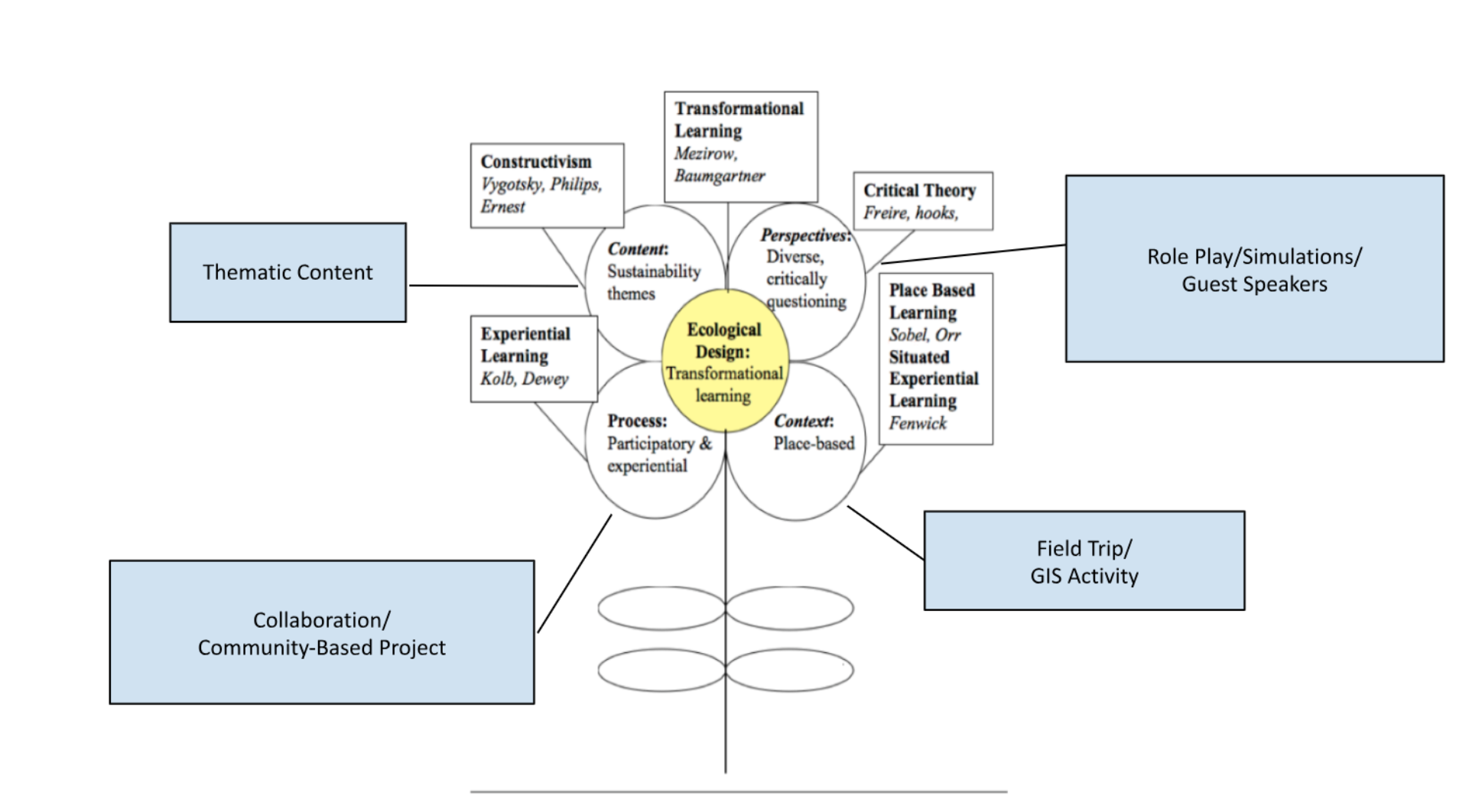
Figure 1. The Burns Model of Sustainability Pedagogy (Burns, 2013)
Note: Circles indicate dimensions, white squares indicate learning theories and blue squares indicate pedagogical methods. Figure adapted from Burns, H. (2013). Meaningful sustainability learning: A study of sustainability pedagogy in two university courses. International Journal of Teaching and Learning in Higher Education, 25(2), 166–175.
Content Dimension
The content dimension aims to expose learners to systems thinking and to increase their understanding of interrelated and interconnected complex sustainability issues and themes. This dimension is grounded in systems theory (Meadows, 2008; Senge, 1990) and social constructivism (Philips, 2004; Vygotsky, 1978). This dimension is fulfilled by weaving content throughout the learning experience so that learners engage with it from multiple perspectives. In this dimension, content is thematically developed and implemented while considering its relationship with other dimensions through systems theory and social constructivist frameworks (Burns, 2013, 2015; Burns et al., 2015, 2019). A pedagogical approach that can help increase learners’ understanding of complex sustainability issues includes designing weekly activities based on underlying themes (Burns et al., 2019). Thematic implementation can be achieved through curriculum mapping that links specific sustainability issues, such as sustainable food systems, to foundational concepts like resource scarcity and ecological footprints. This structure enables a spiral curriculum where themes are revisited at increasing levels of complexity across a program (Woodward, 2019).
Perspectives Dimension
The perspectives dimension asks learners to critically analyze various dominant paradigms and power dynamics. This dimension allows learners to think deeply about complex ecological, social, and economic issues from diverse perspectives. This dimension highlights the cultural and social components of sustainability, which are often invisible to those living in a dominant paradigm (Burns, 2013, 2015; Burns et al., 2015, 2019). The perspectives dimension is grounded in critical theory and pedagogy (Freire, 1970; hooks, 1994). This dimension helps learners understand the power dynamics between stakeholders and highlights the importance of amplifying perspectives that are normally omitted from the decision-making process (Burns et al., 2015, 2019). Pedagogical approaches to help learners critically examine power dynamics include role play and simulations, discussing literature from diverse perspectives, and inviting guest speakers to discuss sustainability issues from various viewpoints (Burns et al., 2019). For example, a curriculum might be structured to include a guest speaker series amplifying the work of leaders from marginalized communities disproportionately affected by climate change. By intentionally curating a wide range of voices, educators can challenge learners to move beyond a single, dominant narrative and recognize the role of power and privilege in shaping sustainability outcomes.
Process Dimension
The process dimension focuses on the collaborative dynamics necessary for learners to build a community of inquiry, and the importance of experiential learning processes when teaching and learning sustainability. Sustainability pedagogy focuses on helping individuals change themselves, engage with others, and interact with places (Burns, 2013, 2015). This dimension is based on experiential learning theory because it provides learners with opportunities to explore real-world problems and develop meaningful and applicable solutions (Dewey, 2013; Krajcik et al., 2008). Issues outside the classroom are often ambiguous and enable learners to engage at a deep level while critically examining complex systems based on their values, beliefs, and judgments (Krajcik et al., 2008; Miller et al., 2011; Savery, 2006; Shephard, 2008). Through this process, learners can reflect on their experiences and change their long-held perspectives, prompting pro-sustainable behaviors (Burns, 2013, 2015; Dewey, 2013). The literature acknowledges that this is a formidable task, as personal beliefs and systemic inertia often present significant barriers to translating new perspectives into sustained behavioral change (Hoggan, 2016; Wamsler, 2020). A pedagogical approach to help students explore real-world issues includes designing an experiential learning capstone project that focuses on a particular sustainability issue (Burns et al., 2019). For example, students can partner with a local non-profit to design a community garden, directly engaging with stakeholders to understand practical challenges and opportunities. This hands-on collaboration creates a shared space for problem-solving and collective reflection.
Context Dimension
The context dimension emphasizes learners’ ecological and cultural understanding as well as connections to their community. According to Burns (2013, 2015), sustainability pedagogy must be integrated into the local learning environment. This dimension relies primarily on place-based learning theory and asserts that meaningful learning occurs only if it is tied to places where students can engage in curiosity (Burns, 2013; Orr, 2004; Sobel, 2004). The context dimension helps learners gain a deeper understanding of both their immediate places and their roles as citizens within those places (Burns, 2013; Krajcik et al., 2008; Orr 2004; Sobel, 2004). Pedagogical approaches to help students explore their connections to the place in which they live include field trips and learning experiences that focus on local and regional sustainability issues (Burns et al., 2019). For these experiences to move beyond novelty, they must be intentionally designed to facilitate deep inquiry into local contexts and foster authentic engagement with community members and their perspectives. For example, a class might partner with a local urban planning commission to analyze a development proposal, which requires students to interview residents and consider the project’s impact on local ecosystems and community identity (Burns, 2013; Krajcik et al., 2008; Orr 2004; Sobel, 2004).
Ecological Design
Finally, ecological design is the synthesis of the four dimensions. If done properly, the learning experience includes the four dimensions that are designed to provide learners with a transformative learning experience. In practice, this process requires faculty to move away from siloed lesson planning and instead engage in a holistic mapping of the course ecosystem. This is achieved by ensuring that the content is not just delivered via lecture but is explicitly tested through real-world problem solving and experienced through diverse stakeholder perspectives (Burns, 2024). The ecological design dimension is not a linear process, but rather a constellation of interrelationships between the content, activities, and assessments of a course (Burns, 2013, 2015, 2024). Rather than a step-by-step checklist, faculty utilize ecological design to identify areas where different dimensions overlap. For example, designing a community-based project that simultaneously addresses sustainability content, collaborative leadership, and place-based learning (Burns, 2013, 2015, 2024). The BMSP’s dedication to transformative learning experiences makes it a promising tool for helping faculty develop sustainability-related courses that have the potential to impact the values and behaviors of learners (Burns, 2013, 2015, 2024; Burns et al., 2015, 2019; Orr, 2004).
While the empirical literature on the efficacy of the BMSP is nascent, early studies offer promising results regarding its transformative potential. A descriptive implementation study of two courses found that learners developed a more holistic, interrelated understanding of sustainability, citing class trips and peer collaboration as significant drivers of their learning (Burns, 2013). This research suggested that interacting with diverse perspectives could inspire hope and motivate students toward proactive global change.
Building upon these findings, an action research study at Portland State University further investigated the BMSP within a peer-mentor course, revealing deep shifts in student literacy and agency (Sherman and Burns, 2015). In this context, students’ understanding of sustainability evolved from simple concepts, such as recycling, to a multidimensional view of broader social and educational systems. Furthermore, students adopted a critical theory perspective, recognizing the intersections of power, privilege, and inequality within sustainability issues (Sherman and Burns, 2015). Most notably, the model appeared to foster significant student agency, as learners applied critical thinking to their own education and took active responsibility for their learning environments (Sherman and Burns, 2015). Collectively, these findings suggest that while the BMSP is an effective framework for fostering sustainability literacy and empowering students, its success depends heavily on the design and implementation of robust professional development to equip faculty for such complex pedagogical shifts (Sherman and Burns, 2015).
Purpose
The literature underscores significant efforts in faculty development aimed at integrating sustainability into higher education curricula. Initiatives such as the Ponderosa Project, Piedmont Project, and Arboretum Collective illustrate the evolution of sustainability education approaches at HEIs. While these programs have successfully enhanced sustainability integration into curricula, they lack explicit grounding in theoretical transformative pedagogical models, which could limit their potential (Chase and Rowland, 2004; Eisen and Barlett, 2006; Hurney et al., 2015). In contrast, the BMSP offers a robust, theoretically grounded framework designed to foster transformative learning experiences through the integration of multiple dimensions and learning theories (Burns, 2013, 2015; Burns et al., 2015, 2019).
However, there is a lack of empirical evaluation on the effectiveness of training faculty to implement the BMSP. To fill this need, this study seeks to assess the efficacy of a professional development workshop designed to introduce faculty to the BMSP and transformative learning experiences for sustainability education. By examining how participants engage with the content, perspectives, process, context, and ecological design dimensions, the study aims to answer the following research questions:
Research Questions
- In what ways do faculty intend to alter their teaching methods to incorporate pedagogical approaches aligned with the Burns Model of Sustainability Pedagogy after participating in the workshop?
- In what ways do faculty plan to implement the content, perspectives, process, and context dimensions of the Burns Model of Sustainability Pedagogy after participating in the workshop?
Methodology
Participants
The workshop was promoted the via Brown University’s Green Schools listserv, as well as the Association for the Advancement of Sustainability in Higher Education’s sustainability across the curriculum community of practice. A link directing the participants to a registration form for collecting basic demographic data was included in the email. Twenty-six participants expressed initial interest by submitting the demographic survey, but only nineteen individuals completed the informed consent. Fourteen participants were invited to participate in the workshop. Prior to the workshop, two participants rescinded their invitations due to other professional obligations, resulting in a study sample of 12 participants.
The participants included ten faculty and two instructional support staff from four-year public and private institutions, and community colleges in the United States and Canada. Three of these institutions were large public research universities, and the private HEIs consider themselves selective liberal arts institutions. The faculty participants were adjunct part-time instructors, professors of practice, tenure-track, and tenured. Subject matter expertise included environmental science, geography, political science, literature, and sociology. It was decided to admit two support staff into the workshop because they directly supported faculty in the design of sustainability education courses at their respective institutions. Table 1 provides additional participant details.
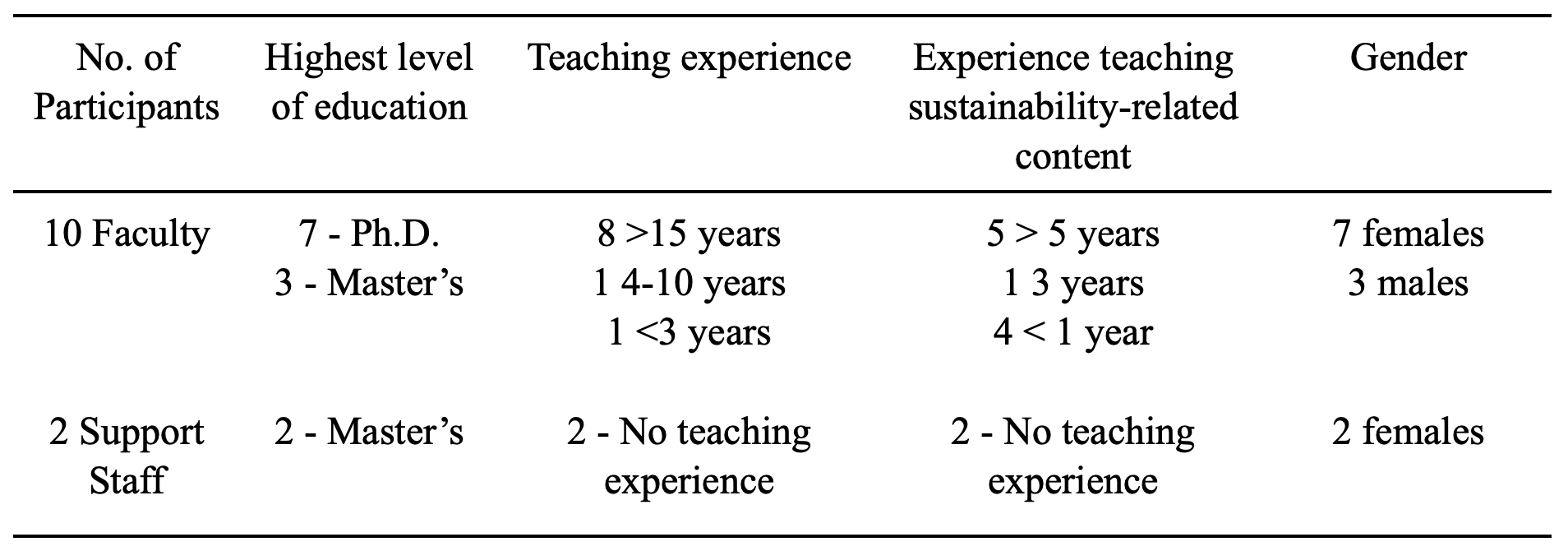
Table I: Participant Details
Study Design
This research employed a small-scale, exploratory case study design to investigate how a professional development workshop influenced faculty members’ engagement of the BMSP. The case study approach was selected for its utility in exploring the lived experiences of the participants as they worked towards advancing sustainability education at their respective HEI. (Creswell & Creswell, 2017; Creswell & Poth, 2023).
Procedures
Three-hour virtual workshop sessions were conducted for three consecutive weeks and focused on the dimensions of the BMSP. The first session covered the content and perspectives dimensions, while the process and context dimensions were covered during sessions two and three, respectively. The workshop was designed to train faculty to utilize the BMSP to develop transformative learning experiences in their courses. To increase accessibility, workshop sessions were held virtually via Zoom. In addition, Zoom allowed for real-time captioning and the sharing of recordings for participants who needed clarification or missed a session.
Data Sources
This study leveraged both quantitative and qualitative data. Data collection occurred throughout the 2023 fall semester and consisted of a demographic survey and pre- and post-workshop surveys (see Supplemental Material 1). The workshop surveys were developed in Qualtrics by the researchers and reviewed by two experts in the environmental education field to validate the measures. The small sample size of the study inhibited calculating the reliability of the workshop surveys. Quantitative data were collected using a selection list of pedagogical methods and 5-point Likert scale items. The list of pedagogical methods included those typically used when implementing the dimensions of the BMSP. For example, place-based learning aligns well with the context dimension, which emphasizes learners’ connections with their geographical location and community (Burns, 2015; Burns, et al., 2019; Hernandez Gonzalez, 2023). The seven Likert items were designed to gauge participants’ inclination towards planning for the implementation of the BMSP dimensions BMSP before and after the workshop. Qualitative data were collected through 12 short-answer questions to assess how participants perceived the usefulness of the model’s dimensions before and after the workshop.
A voluntary focus group (see Supplemental Material 2) was held during the spring semester to follow-up with participants and provide them with the opportunity to share their experiences experimenting with the dimensions. The focus group was recorded using Zoom and verbatim transcripts were used for data analysis. Since one of the researchers also designed and facilitated the workshop, we acknowledge the unique challenges of this dual role and attempted to mitigate any potential biases by being transparent with participants and ensuring the use of multiple data sources for triangulation.
Data Analysis
Quantitative data analysis of the pedagogical methods and Likert-scale questions was performed using Statistical Package for the Social Sciences (SPSS) software to generate descriptive statistics. The qualitative data analysis utilized an interpretive approach and followed a three-stage process based on Saldaña’s (2016) comprehensive coding approach. The analysis began before data collection with the development of an initial deductive framework of seven a priori codes (Saldaña, 2016). Table 2 lists the a priori codes and their corresponding definitions. The second stage involved analyzing the open-ended survey questions through descriptive coding, a technique particularly suited for summarizing short-answer responses (Saldaña, 2016). This stage was initiated by meticulously reviewing individual survey responses and manually capturing relevant phrases and terms aligned with the research questions and participants’ initial perceptions of planning for implementation of the BMSP in their courses. During the third stage, focus group transcripts were analyzed using in vivo coding, an approach well suited for capturing action-oriented codes emerging from participants’ perspectives (Saldaña, 2016). The focus group analysis involved reviewing and annotating the transcripts, with attention paid to the participants’ preliminary insights of how the model could be integrated into their teaching. The a priori codes, along with those generated during the second and third stages, were further analyzed, combined, and organized into major themes highlighting the participants’ preliminary insights regarding the BMSP. To maintain analytical rigor, qualitative data were coded by the lead researcher and subsequently reviewed by a second researcher through a series of random audits. These checks served to validate the coding scheme and ensure that the findings accurately reflected the participants’ sentiments (Saldaña, 2016)
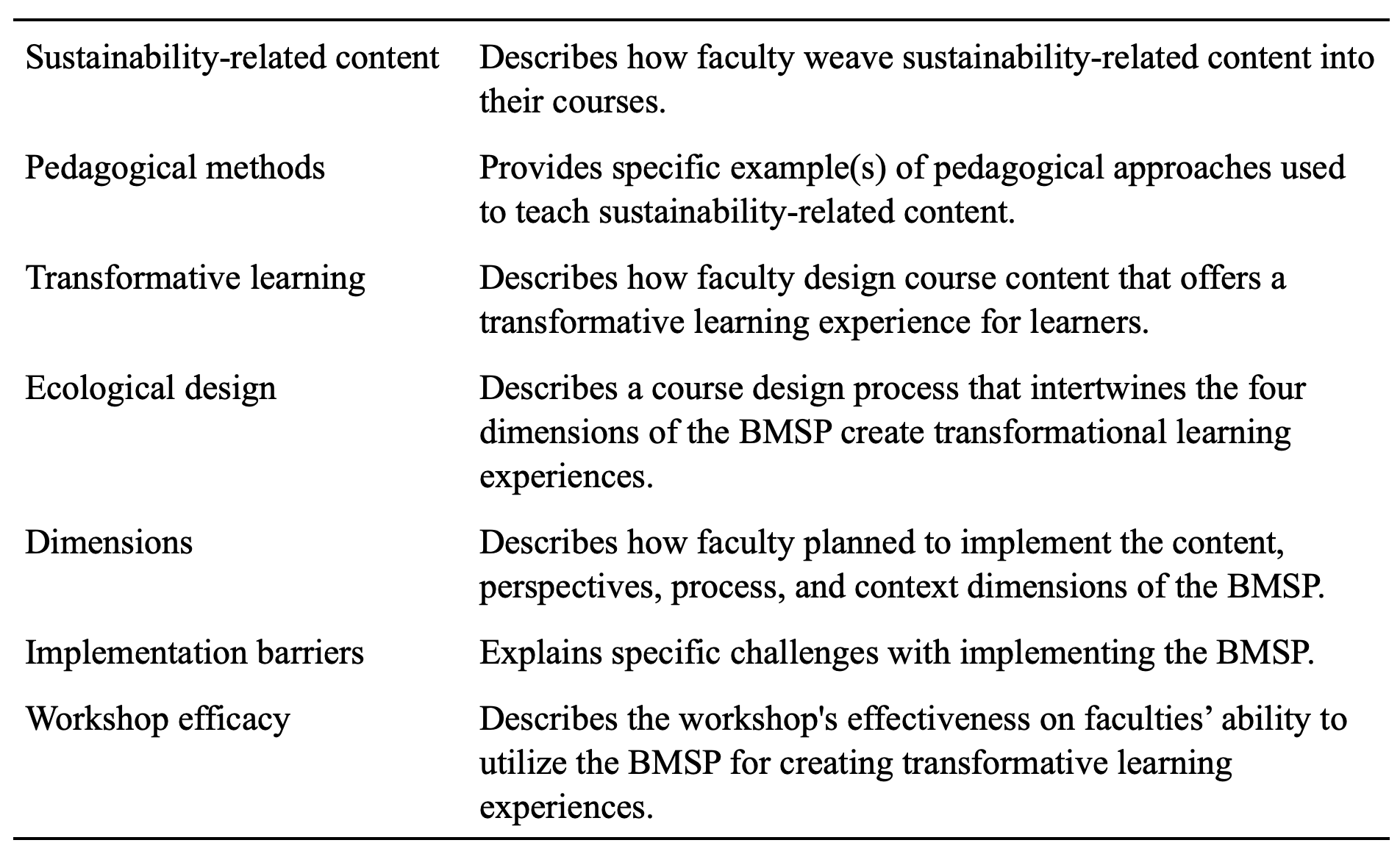
Table II. A priori codes and definitions
Results and Discussion
Change in Pedagogical Approaches
As an exploratory case study investigation into early experimentation, the results highlight the initial shifts in pedagogical intent as participants began navigating the practical application of the BMSP. The quantitative data collected from the 11 surveys provided a foundational understanding of participants’ existing pedagogical practices and a comparison of their intentions to integrate the dimensions of the BMSP before and after the workshop. Analysis of the pre-workshop quantitative data revealed that the participants had previously utilized numerous pedagogical approaches in at least one course. Table 3 provides an overview of these methods. Post-workshop survey data showed increased interest in implementing more project- or problem-based learning, guest speakers, role play, and simulations in their courses. The increased interest in these methods is unsurprising given their effectiveness in teaching sustainability-related content and compatibility with several dimensions of the BMSP (Burns, 2015; Burns et al., 2019; Kricsfalusy et al., 2018; Emblen-Perry, 2023; Gordon and Thomas, 2018; Lozano et al., 2017). The post-workshop survey data indicated a shift away from the didactic lecture method. Prior to the workshop, seven participants had reported using didactic lectures in their courses. While following the workshop, four participants expressed their intentions to continue using this method. This outcome aligns with the workshop’s emphasis on transitioning teaching strategies towards transformative learning, as didactic lectures are typically aligned with transmissive learning approaches (Gaard et al, 2017; Silver, 2022).
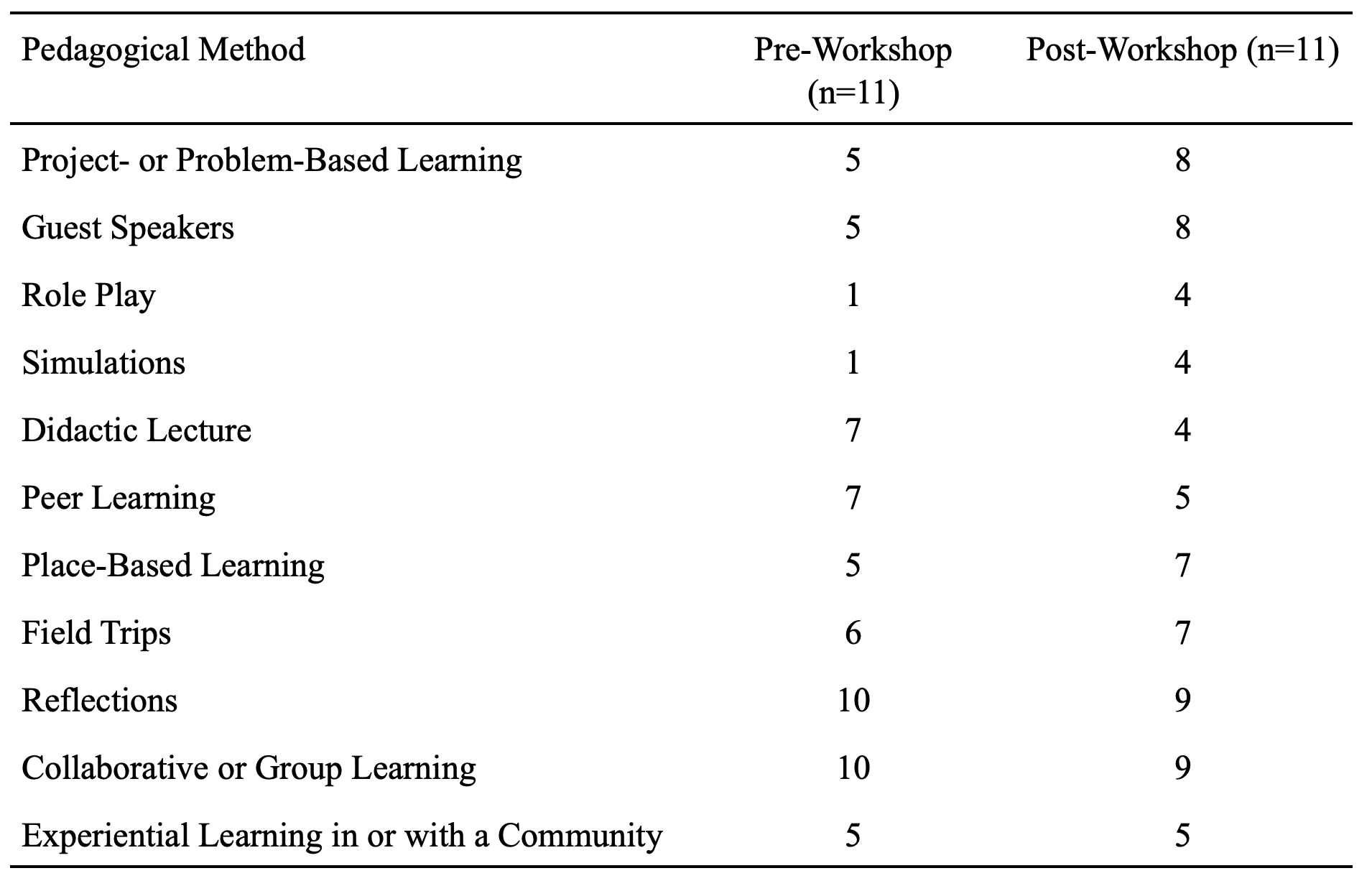
Table III. Pedagogical Methods Pre- and Post-Workshop
Planning for Implementation
The results from the Likert survey data presented in Table 4 indicate a positive skew with all means above 4.0, and most means higher than 4.5. This indicates that participants had a strong inclination toward the model’s dimensions before the workshop, and the professional development experience further empowered them to incorporate the BMSP into their courses. The most notable change between pre-and post-workshop, with a large change in mean (ΔM=0.62), occurred in the content dimension, which assessed whether learners were afforded opportunities to explore the interrelationships among complex sustainability issues. In addition, a comparison of the ecological design dimension in the pre-survey (M = 4.40) with the post-survey (M = 4.20) indicated a small difference in how participants classified their course following the workshop. This item asked faculty to consider whether they synthesize the four dimensions of the BMSP in a manner that enables learners to take control of their purposes, values, and feelings, and develop into socially responsible decision-makers. Although the change in mean was small (ΔM=-0.20), it is worth noting that it is the only mean that decreased following the workshop.
The interpretive qualitative data analysis identified three key themes regarding participants’ preliminary experiences with the individual dimensions of the BMSP. These themes encompass the perceived benefits of the BMSP, perceived implementation challenges, and the pedagogical approaches employed to effectively address the model’s dimensions.
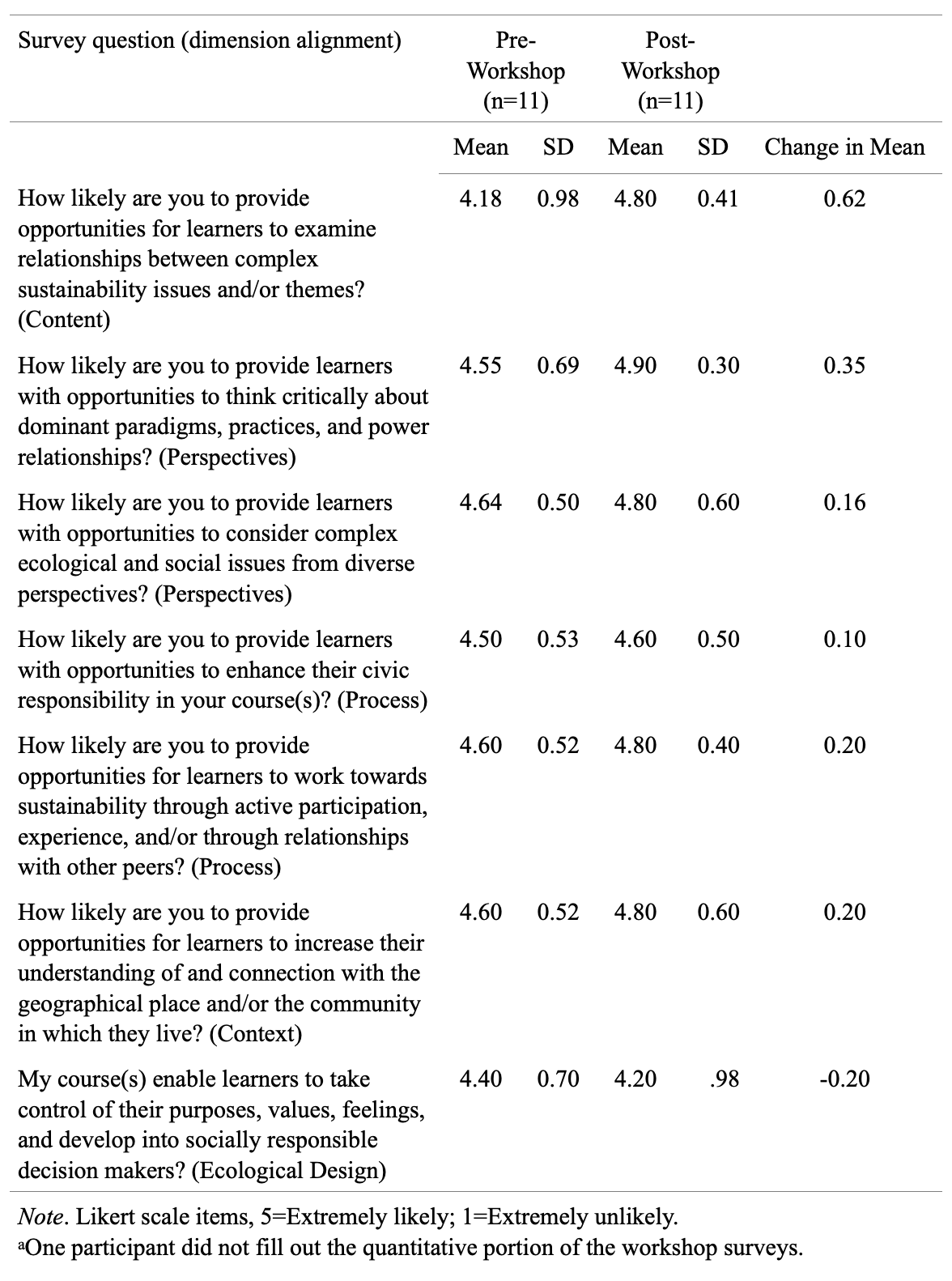
Table IV. Pre-Post Workshop Survey Likert Scale Questions
The first theme emerging from the qualitative analysis focused on the benefits of the BMSP and its ability to enhance a learner’s sense of place, help illuminate the interconnections of complex problems, develop critical thinking skills and civic awareness, and question power dynamics. When reflecting on the benefits of the context dimension after the workshop, one faculty from a large public HEI in the southwest United States stated: “Working with the place where students live helps connect them further to it, enabling them to “see” their place in a different light and perhaps through different perspectives too” (post-workshop survey, November 2023).
Another participant from a small public HEI in the northeastern United States explained the importance of the perspectives dimension and power dynamics stating:
I think students will then appreciate the essential nature of collaboration in solving complex problems. By considering who and what is left behind when one paradigm dominates, students should then recognize that simply replacing one paradigm or power relationship with another will not work; it is only working together that can produce new solutions (post-workshop survey, November 2023).
The second theme focused on the challenges participants anticipated and experienced in implementing the BMSP. These challenges fall under three sub-categories that highlight resource and support constraints, content dimension challenges, and faculty development concerns. By far, the most significant resource and support challenge that participants focused on before and after the workshop had to do with time. Specifically, the time for implementing the model and carving out space in class and student schedules to allow for comprehensive pedagogical approaches. When asked about implementing the dimensions, a participant from another large public HEI explained:
Time constraints are a typical challenge with students at my university who may also have jobs, families, etc. Time constraints within the context of a class can be a challenge too. It can take significant time to support student collaborative work, project logistics, etc. (post-workshop survey, November 2023).
During the focus group, a geography faculty member reflected that they had “great ambitions” to implement a neighborhood walk activity in their spring course that was discussed during the workshop. However, when the spring semester began, they ran out of time to develop the activity and added “Those great ambitions, and then push comes to shove. And it doesn’t happen, because you just don’t have a plan yet” (focus group, May 2024).
Participants also perceived that the ability to develop thematic content and weave it throughout the course could also be a challenge for implementing the model. When explaining the challenges they faced deciding how to implement the content dimension, a faculty explained they had difficulty “incorporating the dimension in a meaningful way that aligns with the course content” (focus group, May 2024). Another participant from a large private HEI explained the connection between developing content and time commitments, stating:
Sometimes it is challenging to find an accessible and relevant example for students to focus on rather than learning through a hypothetical sustainability issue. Finding the time and resources for this can be difficult, especially securing guest experts/speakers at the time of class and compensating them for their time through the university (post-workshop survey, November 2023).
Similar challenges were highlighted during the focus group session by a humanities faculty who explained that they found the content dimension challenging because they want learners to engage in content in specific ways that aligned with their discipline. However, their courses often include majors from outside of the humanities, which can make it difficult for them to ensure that the content is both specific to their expertise and appealed to learners from other disciplines.
In addition to time and content constraints, participants explained that faculty would require additional support to ensure proper implementation of the model. One participant highlighted this sentiment, noting that “the barrier to entry is high for busy faculty” and emphasized the need for ready-made projects or protocols that can be easily adopted or modified (post-workshop survey, November 2023).The participants also discussed how their limited knowledge and understanding of complex issues could affect the model’s implementation. One faculty stated, “As a scientist by training, I do not feel competent to speak with authority on these issues. Paradigm and power represent entire scholarly disciplines” (post-workshop survey, November 2023). One of the instructional support staff participants added the insight that “For faculty members, this could feel overwhelming, as they are supposed to, or used to, mastering every aspect of what they are covering in class” (focus group, May 2024).
When discussing support for implementation during the focus group, a participant explained that the biggest pitfall was the scope of the model and the work involved in ensuring that the dimensions were present and properly designed. They explained that:
I think if faculty wanted to change their whole curriculum, they should start small, initially adopt one dimension, do a micro-version, and spread out afterward. Or just select one capstone project and try to see how the five dimensions are represented in their project (focus group, May 2024).
While reflecting on ways to make the model less burdensome, a faculty sharing the same sentiment on iteration stated during the focus group:
Heading into the spring, I wasn’t sure how much development I could do, and so I decided I would change one thing and then plan another phase for myself going forward. So, in the spring, I developed the content around relationships, which are central to sustainability. This small change created benchmarks and opened up our discussion so learners could experience different ways of thinking about environmental justice (focus group, May 2024).
When asked about the success of this experience, the faculty member explained “From a writing standpoint, I really like how things went and the students also gave positive feedback, and they felt like they had more control over their learning experience” (focus group, May 2024). These findings underscore the need for targeted institutional support to facilitate the effective implementation of the BMSP. Specifically, institutions could provide stipends or course release time for curriculum redesign, while fostering communities of practice in partnership with centers for teaching and learning to address faculty challenges.
The third theme focused on pedagogical approaches that faculty could utilize across the dimensions of the BMSP. The approaches mentioned by the participants were place-based, project-based, and experiential learning. The participants were eager to share how they used or planned to use these approaches in their courses. One faculty member shared how they melded place- and project-based learning into one of their geography courses:
[Students] clean up litter along a local river and one element we consider is waste, waste management and our disposable society. Students work in pairs to explore other dimensions of the river (water quality, development, homeless camping, the dam and reservoir upstream, recreation, flora and fauna, etc.) and present their research findings to the class (post-implementation survey, March 2024).
Another participant described a community-based composting project within their course. Students engaged in a practical “waste-to-resource” cycle by collecting kitchen food scraps and maintaining compost piles in partnership with a commercially licensed kitchen that incubates local food truck businesses. Moving beyond mere participation, this experiential learning design required students to analyze the tangible impacts of waste diversion and CO2 reduction while critically reflecting on the systemic barriers and power paradigms that currently limit community-wide scaling (post-workshop survey, November 2023).
The combination of quantitative and qualitative data provided valuable insights into participants’ interest in integrating the dimensions of the BMSP into their teaching practices. Quantitative analysis revealed a notable shift in the participants’ intentions in providing learners with opportunities to examine the relationships between complex sustainability issues. However, challenges related to resource constraints, content development, and faculty support and development have been identified as potential barriers to implementation. Nevertheless, participants expressed enthusiasm for pedagogical approaches such as place-based learning, project-based learning, and experiential learning, indicating a willingness to adapt their teaching methods to better engage students and foster transformative learning experiences.
This study aimed to investigate the effects of a professional development workshop on faculty as they begin to explore the Burns Model of Sustainability Pedagogy. The findings revealed that faculty were already familiar with many of the pedagogical methods and approaches required to successfully implement the dimensions of the BMSP in their courses (Burns, 2015, 2024; Burns et al., 2019; Kricsfalusy et al., 2018; Emblen-Perry, 2023; Gordon and Thomas, 2018; Lozano et al., 2017). The findings also showed that when carefully planned and implemented, lectures can be efficient and inspiring modes of learning, but faculty understood the limitations of transmissive pedagogical methods and were willing to consider more transformative learning approaches following the workshop (Gaard et al., 2017; Silver, 2022).
Discussion
This study sought to assess the effectiveness of a professional development workshop designed to prepare faculty to implement the BMSP and to examine how participation influenced their intended pedagogical shifts. Guided by two research questions, the study explored (1) how faculty planned to alter their teaching practices to align with the BMSP and (2) how they intended to implement the model’s content, perspectives, process, and context dimensions.
The content dimension, which asks faculty to facilitate learners’ understanding of interconnected systems and engage with thematic content, posed the greatest challenges for the participants. Notably, the workshop highlighted the need for a universally effective pedagogical method to address this dimension, and participants acknowledged the challenges of structuring courses around thematic content that highlight the complex relationships within sustainability issues (Rampasso et al., 2018; Salajegheh et al., 2024). Nonetheless, the content dimension survey data showed the largest change in mean (ΔM=0.62) compared to the other dimensions of the model. This indicates that despite the challenges experienced in implementing the dimension, faculty embraced the benefits of providing learners with opportunities to examine the relationships between complex sustainability issues (Burns, 2013, 2015, 2024; Burns et al., 2015, 2019).
The results from the survey data also indicate that individual dimensions resonate with the faculty, as each dimension showed an increase in the likelihood of implementation after the workshop. However, the change in the pre-and post-workshop ecological design dimension (ΔM=-0.20) shows that participants slightly changed how they viewed the transformative potential of their courses. This difference could be due to the participants’ initial uncertainty about transformative learning experiences before the workshop, which hindered their ability to accurately identify their courses as transformative. It could also demonstrate that the faculty feel it would be easier to plan and implement individual dimensions as separate parts. However, synthesizing the dimensions to ensure a transformative learning experience may overwhelm faculty. In other words, for a successful implementation, faculty should develop a plan of continuous improvement for existing courses, and phased adoption for new courses since implementing all the components of the model could be overwhelming (Salajegheh et al., 2024; Stoddard and Brownfield, 2020). Overall, the findings suggest that while participants reported challenges in operationalizing certain dimensions of the model, they demonstrated measurable growth in their understanding of and commitment to integrating the BMSP into their teaching.
Implications for Practice
This study provides a unique perspective on the efficacy of the BMSP and reveals important implications for faculty or HEIs designing and implementing sustainability-related content. As the faculty noted throughout the study, institutional support and development are essential for the successful implementation of the model. Not only do faculty need to be trained in effective ways to plan for, and implement sustainability education, they also need substantial instructional support from staff and centers dedicated to faculty development. This could be in the form of regular, ongoing long-term professional development and support workshops, individual consultations, increased access to resources, and cross-disciplinary subject-matter expertise (Rampasso et al., 2018; Tasdemir and Gazo, 2020). Additionally, faculty would benefit from course release opportunities to update content and adopt the practice of continuous iterative improvement to reduce stress and feeling overwhelmed.
Another implication of the study is the need for ongoing investigation into the feasibility and impact of instructional models based on transformative learning theory within the context of sustainability education in HEIs (Burns, 2013, 2015; Burns et al., 2015, 2019; Gaard et al., 2017; Rodríguez Aboytes and Barth, 2020; UNESCO, 2017). Beyond sustainability pedagogy, the Head, Hands, and Heart model combines academic learning, practical skills, and community values to foster holistic education aimed at altering learners’ actions and behaviors (Sipos et al, 2008). Additionally, the Inner Development Goals framework emphasizes cultivating inner skills and qualities such as self-awareness, emotional intelligence, and ethical leadership, with the objective of integrating these values into learners’ lives and actions (Nordén, 2024). To our knowledge, the implementation and effectiveness of these models within HEIs and among faculty have not been rigorously explored.
Future Research
With more HEIs developing sustainability-focused curricula and faculty searching for models and frameworks to design effective learning experiences, further research is needed to explore the efficacy of the BMSP. Findings from this study would benefit from a follow up survey, or longitudinal study to see which pedagogical changes and dimensions remained useful for faculty. Furthermore, as adoption increases, it is important to investigate the model’s potential impact in larger-scale implementations and diverse educational contexts. While this study focused on professional development for faculty, it is important to conduct further research on the model’s long-term impact on learners and how it contributes to changes in behaviors and actions.
While this study focused specifically on professional development and the faculty’s initial experience with the model, it is important to acknowledge that the ultimate success of the BMSP is measured by its impact on the learner. Since the focus of this inquiry was on the faculty, student-learning outcomes such as shifts in worldviews, behaviors, and long-term sustainability actions, were outside the current scope and were not investigated as part of this study. Future research may consider conducting longitudinal studies on the model’s impact on learners, as faculty require robust training and confidence in the framework before a truly transformative student experience can be facilitated.
Another important consideration for future research is the issue of faculty “re-novicing” or “out-of-field” teaching (Lane, et al., 2023). Many faculty may not feel fully equipped to weave sustainability-related content into their courses. Therefore, it is important to investigate how to foster more faculty support and encourage inter- and trans-disciplinary collaboration so that faculty do not take on the burden of continuously upskilling alone (Tasdemir and Gazo, 2020).
Limitations
The small sample size of the study limits the generalizability of the findings, and future research should aim to include larger and more diverse samples. Gathering data on a population such as faculty, who have teaching loads, publishing requirements, and other institutional commitments, may have limited the quantity of data gathered for the study. Finally, a semester is too short of a timeframe to fully investigate the impact of the model and its ability to foster transformative experiences for learners. To fully capture the impact of the model, faculty need to be studied over a longer period of time to fully understand the capability and challenges for the BMSP.
Conclusion
The findings of this study indicate that the Burns Model of Sustainability Pedagogy is a promising framework for sustainability education and for training faculty to implement transformational learning approaches in their courses. Participants recognized that transmissive learning approaches are inadequate for addressing complex problems. To develop future leaders, HEIs must facilitate the adoption of more transformative pedagogies among faculty. While faculty appreciate the merits of the model’s individual dimensions, integrating the dimensions comprehensively is a concern. Therefore, an ethos of continuous improvement, supported by instructional staff and teaching and learning centers, is essential for successful implementation.
References
Adams, R., Martin, S., and Boom, K. (2018). University culture and sustainability: Designing and implementing an enabling framework. Journal of Cleaner Production, 171, 434– 445. https://doi.org/10.1016/j.jclepro.2017.10.032
Ajzen, I., Joyce, N., Sheikh, S., and Cote, N. G. (2011). Knowledge and the Prediction of Behavior: The Role of Information Accuracy in the Theory of Planned Behavior. Basic and Applied Social Psychology, 33(2), 101–117. https://doi-org.ezproxy.lib.lehigh.edu/10.1080/01973533.2011.568834
Baumgartner, L. M. (2001). An update on transformational learning. New Directions for Adult and Continuing Education, 89. 15-24.
Burns, H. (2013). Meaningful sustainability learning: A study of sustainability pedagogy in two university courses. International Journal of Teaching and Learning in Higher Education, 25(2), 166–175.
Burns, H. (2015). Transformative sustainability pedagogy: Learning from ecological systems and indigenous wisdom. Journal of Transformative Education, 133(3), 259–276.
Burns, H. (2024). The Burns Model of Sustainability Pedagogy. In: Transformative Sustainability Pedagogy (pp. 171-178). Palgrave Macmillan, Cham. https://doi.org/10.1007/978-3-031-56752-0_21
Burns, H., Diamond-Vaught, H., and Bauman, C. (2015). Leadership for sustainability: Theoretical foundations and pedagogical practices that foster change. International Journal of Leadership Studies, 9(1), 88–100.
Burns, H., Kelley, S. S., and Spalding, H. (2019). Teaching sustainability: Recommendations for best pedagogical practices. Journal of Sustainability Education, 19(2).
Carmi, N., Arnon, S., and Orion, N. (2015). Transforming Environmental Knowledge Into Behavior: The Mediating Role of Environmental Emotions. The Journal of Environmental Education, 46(3), 183–201. https://doi-org.ezproxy.lib.lehigh.edu/10.1080/00958964.2015.1028517
Chase, G. W., and Rowland, P. (2004). The Ponderosa Project: Infusing sustainability in the curriculum. In P. F. Barlett and G. W. Chase (Eds.), Sustainability on campus: Stories and strategies for change, pp. 91–106. MIT Press.
Cortese, A. D. (2003). The critical role of higher education in creating a sustainable future. Planning for Higher Education, 31(3), 15–22.
Creswell, J. W., and Creswell, J. D. (2017). Research design: Qualitative, quantitative, and mixed methods approaches. Sage publications.
Creswell, J. W., and Poth, C. N. (2023). Qualitative inquiry and research design: Choosing among five approaches (5th ed.). SAGE Publications.
Dewey, J. (2013). Democracy and education. Macmillan.
Eisen, A.,and Barlett, P. (2006). The Piedmont Project: Fostering faculty development toward sustainability. The Journal of Environmental Education, 38(1), 25-36.
Emblen-Perry, K. (2023). Guest Speakers: An opportunity to create shared value?. In Educating the sustainability leaders of the future (pp. 191-210). Cham: Springer Nature Switzerland.
Ernest, P. (1993). Varieties of constructivism: Their metaphors, epistemologies and pedagogical implications. Hiroshima Journal of Mathematics Education, 2, 1-14.
Fenwick, T. (2000). Expanding conceptions of experiential learning. Adult Education Quarterly, 50(4), 243-272.
Freire, P. (2000). Pedagogy of the oppressed. Continuum Publishing.
Gaard, G. C., Blades, J., and Wright, M. (2017). Assessing sustainability curriculum: From transmissive to transformative approaches. International Journal of Sustainability in Higher Education, 18(7), 1263–1278.
Gericke, N., and Torbjörnsson, T. (2022). Supporting local school reform toward education for sustainable development: The need for creating and continuously negotiating a shared vision and building trust. The Journal of Environmental Education, 53(4), 231–249. https://doi.org/10.1080/00958964.2022.2102565
Gordon, S., and Thomas, I. (2018). ‘The learning sticks’: reflections on a case study of role-playing for sustainability. Environmental Education Research, 24(2), 172-190. https://doi.org/10.1080/13504622.2016.1190959
Hartfield-Méndez, V., Stolley, K., Hong, L., Melin, C., and America, T. M. L. A. O. (2019). When sustainability means understanding: Modern languages and Emory University’s Piedmont Project. Foreign language teaching and the environment: Theory, curricula, Institutional strategies, 272-288.
Hernandez Gonzalez, F. (2023). Exploring the Affordances of Place-Based Education for Advancing Sustainability Education: The Role of Cognitive, Socio-Emotional and Behavioural Learning. Education Sciences, 13(7), 676-694. https://doi.org/10.3390/educsci13070676
Heeren, A. J., Singh, A. S., Zwickle, A., Koontz, T. M., Slagle, K. M., and McCreery, A. C. (2016). Is sustainability knowledge half the battle? An examination of sustainability knowledge, attitudes, norms, and efficacy to understand sustainable behaviors. International Journal of Sustainability in Higher Education, 17(5), 613–632. https://doi.org/10.1108/IJSHE-02-2015-0014
Hoggan, C. D. (2016). Transformative learning as a metatheory: Definition, criteria, and typology. Adult education quarterly, 66(1), pp. 57-75.
Hong, W. (2020). Build It and They Will Come: The Faculty Learning Community Approach to Infusing the Curriculum with Sustainability Content. In: Nhamo, G., Mjimba, V. (eds) Sustainable Development Goals and Institutions of Higher Education. Sustainable Development Goals Series. Springer, Cham. https://doi.org/10.1007/978-3-030-26157-3_4
hooks, b. (1994). Teaching to transgress. Routledge.
Hurney, C. A., Nash, C., Hartman, C. J. B., and Brantmeier, E. J. (2016). Incorporating sustainability content and pedagogy through faculty development. International Journal of Sustainability in Higher Education.
Irwin, A. and Wynne, B. (1996). Misunderstanding science? The public reconstruction of science and technology. Cambridge University Press.
Kirby, C. and Zwickle, A. (2021). Sustainability behaviors, attitudes, and knowledge: Comparing university students and the general public. Journal of Environmental Studies and Sciences, 11(4), 639-647. https://doi.org/10.1007/s13412-021-00717-x
Kolb, D. A. (1984). Experiential learning: Experience as the source of learning and development. New Jersey: Prentice-Hall.
Krajcik, J., McNeill, K. L., and Reiser, B. (2008). Learning-goals-driven design model: Developing curriculum materials that align with national standards and incorporate project-based pedagogy. Science Education, 92(1), 1–32.
Kricsfalusy, V., George, C., and Reed, M. G. (2018). Integrating problem-and project-based learning opportunities: Assessing outcomes of a field course in environment and sustainability. Environmental education research, 24(4), 593-610. https://doi.org/10.1080/13504622.2016.1269874
Lane, W.B., Galanti, T.M. and Rozas, X.L. Teacher Re-novicing on the Path to Integrating Computational Thinking in High School Physics Instruction. Journal for STEM Educ Res 6, 302–325 (2023). https://doi.org/10.1007/s41979-023-00100-1
Lozano, R., Merrill, M. Y., Sammalisto, K., Ceulemans, K., and Lozano, F. J. (2017). Connecting competences and pedagogical approaches for sustainable development in higher education: A literature review and framework proposal. Sustainability, 9(10), 1889. https://doi.org/10.3390/su9101889
Meadows, D. (2008). Thinking in systems. Chelsea Green Publishing.
Mezirow, J. (2000). Learning as transformation. Jossey-Bass.
Miller, T., Muñoz-Erickson, T., and Redman, C. (2011). Transforming knowledge for sustainability: Towards adaptive academic institutions. International Journal of Sustainability in Higher Education, 12(2), 177–192. https://doi.org/10.1108/14676371111118228
Nordén B. Advancing Sustainability through Higher Education: Student Teachers Integrate Inner Development Goals (IDG) and Future-Oriented Methodologies. Challenges. 2024; 15(2):28. https://doi.org/10.3390/challe15020028
Orr, D. W. (2004). Earth in mind: On education, environment, and the human prospect. Island Press.
Philips, D. C. (2004). The good, the bad, and the ugly: The many faces of constructivism. Educational Researcher, 24(1), 5–12.
Rampasso, I. S., Anholon, R., Silva, D., Ordoñez, R. C., Quelhas, O. L. G., Leal Filho, W., and Santa-Eulália, L. A. (2018). An analysis of the difficulties associated to sustainability insertion in engineering education: Examples from HEIs in Brazil. Journal of Cleaner Production, 193, 363-371. https://doi.org/10.1016/j.jclepro.2018.05.079
Rockström, J., Steffen, W., Noone, K., Persson, Å., Chapin, F. S., Lambin, E. F., and Foley, J. A. (2009). A safe operating space for humanity. Nature, 461(7263), 472–475.
Rodríguez Aboytes, J. G., and Barth, M. (2020). Transformative learning in the field of sustainability: a systematic literature review (1999-2019). International Journal of Sustainability in Higher Education, 21(5), 993-1013. https://doi.org/10.1108/IJSHE-05-2019-0168
Salajegheh, M., Sandars, J., and Mirzazadeh, A. Understanding the capacity development of faculty development programs: a sequential explanatory mixed methods study. BMC Medical Education 24, 744 (2024). https://doi.org/10.1186/s12909-024-05715-5
Saldaña, J. (2016). The coding manual for qualitative researchers (3rd ed.). SAGE Publications Ltd.
Savery, J. R. (2006). Overview of problem-based learning: Definitions and distinctions. Interdisciplinary Journal of Problem-based Learning, 1(1), 5-15.http://dx.doi.org/10.7771/1541-5015.1002
Senge, P. (1990). The fifth discipline: The art & practice of learning organization. Doubleday Currency.
Shephard, K. (2008). Higher education for sustainability: Seeking affective learning outcomes. International Journal of Sustainability in Higher Education, 9(1), 87–98. https://doi.org/10.1108/14676370810842201
Sherman, J. D. B., and Burns, H. L. (2015). ‘Radically different learning’: implementing sustainability pedagogy in a university peer mentor program. Teaching in Higher Education, 20(3), 231–243. https://doi.org/10.1080/13562517.2014.993962
Silver, J. (2022). Does transmissive sustainability education encourage behavior change? A case study of a university course on food systems. Journal of Sustainability Education, N.PAG.
Sipos, Y., Battisti, B., and Grimm, K. (2008). Achieving transformative sustainability learning: Engaging head, hands, and heart. International Journal of Sustainability in Higher Education, 9(1), 68-86. https://doi.org/dpfr2p
Smith, A. B. (2021, January 8). 2020 U.S. billion-dollar weather and climate disasters in historical context. Climate.gov. https://www.climate.gov/disasters2020
Sobel, D. (2004). Place-based education. The Orion Society.
Stoddard, H. A., and Brownfield, E. D. (2020). Culture transformation by stealth: Leveraging incremental change to revamp the curriculum. Medical Teacher, 42(12), 1350–1353. https://doi-org.ezproxy.lib.lehigh.edu/10.1080/0142159X.2020.1805421
Stough, T., Ceulemans, K., Lambrechts, W., and Cappuyns, V. (2018). Assessing sustainability in higher education curricula: A critical reflection on validity issues. Journal of Cleaner Production, 172, 4456–4466. https://doi.org/10.1016/j.jclepro.2017.02.017
Tasdemir, C., and Gazo, R. (2020). Integrating sustainability into higher education curriculum through a transdisciplinary perspective. Journal of Cleaner Production, 265, 121759. https://doi.org/10.1016/j.jclepro.2020.121759
UNESCO. (1990). The Talloires Declaration. Gland. UNESCO.
UNESCO. (2017). Education for sustainable development goals: Learning objectives. http://unesdoc.unesco.org/images/0024/002474/247444e.pdf
United Nations Department of Economic and Social Affairs. (2015). Transforming our world: The 2030 Agenda for Sustainable Development. https://sdgs.un.org/2030agenda
University Leaders for a Sustainable Future (ULSF). (n.d.). Retrieved November 23, 2022 from https://ulsf.org/about/
Vincent, S., Rao, S., Fu, Q., Gu, K., Huang, X., Lindaman, K., Mittleman, E., Nguyen, K., Rosenstein, R., and Suh, Y. (2017). Scope of interdisciplinary environmental, sustainability, and energy baccalaureate and graduate education in the United States. National Council for Science and the Environment.
Vygotzky, L. (1978). Mind in society: The development of higher psychological processes. Harvard University Press.
Wamsler, C. (2020). Education for sustainability: Fostering a more conscious society and transformation towards sustainability. International Journal of Sustainability in Higher Education, 21(1), pp. 112-130. https://doi.org/10.1108/IJSHE-04-2019-0152
Woodward, R., 2019. The Spiral Curriculum in Higher Education: Analysis in Pedagogic Context and a Business Studies Application. E-Journal of Business Education and Scholarship of Teaching, 13(3), pp.14-26.
Zwickle, A., Koontz, T., Slagle, K., and Bruskotter, J. (2014). Assessing sustainability knowledge of a student population. International Journal of Sustainability in Higher Education, 15(4), 375–389. https://doi.org/10.1108/IJSHE-01-2013-0008


 Jason Slipp is a Ph.D. candidate in the Teaching, Learning, and Technology program at Lehigh University, with an expected graduation date of May 2026. He has over 20 years of experience as an instructional designer in both higher education and industry. His research focuses on the intersection of pedagogy, sustainability, and adult learning. He currently serves as the Director of Education at Rodale Institute, where he combines his passions for regenerative organic agriculture, curriculum design, and adult learning.
  Dr. Bodzin's research areas involve design and development of immersive virtual reality learning environments; design of web-based inquiry learning environments; learning with spatial thinking tools including GIS, Google Earth and remotely sensed images; design and implementation of inquiry-based environmental science and environmental curriculum; visual instructional technologies; motivation and learning; and the use of instructional technologies to promote learning. He is also a faculty member of Lehigh's Environmental Studies program. Many of Dr. Bodzin’s curriculum projects are freely available on the Environmental Literacy and Inquiry website.