Fish Sentience, Conservation and the Ethics of Catch and Release Fishing
Link to the JSE March 2026 General Issue Table of Contents
Brown JSE March 2026 General Issue PDF
Abstract: In this age of the Anthropocene, of posthumanism, a far more careful, self-reflexive and critical consideration of more-than-human interactions, of our interrelationships with other species, is imperative. This essay takes as its focus the interaction between humans and fish (mainly rainbow trout) in flyfishing, and sportfishing more generally. I consider what happens when an activity originally designed to lead to the death of the fish is turned to different ends, which are aimed at conservation and more ethical treatment of fish. It is a complex and contradictory subject, which vexes and exercises me as much as a flyfisher as an academic. It requires frequent shifts in the scale of one’s thinking from the interrelationships between species as a whole (humans and rainbow trout), to those between individual members of species (the flyfisher and this individual rainbow trout), and it brings into sharp focus the ethics of interrelationships that spread beyond fishing to multiple human-animal engagements, including those involved in farming and hunting, or in eating animal products. In this article I draw on work by fish scientists, animal ethologists, anthropologists, fishing authors, environmental journalists and my own experience of fishing and talking to other fishers for over five decades, to try to engage fully with the range of issues involved.
Keywords: fish; sentience; consciousness; ethics; catch and release; conservation.
“The storm of the Anthropocene sweeps us off the ladder into the more-than-human sea …”
Tsing, Swanson, Gan and Bubandt (2017: G9)
Introduction
In this age of the Anthropocene, of posthumanism, a far more careful, self-reflexive and critical consideration of more-than-human interactions, of our interrelationships with other species, is imperative. This essay takes as its focus the interaction between humans and fish (mainly rainbow trout) in flyfishing, and sportfishing more generally. I consider what happens when an activity originally designed to lead to the death of the fish is turned to different ends, which are aimed at conservation and more ethical treatment of fish. It is a complex and contradictory subject, which vexes and exercises me as much as a flyfisher as an academic. It requires frequent shifts in the scale of one’s thinking from the interrelationships between species as a whole (humans and rainbow trout), to those between individual members of species (the flyfisher and this individual rainbow trout), and it brings into sharp focus the ethics of interrelationships that spread beyond fishing to multiple human-animal engagements, including those involved in farming and hunting, or in eating animal products. In this article I draw on work by fish scientists, animal ethologists, anthropologists, fishing authors, environmental journalists and my own experience of fishing and talking to other fishers for over five decades, to try to engage fully with the range of issues involved.
In 1985, the South African flyfishing author Tom Sutcliffe wrote:
Some years ago the Flyfisherman magazine, an up-front publication for those of us who are well on the way to being described as Flyfishing Fanatic First-class, ran a quaint little jingle that appeared in the classifieds section as an appeal to the mobster-fringe among the angling fraternity. It read simply:
Limit your kill.
Don’t kill your limit.
It was in the vanguard of a barrage of similar appeals that progressed from this didactic little aphorism to a new state of the art, a philosophy of behaviour and conduct, whose creed today reads simply: CATCH AND RELEASE. (1985, p.150)
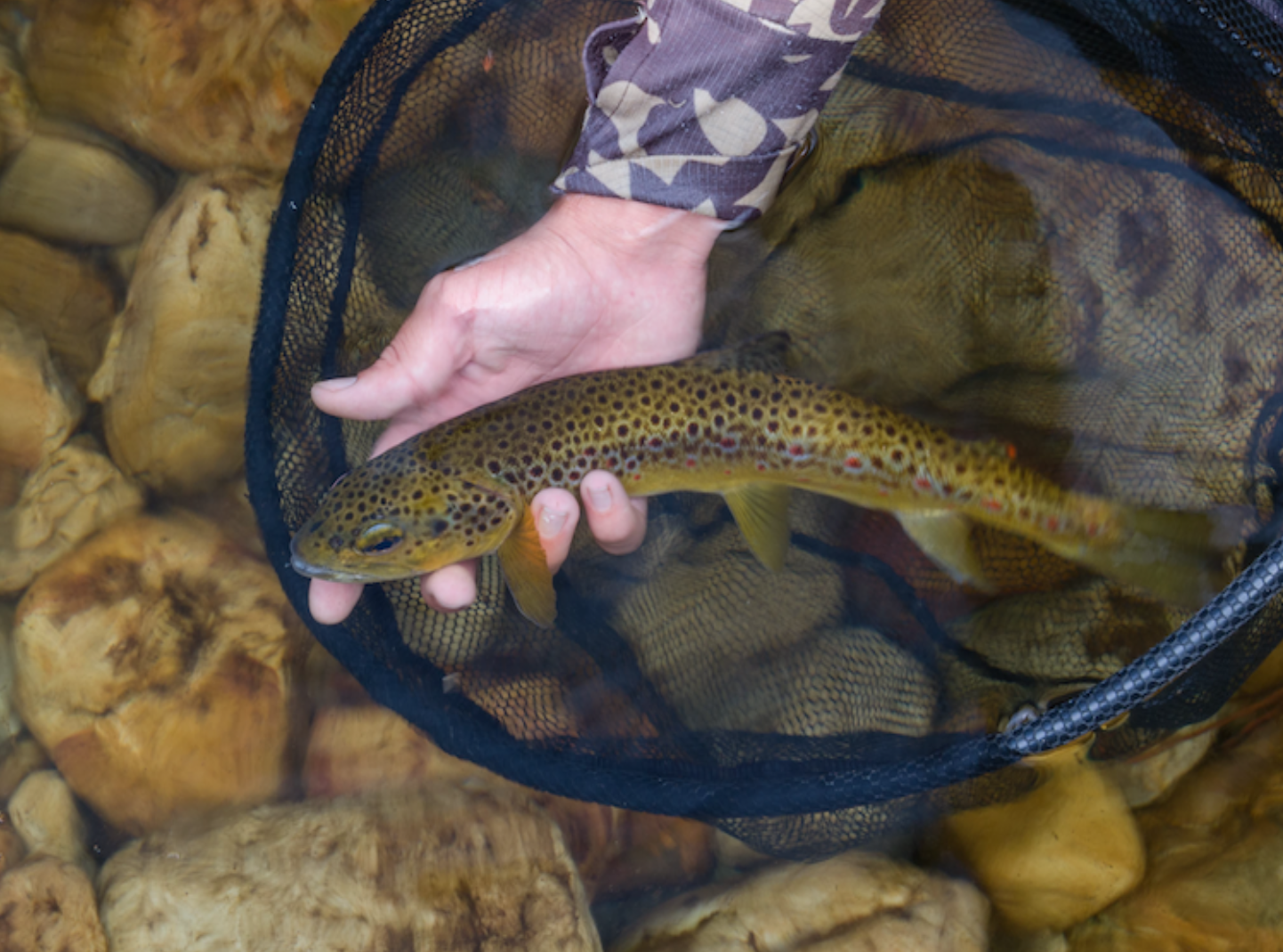
Catch and release (CAR) is a practice that has become deeply rooted in flyfishing (and many other forms of angling) since it was first widely promoted in the mid-1980s. In flyfishing it is now virtually non negotiable that you fish with barbless hooks, that you use the strongest tippet you can get away with, that you bring the fish in as quickly as possible, that you use a soft meshed landing net, that you do not take the fish out of the water, but unhook it in the water with a pair of forceps, that you ensure there is a good flow of water through its gills, either by facing the fish upstream in a river, or moving it forwards in the water in a still water, and that you only release it when it has obviously recovered and will swim away strongly. If you want a photograph with your fish, you are encouraged to photograph it in the water, or – if you must – lift it out of the water for only a few seconds. Those practices are instilled in pretty much everyone who takes up the sport. Almost all flyfishing magazines across the world have for many years refused to publish pictures of dead fish. Of course, the practice of CAR must vary in relation to species. Anyone fishing for barramundi in water that also contains saltwater crocodiles is unlikely to be able, or willing, to wade into the water to release a fish.
As a flyfisher and general angler, I have practised catch and release for many years. It has made my fishing more pleasurable, as I realise I have never particularly enjoyed killing fish. I do still kill a fish to eat every now and then, but fairly seldom. For years it seemed more humane to release fish than to kill them, and – of course – it made sense in terms of not depleting fish stocks. But more recent research on fish sentience – on what they are able to sense and feel – has raised new ethical questions about CAR fishing. Put bluntly, is it morally acceptable to cause suffering to a sentient being in the name of sport merely to release it again? It is a question that may seem to admit of a simple answer. No. In this regard, Germany and Switzerland have effectively declared CAR illegal, and insist that all fish caught that are of legal size in season must be killed. But I argue that more substantive engagement with the questions may lead to surprisingly different answers about what a practice like CAR might mean for interspecies relationships.
In doing so, I adopt (and adapt) Donna Haraway’s suggestive phrase of “staying with the trouble”, which she defines as follows: “Staying with the trouble requires learning to be fully present, not as a vanishing pivot between awful or Edenic pasts and apocalypse or salvific futures, but as mortal critters entwined in a myriad unfinished configurations of places, times, matters, meanings” (2006, p.1). I use “staying with the trouble” also to mean remaining with the questions for some time, and in all their complexity, rather than rushing to simple conclusions; allowing answers that may remain troubling, paradoxical, possibly even contradictory (or, to follow Haraway, “unfinished”), but which work as real world answers precisely because they eschew absolutism for an ethics and practice that take account of the actual creatures and places with which they interact. Tsing, Swanson, Gan and Nubandt put the approach somewhat differently, and perhaps more suggestively: “Perhaps counterintuitively, slowing down to listen to the world – empirically and imaginatively at the same time – seems our only hope in a moment of crisis and urgency” (2017, p. M8). It is an approach that has affinities with what has been called “rubber boots anthropology” (though I am not myself an anthropologist).
Fish and sentience
Before we consider the question of sentience in fish, in particular rainbow trout, we need some discussion of terminology. There is considerable slippage in discussions of the inner lives of animals between ‘sentience’ and ‘consciousness’. To take just two examples, Jonathan Balcombe seems to use the two interchangeably (2016, pp. 71-85), and Jonathan Birch slips from one to the other (as if they are equivalent) in the first two sentences of his argument (2024, p. 1). I think this is mistaken, and potentially blunts our thinking, as it forecloses the question, “Can an organism be sentient, without being conscious?” I think holding the terms apart allows for a more nuanced argument about what and how animals may feel, experience or think.
For my purposes, I define sentience as: possessing relatively complex sensory capabilities; having the ability to learn and recall; having some ability to communicate; and expressing a degree of individuation in behaviour. I define consciousness as involving: awareness of one’s own existence; possessing decision making skills; having logical and imaginative capabilities; possessing volition; revealing advanced communicative skills; and being able to experience emotions. Of course, neither definition claims to be exhaustive, and we may allow that either category may exist in higher gradations in some organisms than in others. Mussels and octopuses are both molluscs, but I doubt that anyone would seriously deny that the degree of sentience is higher in the very complex behaviour of the latter than the stationary bivalve filter feeding of the former (though mussels can ‘communicate’ with each other by releasing specific hormones or chemical substances).
In the song “Something in the Way”, Kurt Cobain of the band Nirvana famously sang, “It’s okay to eat fish ’cause they don’t have any feelings”. The idea that fish are creatures with such tiny brains and simple nervous systems that they are capable only of very rudimentary sensory perception (and so are incapable of experiencing pain) held sway in scientific and angling circles for many decades, and is still trotted out by some anglers who have not bothered to keep up with the literature, nor paid much attention to the fish with which they interact. However, there is now abundant evidence, in scientific and popular publications, and even in some angling magazines themselves, that fish are sentient creatures that lead lives that are more complex than we had previously imagined. Probably the most extensive argument for fish sentience is Jonathan Balcombe’s well-known book What a Fish Knows: The Inner Lives of Our Underwater Cousins (2016), in the Prologue to which he says:
What this book explores is a simple possibility with a profound implication. The simple possibility that fishes are individual beings whose lives have intrinsic value – that is, value to themselves quite apart from any utilitarian value they might have to us, for example as a source of profit, or of entertainment. The profound implication is that this would qualify them for inclusion in our circle of moral concern. (p. 6)
Stephanie Yue points out that debates about lack of fish sentience are complicated by the fact that they “do not typically display traditional and obvious signs we are familiar with in other animals. They are not capable of facial expression, nor can most species of fish vocalize; given their general anatomical structure, changes in body posture are extremely limited” (Anon. n.d., p. 2). Balcombe echoes this sentiment: “Lacking detectable facial expressions and appearing mute, fishes are more easily dismissed than our fellow air breathers” (2016, p. 19).
The evidence for fish sentience in terms of their physical and neural structures is abundant, and is frequently supported by the experiences of those who interact with them on a regular basis (marine biologists, divers, anglers, aquarium curators, aquaculturists, and so on). The question of what fish feel is of course complicated by their sheer diversity as a group of animals (33 249 species in 564 families and 64 orders, according to Balcombe (2016, p. 11)), so we sometimes need to stipulate which species is being referenced in making claims about sentience.
Fish have separate organs for smelling and tasting (the variety of smells and tastes added to bait for carp fishing are evidence of how sensitive their smell and taste may be), and they can hear better than humans (Balcombe, 2016, p. 43). They cannot hear sounds above the surface of the water, but – as any angler knows – they will flee if you wade noisily or inadvertently drop something in a fiberglass boat. In laboratory studies they have been taught to distinguish, not just between different pieces of music, but between different genres of music played underwater (p. 46). If you free dive in the kelp forests in the Western Cape sea region of South Africa, you will hear a variety of clicks and squeaks around you. Balcombe points out that fish “actually have more ways of producing sounds than any other group of vertebrate animals” (p. 40). Their lateral line “acts as a sonarlike system and is especially useful at night and in murky waters” (p. 59). Many species also use electroreception to detect the subtle electric signals given out by the nerve systems of prey animals (p. 61), and also generate electric impulses to communicate with others of their species (pp. 62-3). Fish like salmon, sharks, tuna and eels can use the earth’s magnetic field as an aid to navigating (p. 57), as well as the smell of particular chemical configurations that distinguish different rivers or sections of ocean.
Anglers will talk of what they call “educated fish”. These are fish that have been subject to heavy angling pressure, and have ‘learned’ resolutely to avoid certain commonly-used lures or flies. They also learn how to avoid capture when hooked by swimming straight towards any rock, tree root or sunken branch on which they can snap or entangle the line of the angler, appearing to have clear memory maps of the underwater terrain that they inhabit. Culum Brown says in this regard: “Fish are more intelligent than they appear. In many areas, such as memory, their cognitive powers match or exceed those of ‘higher’ vertebrates including non-human primates” (Anon., n.d., p. 1). Balcombe claims that “a small squid can learn mazes faster than dogs do, and a small goby fish can memorize the topography of a tide pool by swimming over it at high tide – a feat few if any humans can achieve” (2016, p. 13).
As regards visual abilities “fishes have evolved capacities beyond our own. For example, most modern bony fishes are tetrachromatic, allowing them to see colours more vividly than we do. We are trichromatic creatures, which means that we possess only three types of cone cells in our eyes and our colour spectrum is more limited” (Balcombe, 2016, pp. 30-31; Land & Nilsson, 2006, p. 65). Anglers will confirm that the colours of lures or flies are very often the determinant of success or failure, and that fish preferences in this respect vary quite dramatically according to weather, season, water temperature, or the predominant prey items available. Goldfish have even been taught to recognise symbolic patterns (Balcombe, 2016, pp. 36-7).
And finally, there can be a degree of individuation between members of the same fish species, as scientists or owners of aquaria will argue, with – for example – individual trout displaying “very different characters – some are bold and inquisitive; others are shy and passive” (Mark Henderson in Anon., n.d., p. 5). They may also have different food preferences (Balcombe, 2016, p. 54).
Do fish feel pain?
So, if research suggests that fish are sentient animals, can they feel pain? The answer to that question is complicated by several factors, including that pain is a highly subjective experience, which is never exactly commensurate with the degree, say, of physical injury (some people may feel more or less pain than others from ‘the same’ injury or surgical procedure), and that pain is usually evident through verbal or bodily expression (I can hear and see that you are in pain, but I cannot actually know what you are experiencing). It is also not clear what degree of consciousness is required to experience pain. We can, of course, consider what ‘pain receptors’ an organism may have, but our comparative standard is usually what humans or higher order mammals require to experience pain, which is not necessarily an appropriate measure and remains anthropocentric.
The question of whether fish feel pain is complex, and still debated, mainly because we can only surmise what and how they feel by analysing their brains and nervous systems, and/or by subjecting them to experiences which in other animals would cause pain, and then gauging their reactions. They do undoubtedly respond to negative stimuli, but whether this is simply a reflex (what scientists call “nocioception”) or whether it is a more cognitively complex experience of pain as, say, mammals understand it remains a point of argument. Central to the debate is the fact that fish do not have a neocortex, which in higher order animals is amongst other things a pain receptor.
Brian Key states categorically: “Everyone has a set of core values but mostly it runs on ‘if you poke it and it reacts, therefore it must feel’ … But it’s nothing to do with intelligence. It’s about whether [fish] have the hardware to feel and I’m saying no they don’t” (quoted in Kilvert, 2021). In direct contrast, Jonathan Balcombe quotes the American Veterinary Medical Association’s 2013 Guidelines for the Euthanasia of Animals:
Suggestions that finfish [fish that are not shellfish] responses to pain merely represent simple brain reflexes have been refuted by studies demonstrating forebrain and midbrain electrical activity in response to stimulation and differing with type of nociceptor stimulation. Learning and memory consolidation in trials where finfish are taught to avoid noxious stimuli have moved the issue of finfish cognition and sentience forward to the point where the preponderance of accumulated evidence supports the position that finfish should be accorded the same considerations as terrestrial vertebrates in regard to relief from pain. (Balcombe, 2016, p. 83)
In an article provocatively entitled “Mammals, Birds, Reptiles, Insects Declared Conscious”, the environmental journalist Don Pinnock refers to
The New York Declaration on Animal Consciousness [that] was signed by 264 leading professors, researchers, neurobiologists, natural science lecturers and animal behaviourists who met to discuss the future of human engagements with our fellow creatures […] Striking new results have hinted at surprisingly rich inner lives in a very wide range of other animals, including many invertebrates, driving renewed debate about animal consciousness. (2021)
He continues: “With mammals and birds, the declaration says there’s ‘strong scientific support’ for attributions of consciousness, and for other vertebrates like fish and reptiles and many invertebrates like octopuses and crayfish, there’s a ‘realistic possibility’” (2021).
In turn, Balcombe refers to the Declaration of Consciousness statement drafted and signed in 2012 by a group of scientists who met at Cambridge University “to discuss the current scientific understanding of animal consciousness”:
Neural circuits supporting behavioral/electrophysiological states of attentiveness, sleep and decision making appear to have arisen in evolution as early as the invertebrate radiation, being evident in insects and cephalopod mollusks (e.g. octopus) … The neural substrates of the emotions do not appear to be confined to cortical structures. In fact, subcortical neural networks aroused during affective states in humans are also critically important for generating emotional behaviors in animals … The absence of a neocortex does not appear to preclude an organism from experiencing affective states. (Balcombe, 2016, pp. 83-4)
Elsewhere he says: “‘If an animal is sentient then it should be included in the moral circle,’ say five authors from veterinary, theological and philosophical disciplines in a 2007 article on fish farming. Based on clear evidence that they can feel pain, we may conclude that fish should be given the benefit of the doubt” (p. 229). Stephanie Yue states categorically: “After reviewing the current scientific evidence and exploring the many arguments, it is irrefutably substantiated that fish are capable of feeling pain” (n.d., p. 1).
With the exception of Yue, it is interesting to note that even apparently strong statements on the ability of fish to feel pain usually qualify their claims with a phrase which is effectively in the subjunctive: “realistic possibility”, “may conclude”, “may cause”, “does not appear to preclude”, “given the benefit of the doubt”. We are in complex scientific, ethical and philosophical terrain here, and there is a great deal at stake. Regardless of which side of the argument they take, all involved seem to agree that the welfare of fish is the main concern.
The stark oppositions in the debate, and hence the difficulty of making a clear call on the issue, are exemplified in reading Jonathan Balcombe’s book What a Fish Knows (chiefly in the chapter on “Pain, Consciousness, and Awareness”), and an earlier article entitled “Can Fish Really Feel Pain?” by J. D. Rose, R. Arlinghaus, S. J. Cooke, B. K. Diggles, W. Swawynok, E. D. Stevens and C. D. L. Wynne (2012). These studies are fascinating to read against each other because they refer to the same experiments done on fish, but come to diametrically opposite conclusions on whether fish can feel pain.
Balcombe’s main point is that the absence of a neocortex in fish does not mean that they are not ‘conscious’ (he critiques this assumption as ‘corticocentrism’). He points out that birds lack a neocortex, but appear to live complex conscious lives. His counter-argument is that in fish, the pallium is “the fishes answer to the mammalian cortex” (2026, pp. 74-5). The crux of his argument lies in a series of experiments on rainbow trout in which they had bee venom, acetic acid or saline solution injected into their lips, and were then observed. The ones with the noxious liquids injected displayed symptoms like ‘rocking’, rubbing their mouths against the aquarium glass, increased breathing rates, and food aversion. When opiates were administered into the water, fish behaviour appeared to normalise. Balcombe concludes: “The experiments by Braithwaite, Sneddon and Chervova are strongly suggestive that fish are feeling pain and not merely responding reflexively to a negative stimulus” (2016, p. 80) (note that qualifying “strongly suggestive” again).
In stark contrast, Rose et al. consider the same experiments, and attempts to replicate them (mostly unsuccessful), and come to a radically different conclusion:
We evaluate recent claims for consciousness in fishes, but find these claims lack adequate supporting evidence, neurological feasibility, or the likelihood that consciousness would be adaptive. Even if fishes were conscious, it is unwarranted to assume that they possess a human-like capacity for pain. Overall, the behavioral and neurobiological evidence reviewed shows fish responses to nocioceptive stimuli are limited and fishes are unlikely to experience pain. (2012, p. 1) (Note again the “unlikely”.)
Rose at al are concerned that many of the experiments are conducted to prove that fish feel pain, not to ascertain whether they feel it (i.e. that the research is designed to deliver preconceived outcomes), or that their design leaves their results open to discrepant interpretations. Unlike Balcombe’s study, these authors start with the question of what we mean when we talk of experiencing pain, and they try carefully to distinguish between ‘nocioception’ and ‘pain’ in terms of the latter’s involving conscious experience:
One of the most critical conceptual advances in the understanding of pain is the distinction between nocioception and pain. As Wall (1999) emphasized, “… activity induced in the nocioceptor and nocioceptive pathways by a noxious stimulus is not pain, which is always a psychological state.” This seemingly simple statement is actually fundamental to understanding what pain is and what it is not. (p. 3)
The authors also point out that the rocking and rubbing behaviours observed in the research described by Balcombe have not been seen when the bee venom and acetic acid tests have been replicated, and that they may be attributable to other factors than pain, especially in view of the high dosages involved, which could have had other neurophysiological effects on the fish. They also argue that descriptors like “rocking” or “rubbing their mouths” verge on the anthropomorphic and may be suggestive of emotional bias in the conclusions drawn from the experiments. In fact they point out that the ‘negative results’, in which fish behaviour was not affected by the administration of noxious stimuli, could be read as suggesting that fish feel little or no pain at all. They note that arguments that learned behaviour in fishes signifies their possessing consciousness have been disproved by removing large sections of fishes’ brains with no change in learned or habitual behaviour (p. 6). They are skeptical about studies that claim to ‘map’ fishes’ cognitive abilities by scanning their brains to see which sections light up under which stimuli, as these are open to wide varieties in interpretation. One may recall that some brain ‘mapping’ results on live salmonids were in one notorious case replicated using a dead salmon (Murphy, 2009; Scicurious, 2012).
Both Balcombe and Rose et al. raise the issues of hook avoidance, recapture or neurophysiological responses after being caught and released. Balcombe notes that “the issue of hook shyness proves little” (2016, p. 77), though he does refer to studies on largemouth bass which “remained hookshy for six months” (p. 76), though it is unclear how one measures that. Rose et al. produce very different evidence, referring to an “ongoing study [in Australia that] has revealed that 380 fish of 37 species have been recaptured the same day as tagged. Moreover, three fish of two species […] were tagged then recaptured twice more on the same day (i.e. caught three times in one day). A total of 2141 were recaptured within a week (2012, p. 19). And they state in this regard that: “The repeated capture of angled fishes is also consistent with the notion that a catch-and-release fishing event does not induce a state that is similar to pain in humans” (p. 19). (1)
Their research also supports the anecdotal evidence of sportfishers who frequently catch the same fish twice in one day, sometimes even on consecutive casts. They support the claims that catch and release is a relatively benign practice. From measuring the vital signs and chemical indicators of brook trout that had just been caught, they did not find severe reactions to capture; and they suggest that the deaths of released fish are more likely due to exhaustion than pain. This latter idea is supported by evidence from sportfishers that fish that have been ‘played for too long’ are less likely to survive, hence the emphasis on retrieving and releasing the fish as quickly as possible with the least amount of stress placed onto it.
The question of whether fish feel pain is further complicated, as Rose et al. argue (2012, p. 18) and my own experience as a sport fisher confirms, by the fact that fish eat things like crabs, spiny finned fish, bees, grasshoppers and a whole range of prey items that must cause discomfort in the mouth or gut. I have caught several largemouth bass and a trout that appeared to have eaten large live crabs, which were still entirely intact in their stomachs but must have caused some damage before succumbing to the fishes’ digestive juices. Fish like steenbras and galjoen crack open mussel shells with their jaws and swallow both the mussel’s flesh and the sharp shards of shell to which it is attached. I suspect that the prick of a barbless hook pales into insignificance against the claws of a crab or the gash of a mussel shell, the teeth of an otter, the beak of a cormorant, or the talons of a fish eagle. Fish live with the constant threat of being killed or injured. Many fish that one lands bear the scars of battles with predators, but seem nevertheless to have continued to live ‘normal, ‘healthy’ lives. (2)
The issue of whether fish feel pain, and what we mean by that, will no doubt continue to be debated for some time, and is unlikely to be answered by an English professor like myself. But the results of the studies mentioned above, my own experience of catching many fish, and of watching underwater footage of fish that have been hooked make it very clear that fish react to being caught as they do to other noxious stimuli by trying to flee them, and that they pit almost all of their physical strength and abilities against being pulled towards the angler. If it may not be ‘painful’, to choose another possibly over-humanising word, it is likely to be ‘unpleasant’. So the question is whether knowingly causing discomfort to an animal through the practice of CAR is ethically justifiable? It is a compelling and troubling question, which may lead us away from what Balcombe calls ‘corticentrism’ to a broader, perhaps less anthropocentric, understanding of (dis)ease in species relationships. But I need briefly to address two other aspects of CAR before taking on the question directly.
Catch and release and conservation
Catch and release was introduced as a fisheries management strategy to preserve fishing populations that were under threat from angling pressure (or, as in the case of salmon, whose numbers had been massively depleted by commercial fishing companies, and could not take additional pressure from recreational anglers). It was primarily a conservation, rather than an ethical, position, though – as I shall argue later – it has since taken an ethical turn. Tom Sutcliffe says in this regard: “We … know that [CAR] was born not so much because of a sudden concern for the well-being of the trout as much as concern for the well-being of the angler. If the Americans were to let loose their full angling potential on the trout in the USA they would face, flyfishermen and fish alike, the risk of rapid extinction” (1985, p. 150).
Fishing is the biggest participatory sport in the world, and – even with strict bag limits imposed – if all anglers were to kill their catch, most fish populations would be obliterated, along with all the plant and animal species with which they co-exist symbiotically. On waters with self-sustaining populations of fish, CAR ensures that the ecosystem can continue to function without the need for artificial stocking of additional fish. In stillwaters in which fish like trout cannot breed, CAR means that the need to stock fish is dramatically reduced, which reduces the need for more and more hatcheries with their attendant ecological problems (parasites, water pollution, water extraction and genetic degeneration of wild stocks through interbreeding with escaped hatchery fish, especially if they are not closed systems). The clearest evidence of the effects of not implementing catch and release in favour of catch and kill (even with size and bag limits) is the depleted state of the coastline of South Africa (and many other locations globally). (3)
Ironically, if catch and release were to be considered/classified unethical, what would be classed as ethical would be those fisheries (currently decried as unethical by anglers) in which fish are taken from a hatchery, put into small ponds, and then caught and killed on the same day by paying customers. In contrast, in catch and release fisheries of some size, many fish will never see an artificial fly, and will lead ‘natural’ lives, dying eventually of old age or through predation.
Catch and release vs subsistence fishing
I need to offer a side note at this point. The issue of CAR is complicated in societies characterised by deep economic and social inequalities. In South Africa, and many other countries across the globe, artisanal or subsistence fishing is an important activity through which poorer communities support themselves. The relative fishing rights of local communities as opposed to large commercial ventures are highly contested, and very often poorly handled, in that commercial interests almost always tend to prevail. There are also legitimate questions about the impact of subsistence fishing (often with gill nets) in fragile ecosystems or waters with already endangered fish stocks. But that is the topic of another article. At this point, I want simply to reflect on the practice of CAR in an area in which local fishers are plying their trade, a context in which economic and class statuses come into play, and in which the concept of ‘harm’ to fish is weighed against their value as ‘food’.
To illustrate, when I lived in KwaZulu-Natal, I fished an area at the top of Midmar Dam, called Cascades, at which the tributary river ran into the dam. Natal Yellowfish (scalies) congregate there in large numbers at specific times of the year. One morning, I was flyfishing there alongside three artisanal fishermen who were using either handlines or rods and bait. In the time I was there, they caught nothing. I did not have any success until, towards the end of my spell, I hooked and landed a fish of 1.5 kgs. Under any other circumstances I would have released it as quickly and humanely as possible. Had I done so, as a middle-class person I would still have driven home to a fridge full of food to provide supper. The other fishers were, I assume, unemployed, and were dependent on their success for sustenance. So I had no moral choice other than to offer them the fish, which they received gladly. It would have felt to me grotesque to have deprived them of a meal and flaunted my economic status by releasing what was for them a much-needed source of protein.
In waters in which the fishing club rules state that all largemouth bass caught in trout waters must be killed, I always collect the fish I kill in my creel, and then offer them to members of the local community. (4) In a country in which animal protein is a luxury that many people can only rarely afford, dumping several kilograms of fish on the bank of a dam to rot feels to me criminal.
The ethics of catch and release fishing
Lynne Sneddon frames the issue very directly: “Really, it’s kind of a moral question. Is your angling more important than the pain to the fish?” (Anon. n.d., p. 7). Even if I were to modulate the question in line with my argument above (“Is your angling more important than discomfort to the fish?”), it remains a provocative challenge. But on my principle of ‘staying with the trouble/question’, I will argue that it is a question that contains a series of sub-questions, which I want to unpack.
Fishing as a mode of food collection or recreation is embedded into the cultures of virtually every society in the world, so attempting to ban or eradicate it is extremely unlikely to be successful. But let us ask, hypothetically, if, say, freshwater fish populations in South Africa would be better off if no one was allowed to fish for them. As water extraction and pollution are the two greatest threats to freshwater fishes, the answer is a simple “no”. Fishing clubs and sportfishers are heavily invested in protecting the aquatic environments in which they practise their activities, and frequently call conservation authorities to account if they are overlooking damaging practices by farmers or fish hatcheries. It is a truism of conservation that the better educated people are about their environments, the more they become involved in conserving them. The converse is that it is very difficult to convince people to change their behaviours if they have no idea what negative impacts their actions cause. Environmental knowledge and interaction with species are key to ensuring healthier ecosystems. Let me take an example from my own fishing club. It is responsible for managing about seven kilometres of the Lourens river, which was first stocked with trout in 1894, and which has been declared a conservation area from source to sea. It runs though wine farms, public parks, golf courses and suburbia in the area of Somerset West. Some years ago, as flyfishers we noticed that the fish were suddenly very few and far between, and traced the source to a chemical spill into the river on one of the wine farms. To the untrained eye of a picnicker, the river would have looked as clear and beautiful as usual, but as flyfishers we knew that its fish population, and hence the populations of other creatures that prey on them (otters, cormorants, fish eagles, kingfishers) were at risk of collapse. The solution in that case was to ensure that the chemical spill was never repeated, and then to reduce fishing pressure on the remaining trout so that they could replenish their numbers, which they have done magnificently.
If, as I argued earlier, fishing is only sustainable if CAR is practised, then we face the ethical conundrum that discomfort caused to some members of the population produces the greater benefit of survival and thriving of the population as a whole. It is a messy answer, one that seems to be in keeping with Haraway’s avoidance of “edenic pasts and apocalypse or salvific futures” (2016, p. 1) for answers more attuned to real-world locations and what she routinely calls ‘critters’.
But there is a more complex dynamic at play here. As I have argued, CAR was initially introduced as a conservation strategy, but it has since for the most part changed the nature of what it means to fish. We have seen in recent years what I would call an ‘ethical turn’. While you would certainly value your ‘prey’ in catch and kill fishing, especially if you landed a large specimen or caught your daily limit of good-sized fish, it is nevertheless a mode of fishing that is extractive and acquisitional. If you plan from the outset to release the fish you hook, you are concerned about its individual welfare, as a member of one species engaging with another, so that each fish is valued in and of itself. It is carefully handled, admired, revived and released. In the process, CAR may even change the value attached to waters and fish. If your object is to catch a fish to eat, anything under about 500g will likely be of little interest to you, and you would avoid small streams where fish averaged about 200g. But if your interest in fishing is to encounter and interact with another species, then a tiny jewelled trout from a small stream may be as valuable to you as a four kilogram lunker caught in a large lake. To illustrate further the change in mindset potentially brought about by CAR, in my fishing club we have agreed not to fish during the hotter months (even though the season is still open) when we know that the fish are already stressed, and will probably not survive if caught and released. If we planned to kill them anyway, we would not impose such a (strictly voluntary) self-restriction. The conservation ethic within CAR has also extended the range of fish targeted (and hence preserved) by sportfishers to include species that you cannot or would prefer not to eat, such as garrick, tigerfish, barbel or yellowfish.
I need to add two caveats here. Firstly, some might say that the CAR model I have outlined above is idealized. I am aware that there are cases in which CAR practices are abused or flouted. For example, several trout rivers in the United States are divided into ‘no kill’ and ‘kill’ sections. There are many accounts of people hooking fish in the ‘no kill’ zone, and then dragging them downstream into the ‘kill’ zone so that they can take them home for dinner. I have also spoken to a strictly CAR fishery owner who says he has heard visiting anglers pontificating about being strictly CAR practitioners, and then seen them secreting dead fish down their waders or in their fishing bags. (4)
Secondly, as one of the readers of this article asked: “Is the veneration of the catch truly for the benefit of the fish, or is it a new form of anthropocentric performance?” It is an important and valid question, that can be answered in many ways. Let me take just one, simply for the purposes of space in this article. If one compares the semiotics of ‘kill and eat’ or ‘trophy’ hunting/fishing photographs of hunters/anglers with their kill, and those of catch and release anglers with their catch, the contrasts are often striking. In the photographs with dead animals, I would say generally that the posing of hunter/angler with animal (foot on the head or shoulder of the prone antelope; standing over it with a rifle in hand; sitting astride a dead shark holding its jaws open) suggests a performance of anthropocentric mastery, whereas CAR pictures tend to have the fish as the focal point (sometimes very small but pretty ones), and the angler in a relatively reticent place in the background.
If, as I have argued, CAR is paradoxically an ethical stance and way of being towards other species, then we need as sportfishers to be clear about the discomfort that our angling causes to fish, and to mitigate that. I fish with a group of people who have this very much in mind when they take up a rod. Their responses are varied and thoughtful.
Craig has a simple, self-imposed rule that he will not catch more than four fish in a session. Once he reaches that limit he reels in his line and heads back to the cottage or truck for a coffee or a beer, depending on the time of day. I sympathise with this approach, and am horrified when I hear stories of people catching and releasing forty or more fish in a day. Not only does that seem gratuitous to me, but it is bad conservation, since we know that there is always a mortality risk in CAR.
Stephen’s approach is very different. He quotes the case of the famous flyfishing author and flytier John Betts, whose psychologist wife apparently asked him, “How many more fish will have to die before you become famous?” Betts’s response was to develop the TAG (Touch and Go) hook, which does not have a sharp point but ends with a small round ball, making it impossible for it to penetrate the mouth of a fish. The idea is that you get a few seconds of experiencing a fish on your line before it simply spits out the fly. To be honest, I find the idea of setting out not to catch a fish a little bizarre.
The flyfishing author Steve Duda refers at one point to his waders being “tattooed with blood splotches that would never come out” (2024, p. 101). If you fish for long enough, you will end up with blood on yourself, sometimes your own. It is a realisation that Cato has come to. He says that when he practised CAR only, he found that it did not matter to him if he landed the fish, as he knew he was going to release it, and he became less interested in fishing at all. Now, he occasionally kills the fish he catches, “to remind himself that fishing is, after all, a blood sport”. Assuming that you are neither vegan nor vegetarian, is this an approach that keeps you in touch with the actual bloodletting involved in producing the food which you consume, innocuously presented to you in clingfilm and polystyrene, without depleting the fish population?
Conclusion
A possibly apocryphal episode nicely sums up the paradoxes and contradictions of CAR fishing. An Inuit local, watching a plane load of departing American flyfishers, said: “They aren’t fishermen, they just come here to fuck with the fish.” How do we account for the ethics of our interactions with other species?
In seeking an answer to the question of the ethics of CAR, as I have argued, perhaps we need to ‘stay with the trouble’, in Donna Haraway’s suggestive phrasing, remaining with the problem before rushing to a simple solution. Whether we like it or not, predation is a fundamental biological principle. The lion does not lie down with the lamb. There are many reasons why people fish, but somewhere among the more metaphysical explanations is probably that it satisfies a deep evolutionary need to collect one’s own food. The insistence in Germany and Switzerland that every fish caught that is of regulation size be killed would, if practised on a global scale, lead to the extinction of almost all fish species, as angling is – as pointed out earlier – the biggest participatory sport in the world. CAR is a conservational necessity, but it has become more than that. If fishing means killing a bunch of fish and taking them home for dinner, then the fish are largely objects. If each fish is carefully handled, and its survival ensured as gently as possible, if you enjoy the time you spend with it, rather than rapping it over the head, and you take pleasure in its swimming away from you, then you are engaged in a process of respect and veneration, of gratitude for the brief encounter with a creature of another species. I need to add that I am not wishing to set up an absolute (false) dichotomy here. Even in cases where animals are raised for slaughter – as in farming – or are hunted for meat, it is entirely possible still to have an ethical, even emotional, relationship with them (Haraway: “making kin as oddkin”? [2016, p.2]) It is a fundamental contradiction in the notion of the Anthropocene that, even as we acknowledge that the impact of humans on our planetary systems has been inordinately destructive and that consequently we wish to reduce our impact, agency and authority in deference to those of other species, in doing so we need to accept the power and hence responsibility that we do have as a species. Maybe CAR is one of the “arts” that we need to “live on a damaged planet”. (5)
Endnotes
- Balcombe would counter that being hungry might override one’s experience of pain, leading fish to be recaught (2016: 76). My own experience of severe pain, and of talking to others who have experienced it, suggests that pain overrides any desire to eat, and frequently induces profound nausea, but I am aware that this observation may be dismissed as anthropomorphic.
- In conducting the research for the article “The Making of a (Wild) Fish” (Brown and Thom 2025) my co-author and I participated in a project to net large rainbow trout from Thrift Dam in the Eastern Cape region of South Africa, to strip them of eggs and milt to produce more trout to stock local dams. The fish were large and in very good condition, but many had one or more scars from skirmishes with predators.
- While commercial fishing is the most severe pressure on coastal fish species, even those that are not commercially exploited (blacktail, Cape bream, bronze bream, elf, etc.) have dangerously depleted populations.
- Largemouth bass are sometimes accidentally introduced into stillwaters otherwise reserved for trout when a dam upstream in which they are present bursts, or when anglers who favour bass deliberately introduce them.
- Tsing et al. (2017).
Acknowledgements
The research for this article was funded by the Norwegian Research Council through the project “Global trout: Investigating environmental change through more-than-human world systems” [grant number 287438], and also by the National Research Foundation project on “Rethinking South African literatures”, based in the Centre for Multilingualism and Diversities Research at the University of the Western Cape.
References
Anon. n.d. “Sentience in farm animals and aquatic animals: fish”. https://thinkdifferentlyaboutsheep.weebly.com/sentience-in-farm-aquatic-animals—fish.html
Balcombe, J. (2021) [2016]. What a fish knows: The inner lives of our underwater cousins. London: Oneworld.
Birch, J. (2024). “Why is animal consciousness controversial? Talking to my inner sceptic”. https://lse.ac.uk/philosophy/blog/2024/07/11/why-is-animal-consciousness-controversial-talking-to-my-inner-sceptic/
Brown, D, and Tom, C. (2025). “The making of a (wild) fish”. Environmental Humanities 17(2): 411-29.
Duda, S. (2024). River songs: Moments of wild wonder in fly fishing. Seattle: Mountaineers Books.
Haraway, D. J. (2016). Staying with the trouble: Making kin in the chthulucene. Durham and London: Duke University Press.
Kilvert, N. (2021). “Do crabs, octopuses and fish feel pain? Should they have greater rights to humane treatment?” ABC Science https://www.abc.net.au/science/2021-07-21/sea-creatures-crabs-lobsters-fish-octopus-humane-treatment/100292422
Land, M. F. and Nilsson, D-E. (2006) [2002]. Animal eyes. New York: Oxford University Press.
Murphy, E. R. (2009). “What a dead salmon tells us about fMRI analysis”. Standford Law School 18 September. Htttps://law.standford.edu/2009/09/18/what-a-dead-salmon-reminds-us-about-fmri-anlysis/
Pinnock, D. (2021). “Mammals, Birds, Reptiles, Insects Declared Conscious.” Daily Maverick www.dailymaverick.co.za/article/2024-06-27-leading-scientists-declare-animals-to-be-conscious-they-feel-pain-joy-and-sadness/
Pinnock, D. (2021). “Our burning planet: South Africa at a crossroads on wildlife welfare and sentience”. Daily Maverick 1 June. https://dailymaverick.co.za/article/2021-06-01-south-africa-at-a-crossroads-on-wildlife-welfare-and-sentience/
Rose, J. D., Arlinghaus, R., Cooke, S. J., Diggles, B. K., Swawynok, W., Stevens, B. D. and Wynne, C. D. L. (2012). “Can fish really feel pain?” Fish and Fisheries, 1-37. https://doi.org/10.1111/faf.12010
Scicurious. (2012). “IgNobel prize in neuroscience: The dead salmon study.” The Scicurious Brain 25 September. n.p.
Sutcliffe, T. (1985). My way with a trout: Reflections of a South African flyfisherman. Pietermaritzburg: Shuter and Shooter.
Tsin, A., Swanson, H., Gan, E. and Bubandt, N. (Eds). (2017). Arts of living on a damaged planet. Minneapolis and London: University of Minnesota Press.
Yue, S. (n.d.) “An HSUS report: Fish and pain perception”. The Humane Society of the United States: 1-13.


 Duncan Brown is Professor of English in the Centre for Multilingualism and Diversities Research at the University of the Western Cape, where he also holds a Research Chair in South African Literature and Multilingualism. He has published widely in South African literary and cultural studies, and the environmental humanities.