




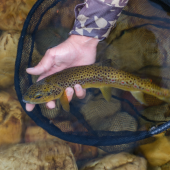
Abstract: In this age of the Anthropocene, of posthumanism, a far more careful, self-reflexive and critical consideration of more-than-human interactions, of our interrelationships with other species, is imperative. This essay takes as its focus the interaction between humans and fish (mainly rainbow trout) in flyfishing, and sportfishing more generally. I consider what happens when an activity originally designed to lead to the death of the fish is turned to different ends, which are aimed at conservation and more ethical treatment of fish. It is a complex and contradictory subject, which vexes and exercises me as much as a flyfisher as an academic. It requires frequent shifts in the scale of one’s thinking from the interrelationships between species as a whole (humans and rainbow trout), to those between individual members of species (the flyfisher and this individual rainbow trout), and it brings into sharp focus the ethics of interrelationships that spread beyond fishing to multiple human-animal engagements, including those involved in farming and hunting, or in eating animal products. In this article I draw on work by fish scientists, animal ethologists, anthropologists, fishing authors, environmental journalists and my own experience of fishing and talking to other fishers for over five decades, to try to engage fully with the range of issues involved.
Continue Reading
 Journal of Sustainability Education is licensed under a Creative Commons Attribution License.


