Link to JSE March 2026 General Issue Table of Contents
Link to Article PDF
Abstract: In a creative exploration, Nicole Taylor and Xander Garcia engage in a collaborative reflection that entwines visual exploration and metaphor to weave together personal and poetic narratives, academic theories, and observations of a world fragmented by Cartesian dualism. Drawing on personal and lived experiences, place-based and outdoor education, systems thinking, and transformative education, their conversation seeks the possible re-entanglement of humans with the more-than-human world. Taylor and Garcia use wefts and warps as weaving symbols to represent their voices and their lived experiences. Also woven throughout is their journey with theoretical insights and historical roots of the separation of humans from nature (Cartesian dualism and the Capitalocene). With deep grief and curiosity, they effort to make sense of witnessing ecological devastation while also advocating for a movement and language that creates a possible “next,” beyond the Anthropocene. This work, with heartbreak and hope, searches for interconnected roots and community through multi-modal forms of engagement and reciprocity, ultimately envisioning possible paths toward collective re-entanglement, transformative justice, and in-becoming more-than-human.
Keywords: re-entanglement, more-than-human, dualism, Anthropocene, transformative justice, place-based education
Author note: Voudou is spelled purposefully in the Haitian Creole (Kreyòl Ayiseyn) to honor it as a religion and to step away from any sensationalized connotations of the term in Western culture.
The Threads that Weave: An Introduction
We invite you to join us on a search for re-entanglement with the more-than-human world. It is an imperfect, ponderous, confused, liminal, and poetic journey. It mirrors the confusion of our times. It is our hearts that write this journey in a time of great uncertainty, and in a search for something beyond despair. In this writing, we purposefully drift from any standard academic space of writing. Instead, we engage the art of storytelling, poetry, narrative, and metaphor. The photographs woven throughout are part of the text to be interpreted. Journaling passages, through wefts and warps (terms used for the process of weaving) signal shifts of voice, while weft easing and warp reduced tension (terms used when thread is being eased out of tension in the weaving process) signal attempts to move from the desperate, toward hope. Poetic musings and photographs hope to share what the heart cannot speak and include the many moments we have both lived with the more-than-human world.
We ask that you take this journey with us, through times of great grief where we have personally lost everything to hurricanes, fires, and to capitalism’s push and pull. Sometimes we have been witnesses, like you, to the devastation of earthquakes, tsunamis, and global climate change. We ask that you decenter into landscapes of spiritual explorations, including communing with trees, planting gardens, translanguaging with students, and dancing with the lwa (gods and goddesses) in Voudou ceremonies in New Orleans as part of a search for re-entanglement.
We are both educators and have worked with young people in traditional K-12 education settings and in non-traditional third spaces, such as community centers and community gardens. This educational focus is woven throughout our search for hope and re-entanglement. We ask that you invite the idea that connection with plants and animals, the soil of gardens, and the wind in the trees, may spark an imagination toward re-entanglement, especially with the generations to come.
We hope you will find your own image, reflection, and wonder in the spaces of purposefully elusive prose. We hope you may find your own story to share, or a witnessing—woven between the lines.
Threading the Beat
––Weft. Home is synonymous with elusive, intangible, and impermanent. Especially as fire sweeps over the top of the mountain, a mountain that anchored my childhood. This life has been filled with witnessing impermanence. I have often wondered if I am here only to love, witness, and feel the complete heartbreak of what is ending. I have never imagined that I would be part of what comes after. Or, maybe I have daydreamed a utopia, a community of care, or a past life where I collected herbs for healing in the commons or a free forest. However, “after” is often stitched together with plastic thread, appropriated visions, and monetary priorities, in the name of “rebuilding efforts,” where capitalistic prospectors and politicians see a land ripe for takeover. Those who come after do not want to know what a broken heart has to say, nor a witness, nor a dream (see Figure 1).
 [1]
[1]Figure 1. Dreaming, by Nicole Taylor, 2008
It can be said that the impact of humans upon nature, and vice versa, is an entanglement witnessed throughout time. Moore (2016) claimed that the irrevocable implications, to which we are suffering the consequences today, began around 1490, when “land productivity stopped yielding the profit necessary for those in the business of profit, and a philosophical shift arose to separate nature from humans. This Cartesian ideology, named after philosopher René Descartes, separated man from nature and mind from body” (Moore, 2016, p.88). There was a shift, or move from land productivity to labor productivity and offered to those in power a justification to “other” nature from humans, and to possess and dominate the environment as part of a means of production and profit. Moore explained that many people were also cast into the nature category to justify their labor as slaves, or as “cheap nature” (p.87 & 89). Specifically, people of color, Indigenous peoples, women, certain ethnic groups, and people with disabilities were categorized as other-than-human, as part of nature, and thus were expendable in the means of production, outside of humanity (Moore, 2016; Apffel-Marglin, 2011). This Capitalocene, as Moore has called our times, is seen as unrelenting waves of capitalism’s cunning grip. It is like a long dance of time between humans and nature–– a dance of sacrifice.
Apffel-Marglin (2011) explained colonialism in the Americas and around the world, in which a divide of nature and culture worked to justify genocidal acts against Indigenous peoples, and established nature as controllable, boundaried, monetized, owned, and agent-less. According to Apffel-Marglin, this divide relegated the wild as a resource, worked to tame the wild, and cut off any rights or agency these living beings had. In the manicured landscapes of “culture,” nature became the “other.” This dualistic framing of nature and culture served political purposes that Apffel-Marglin extended toward greater “othering,” (p. 25) including Indigenous peoples, women, and those whose worldview embraced the agency of the more-than-human world. Apffel-Marglin stated that magic sat opposite what would become the scientific method, the mechanistic worldview where nature could be shaped and dominated, and that as an “agency-less” non-being, it hurt no one and no thing (2011, p. 24).
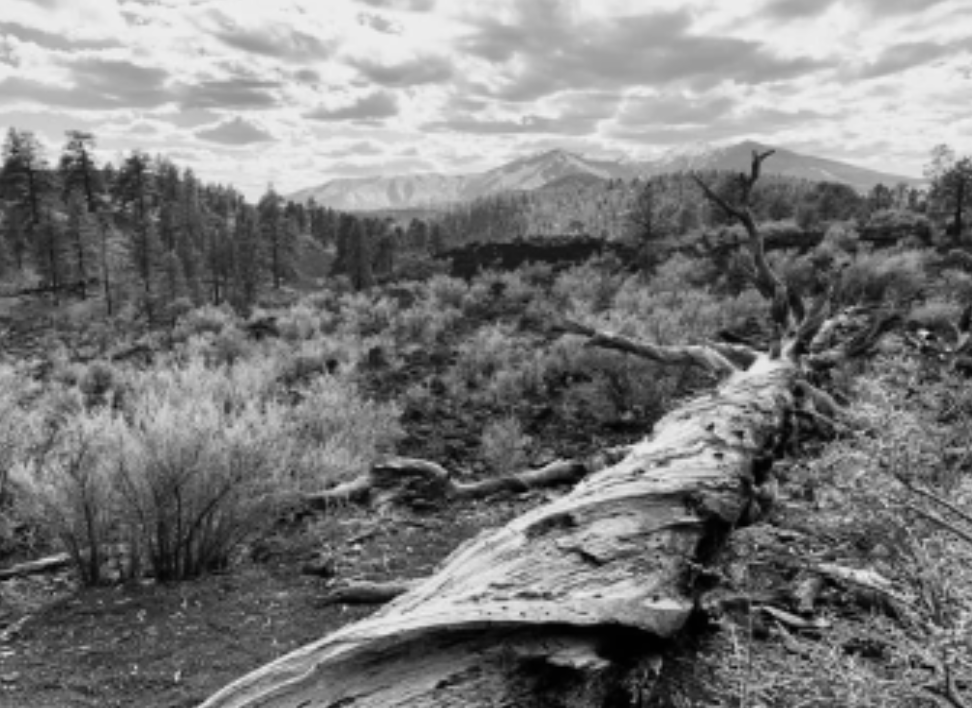
––Weft. I remember reports of the fire that said the cause was a homeless man. Later, it was thought to be an abandoned campfire on a pathway frequented by hikers, mountain bikers, and campers. I think it was called the Pipeline Fire for the underground natural gas pipeline that the fire burned along. The fire burned for 21 days and scarred around 27,000 acres on the mountain, considered sacred to 13 Indigenous tribes (Bowling, 2018; USDA, 2026). These same tribes had been fighting for greater protection of the mountain under the Federal Religious Freedom Restoration Act (RFRA) of 1993, which requires government agencies to use the “least restrictive” means of interfering with any religious practice (Benally, 2009; Corbin, 2009; Religious Freedman Restoration Act, 1993) (see Figure 2). In the last judgment, the court ruled against the tribes, who wanted to stop using wastewater to make snow for the Snow Bowl ski resort. The tribes said, this was a desecration of sacred lands. The court called the tribes’ “damaged spiritual feelings…insufficient” (Navajo-Hopi Observer, 2018). The Snow Bowl was not impacted by the fire.
There were no obituaries for the deer, the endangered Mexican Spotted Owl, the Black Bears, the Mountain Lions, the Aspen groves, the Gambel Oaks.
 [2]
[2]Figure 2. Dookʼoʼoosłííd— (San Francisco Peaks, Flagstaff, Arizona), by Nicole Taylor, 2020.
The Anthropocene is the current name of our time, circulating in sustainability, eco-poetics, and transdisciplinary research. An idea and name first introduced by Paul Crutzen in 2000, when he shared “his hypothesis that human beings can change the Earth in such profound and lasting ways that they usher in a new chapter, in its history—the geological epoch of human beings—Crutzen pioneered a new view of nature and of ourselves” (Schwaegerl, 2021, para. 4). The Anthropocene can be seen as the consequence of Moore’s (2016) Capitalocene. It is a time marked by layers of plastic that permeate our footsteps anywhere on the planet. Plastic, a human-made product made from crude oil, natural gas, coal, and refined into polymers, can take up to 500 years to decompose, but never entirely disappears (United Nations, 2021).
Using the ideas of William Kapp (1950), an ecological economist, Moore spoke further about the Capitalocene as a “system of unpaid cost” (p. 112). He explained this through costs we are all now so familiar with, including “heavy metals in children’s bloodstreams and Arctic ice, massive garbage patches in the oceans, agro-toxic overload in our soil and water…climate change” (p.112). These costs, however, seem acceptable to the majority, or are made invisible through our separation from nature. Perhaps it is the marketing or commercialization of our consciousness. Perhaps we are stuck in a feedback loop of debt, into despair, and working without end to pay for the food, wrapped in plastic and filled with chemicals.
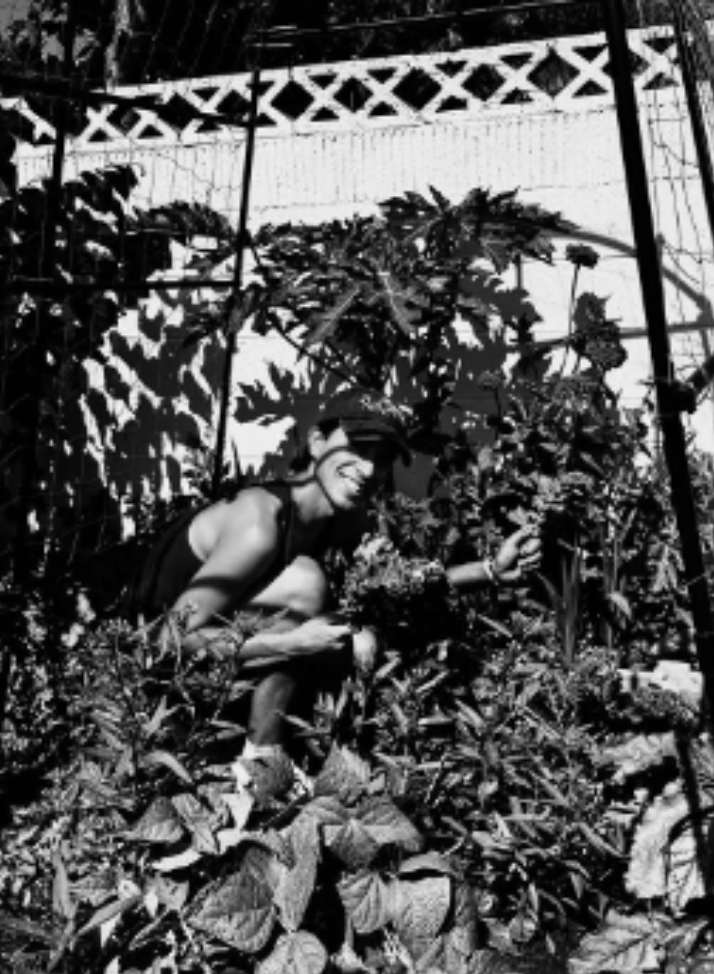
––Warp. I grew up at the intersection of being connected to earth through tending to the garden with my grandmother, and of being a child glued to our Sony Triniton TV and Nintendo gaming systems. Through self-reflection and academic education, I had to learn the most viable and fulfilling path to follow (see Figure 3). I saw two paths, one a clear path of connection and well-being that my ancestors immemorially followed, or a path of “connection” and “relaxation” fostered by small hand-held screens, allowing for quick and easy dopamine rushes.
I refuse to be stuck in a feedback loop masquerading as a glorious, leisurely path in life. I will, like Gandhi (1913) once called for, “be the change I wish to see in the world,” and pull as many people along with me on the journey to self-sufficiency, resilience, and resistance through gardening and reconnection to nature.
 [3]
[3]Figure 3. Harvesting, by Alexander Garcia, 2025
We need a new language that identifies our human culpability in the mechanisms of destruction and control. In the work of Keller (2018), the Anthropocene is the “Self-Conscious Anthropocene,” (p. 3) where we can consider our collective awareness of the scope of devastation we are living in. Then, beyond the Anthropocene, Dr. Natasha Myers (2020), in a For the Wild podcast interview with Ayana Young, proposed the Planthropocene and the decentering of humans as liberators of this apocalyptic world we have created. Myers suggested that this view, where the world is “terraformed by humans in the throes of destruction, where consumer pleasure has deprived a thriving more-than-human world,” (Young, 2020, para.7) requires a move away from the imaginaries of the Anthropocene and toward the Planthropocene. This Planthros invites a “human and plant alliance to seed livable worlds” and according to Myers, “to thwart apocalypse, to aspire to something livable,” we must move beyond “humans as the imaginary creators…we need to center all the beings, a hybrid collective of being, and we need to conspire with the plants to breathe together and aspire for something out of these ruins” (Young, 2020, para. 7).
This alliance is a conspiracy with plants that echoes translanguaging, or a disruption of “naturalized stable boundaries of what are traditionally understood as languages” and instead embraces full linguistic repertoires (Garcia and Kleifgen, 2019, p. 556). The very act of “doing language” and experiencing the movement possible across languages, modalities, abilities, and with the more-than-human world, offers a space for conspiring (Walqui & Bunch, 2019). The beautiful fluidity of connection through diverse repertoires in spaces inviting the mingling, empathy, and collective breath is decentering. Inspired by Bettina Love (2019), Kayumova and Tippins (2021) stated that we can create “spaces of collective transformations where youth engage in learning science and sustainability through relational perspectives and acknowledge entangled relations of humans and more-than-humans, as they tap into each other’s humanity, history, culture, and knowledge in ways that challenge normativity” (p. 826).
Like the alignment needed to discuss and conspire with plants, we, too, must align and discuss with each other. Martin (2022) suggested this can be inviting languages, neurodivergent gestures and movements, the languaging in songs and signs, humming and ticks, glances and typing, and rhythm and poetry. This invitation and alignment are part of transformative justice, a step toward transformation. According to Taylor (2024) it is all about meaning-making across, through, and with language.
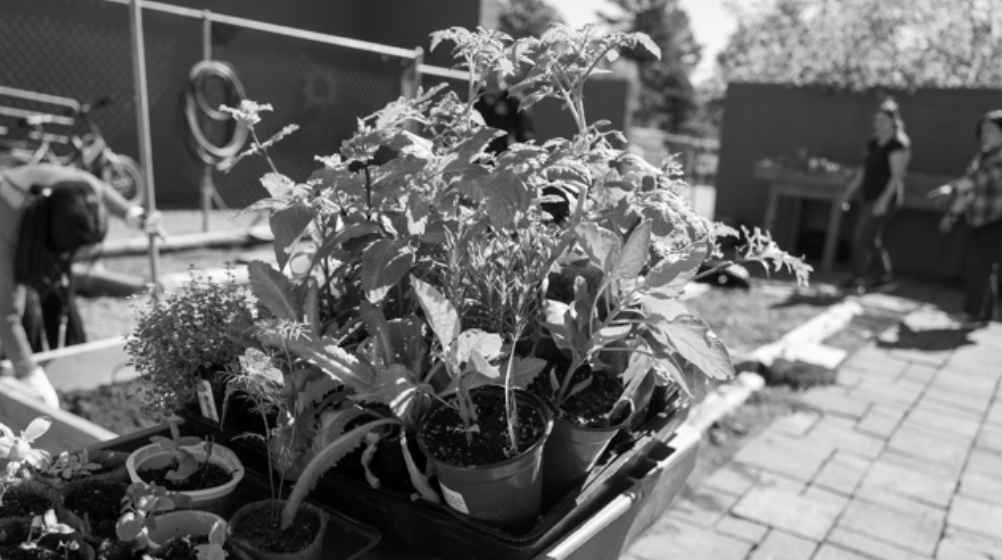
––Weft. A rare spring day in the high desert, when the wind dies down and the blue-sky beams. Students are planting the starts, seeded under indoor grow lights over the winter months (see Figure 4). Fingertips delicately remove broccoli, kale, basil, and zucchini from their trays. Eyes search root systems and noses smell. Most of these high school students have never seen anything grow from a seed or the web of roots that connects each living plant to the earth. In this moment, language spirals. One sees gesture, feels through the basil, dances all the smells of earth. Some speak between Spanish and English, searching and naming plants across languages. Others are busy in the garden meshed in discussions more familiar as hands dig in soil and plant conversations. In one hour, a diverse community, transforming space, challenges normativity.
 [4]
[4]Figure 4. Accessible Garden, by Nicole Taylor, 2022
Transformative justice, efforts to solve community problems within community collective action, like translanguaging woven with emergent strategy, or the idea that change is possible in the emerging and responsive efforts with community (Barnard Center for Research on Women, 2020; brown, 2017), flourishes in the margins of systems and outside of state harm, and is always in process, being created and finding movement. In systems of education, schooling, and academia, transformative justice can be found in spaces of transdisciplinary approaches, with the ideas and inquiry moving fluidly between. For example, when poetry and science combine. These spaces, as brown (2017) said, are “beautiful in…collectivity” (p. 128). Or, for Walsh (2021), “adaptive and interdependent” (p. 81) and created through interaction and relational approaches.
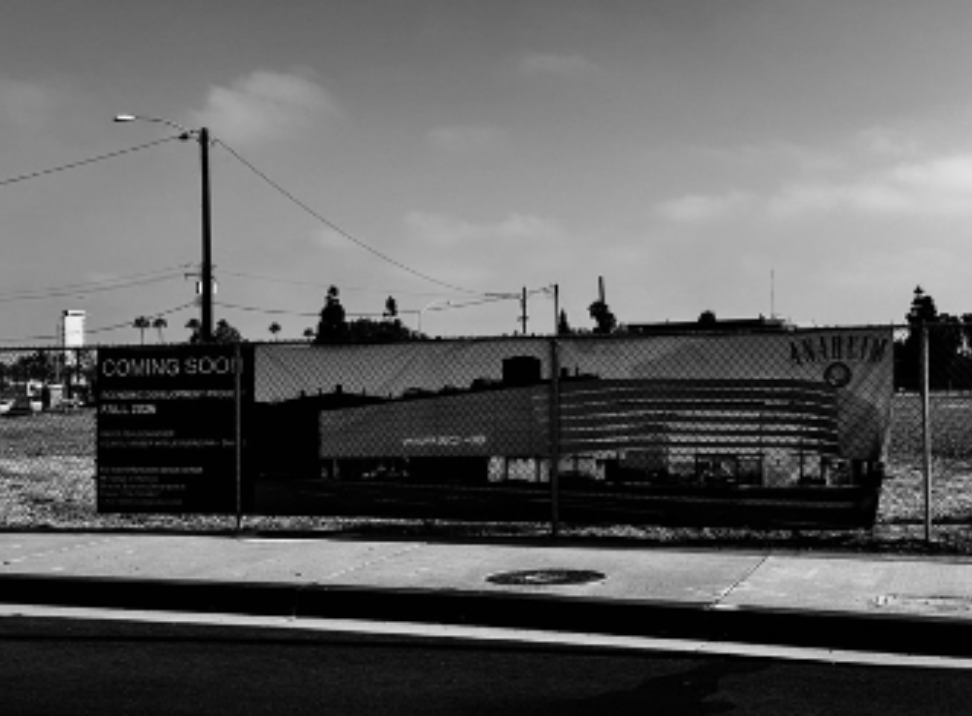
—Warp. Community gardens are slowly disappearing or at risk of closing if they cannot afford to secure land for the community to unite (see Figure 5). What an injustice to life, both human and more-than-human. The community can advocate to policymakers for space to grow food, bask in their cultural roots, and engage with the community, but at the end of the day, the city, where a garden is located, can shut it down. I imagine my ancestors, my grandmothers, infuriated by the state in which we currently live and how disconnected we have become from the very beings that nurture all life.
 [5]
[5]Figure 5. Urban Development, by Alexander Garcia, 2025
According to Garcia (2025a), there is a need to reclaim the commons through community gardens. Garcia’s (2025a) Decolonized Community Garden Framework becomes incredibly pertinent. The framework emphasizes the reclamation of Indigenous Traditional Ecological Knowledge (ITEK) and challenges the dominant Western scientific narrative. For example, the framework suggests the following seven components:
- Recognize Indigenous Knowledge, traditional practices, and culturally significant plants
- Ensure inclusive participation and decision-making
- Ensure accessibility and inclusivity
- Invite education and knowledge sharing
- Acknowledge historical and cultural contexts
- Collaborate through co-creation and co-management
- Be adaptable and flexible in the various spaces of engagement and responsive to community needs (pp. 4-5).
With Moore’s (2016) Capitalocene and the historical separation of humans from nature that led to exploitation, a decolonized garden rejects land commodification. Instead, it focuses on nurturing reciprocal relationships with the earth. By centering marginalized voices and histories, the community garden becomes a site for healing and cultural revitalization, challenging the entangled facts that have historically diminished the perspectives of the silenced. It is not merely about growing food, but about restoring cultural practices, seed sovereignty, and a deep spiritual connection to the land, echoing the call to reconnect with the more-than-human world.
Further, within a decolonized approach to gardening, led with the Decolonized Community Garden Framework (Garcia, 2025a), “witnessing” takes on added depth. Just as we need a new language and a move beyond the Anthropocene, this garden space offers a living language of resistance and resilience. Growing food becomes an act of witnessing the land’s healing and the community’s strength, challenging the narrative of ecological destruction. The garden mirrors transformative justice as it disrupts normative power dynamics and creates a space for collective transformations. It embodies the Planthropocene of a human and plant alliance by prioritizing the agency of plants and acknowledging the interconnectedness of all beings. This framework insists on moving beyond garden research as purely scientific data collection. Instead, it embraces the entangled facts of history, culture, languaging, and spirituality that are deeply woven into the soil, the seeds, and community relationships.
—Warp. I have gradually become more spiritual and instinctual as I have grown older. I now embrace the “crazy” that are the sounds or sensations I feel when I am outdoors, gardening, or walking.
My mom and I have a tree friend in the neighborhood that we greet when walking by (see Figure 6). Once, after my mom greeted it by placing her hand on its bark, I felt a static feeling rush from the sole of my foot through my knee cap. And, just yesterday, when I greeted it again, I felt the same static feeling in both legs, my arm, and my head.
Through my advocacy of urban community gardens and the push for community engagement, I have shifted my views of what matters to me and my goals in life. I want to invite myself and others to connect with the planet. By shifting people’s perspectives and allowing this critical work to be my mission in life, I have been blessed by feeling deep connections with nature.
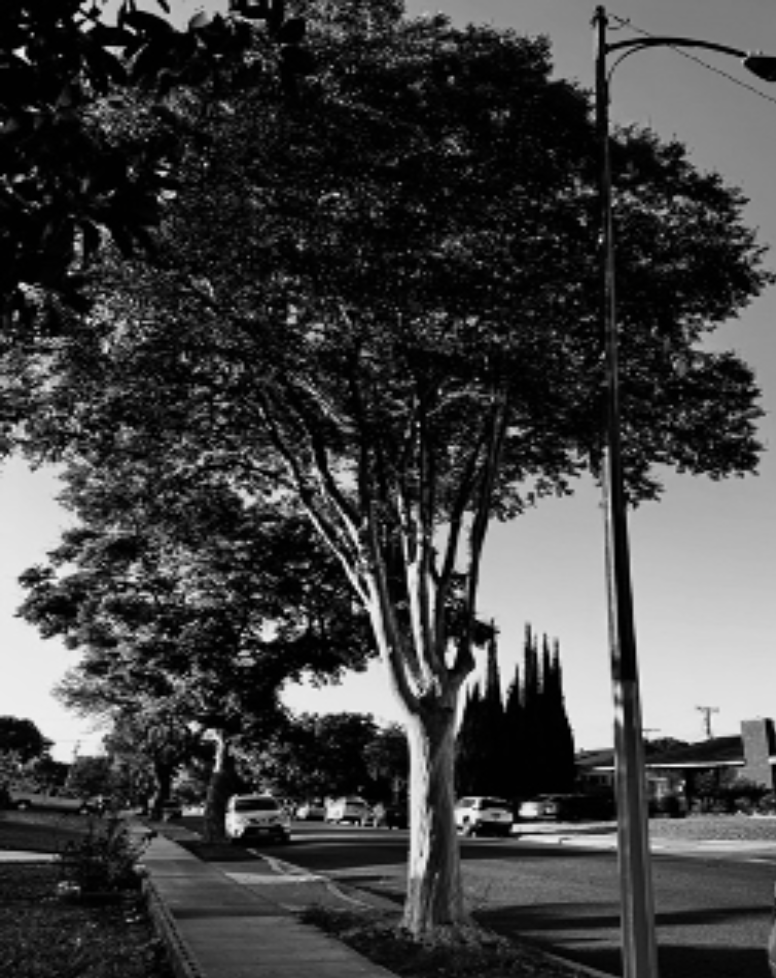 [6]
[6]Figure 6. Tree Friend, by Alexander Garcia, 2025
If we expand our connected understanding, unlearn our misconceptions that center only on human experiences, and engage in presencing the more-than-human world, we may find a way to elevate the relational life, not separating but becoming with.
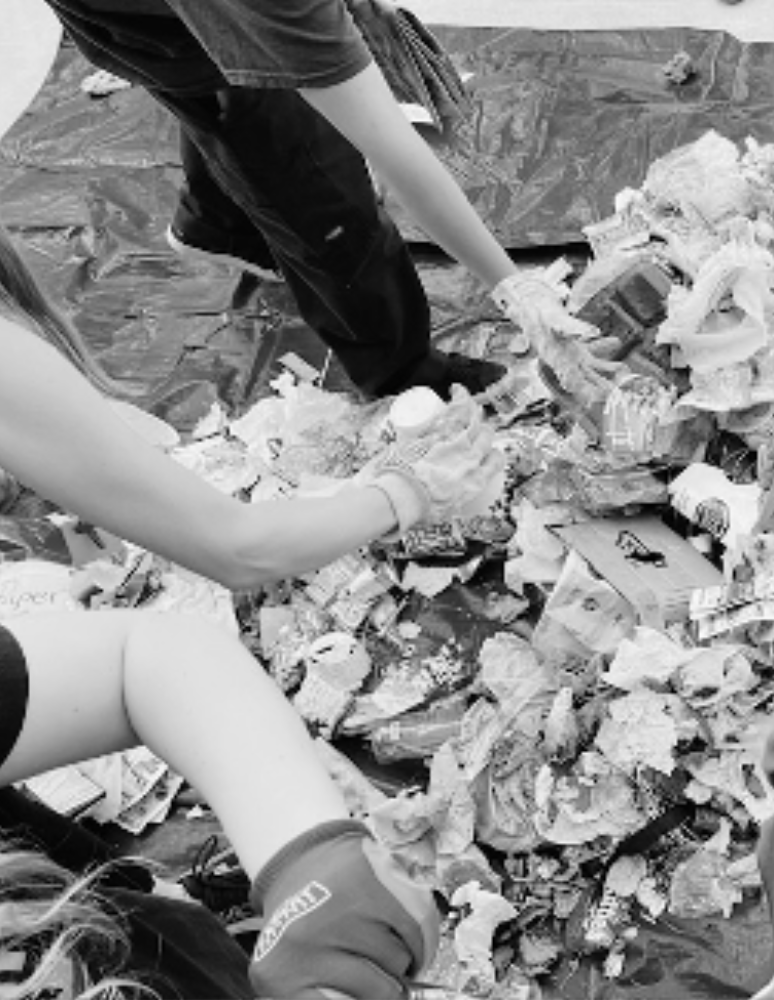
––Weft. I realize I have been witnessing the world through the Anthropocene, through the lens that our human geologic layer holds in its excavation, when humans recognize the impact of our single-use, consumer, disposable lifestyle, and how it harms us, harms the more-than-human world (see Figure 7). Yet, through this perspective, I have been in great grief for this time we are living through, as many move seemingly blind, through this capitalist mirage, imagining happiness while waste piles and seeps, starves the bellies of birds and whales, and in the end starves our bellies and our hearts of genuine connection and love.
 [7]
[7]Figure 7. Plastic Audit, by Nicole Taylor, 2024
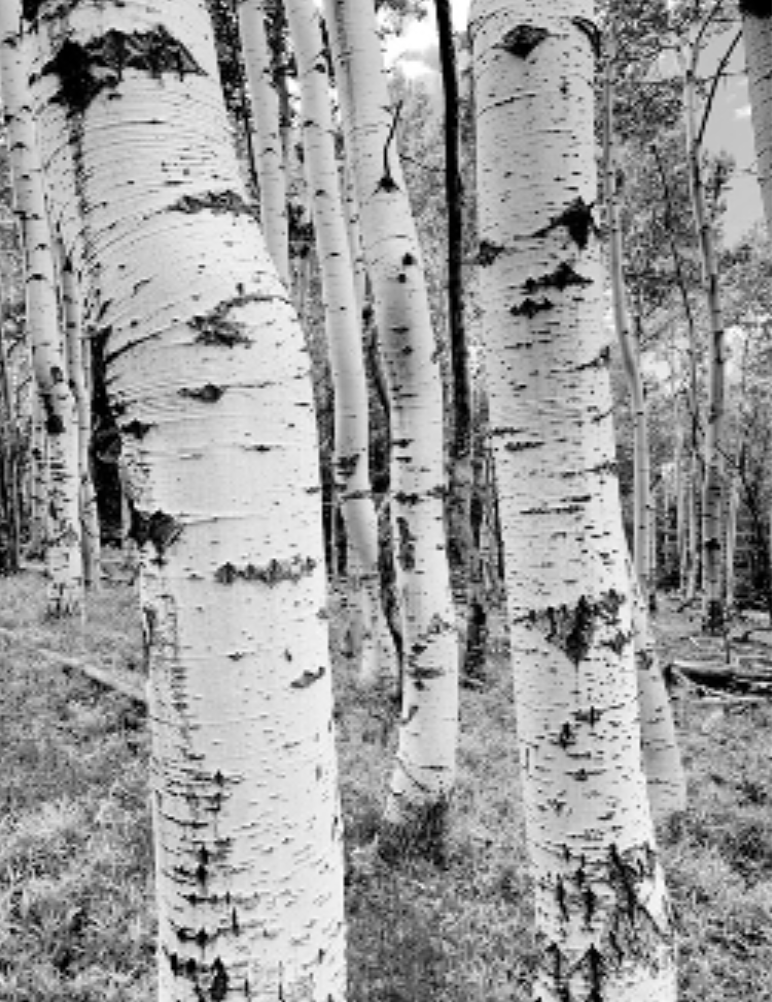
––Weft Easing. When you walk through the Aspen, they sing, and their smell is intoxicating (see Figure 8). Roots interconnected, birthing each new sapling of a grove. Once, when we were younger and unafraid, I took a naked photo of you among the Aspen. Our laughter, unknowing. We didn’t understand.
 [8]
[8]Figure 8. Aspens, by Beatrice Szymkowiak, 2020
In Myer’s (2020) call, we understand that we cannot stop at the devastation or even at the roots of capitalism and colonialism that continue to strangle us, or we become immobilized by doom. Rather, we must look toward hopeful and proactive stances with the more-than-human world, where we engage in communication with, or where we dream of, futuristic possibilities of what may be called a Solar Punk world (Wagner & Wieland, 2022). A world free of capitalism that embraces sustainability, consciously.
The Society for the Protection of Underground Networks (SPUN) is a collaboration in force to “mitigate ecocidal destruction” (Young, 2024, para. 30) by mapping the biodiversity of fungi and connecting this resource to the legal and policy fights of many harmful projects underway around the world. One such collaboration has occurred between SPUN land protection efforts and the, Indigenous peoples in Ecuador, as they fight to protect their forests and home (Amazon Conservation Team, 2024). According to SPUN researcher Sheldrake in a For the Wild interview, expanding our language and communication with fungi and acknowledging new ways of thinking into more fertile entanglements, symbiotic relationships, we may also be able to “expand legal frameworks to include that we are living on a multi-species planet and deepen our legal systems to take account of this and steer us off the destructive course” (Young, 2024, para.40).
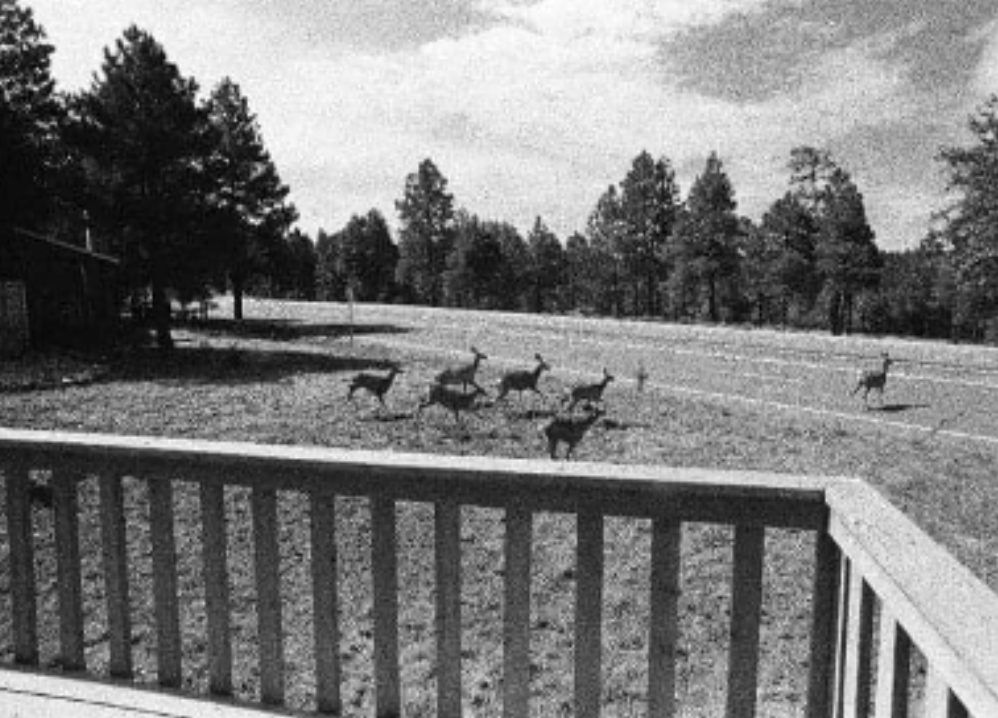
––Weft. The deer have always crossed my parents’ backyard during their seasonal migrations from the mountain to Lake Mary (see Figure 9). Sometimes they sleep next to the house, catching the warmth. There has always been a four-lane road behind my parents’ house, and the deer have crossed with ease since I can remember. However, after lifting pandemic restrictions and the explosion of development in small towns like Flagstaff, the deer are now in danger of endless traffic.
The hum of the road could be imagined as ocean waves if the sun shining off metal bumpers did not interrupt the illusion.
Late last summer, a deer was hit by a car. She limped into the yard and tried to sleep quietly under the Blue Spruce. She then made her way under the back deck, looking for privacy in her death. The neighbors called Fish and Game. A man with a yellow vest and a shotgun walked around to the back porch and shot the deer. He hauled her body through the daisies and grasses along the side of the house where she may have once slept, and put her flesh and bones in the back of a truck.
 [9]
[9]Figure 9. Deer Crossing, by Nicole Taylor, 2006.
Capra (2005) suggested that nature and living systems provide a model for living sustainably. Humans, by considering nature’s language, its living systems, and non-linear systems thinking, can engage more sustainably in our human communities and with the more-than-human world. This change embraces the non-linear and cyclical cycles and patterns that shift our thinking from “quality over quantity” (p. 20). According to Apffel-Marglin (2011), it was “the disentanglement of the individual from a web of community and spiritual obligations [that] gave rise to the individual subject action based on his perceived self-interest” (p.37). Our move away from the commons, from hylozoism, a doctrine that all matter has life, was cast as “other” in the movements of “enclosure of common lands, the privatization of agricultural lands, and the enclosure of bodies with the creation of labor as commodity” (Apffel-Marglin, 2011, p.35).
—Warp. I struggle being a product of both the overconsumption of technology, which now has a global reach, and the call to tend to nature, whether through gardening or taking nature walks and runs. I tried working for a large chain smoothie shop, making my way up to District Manager; I later worked for a global IT company, expected to work over 40 hours, even when on vacation. I did a great job fitting into the mold I was expected to fit, but I suffered.
My grandmother would not have wanted this for me.
It has been just over a year since being let go in one of the two waves of lay-offs sweeping the IT company, and it has been one of the best years of my life. I began to connect more fully with the nature around me, entangled in the dense urban landscape of the city. The incorporation of nature is highly beneficial to us humans and our connection with more-than-humans.
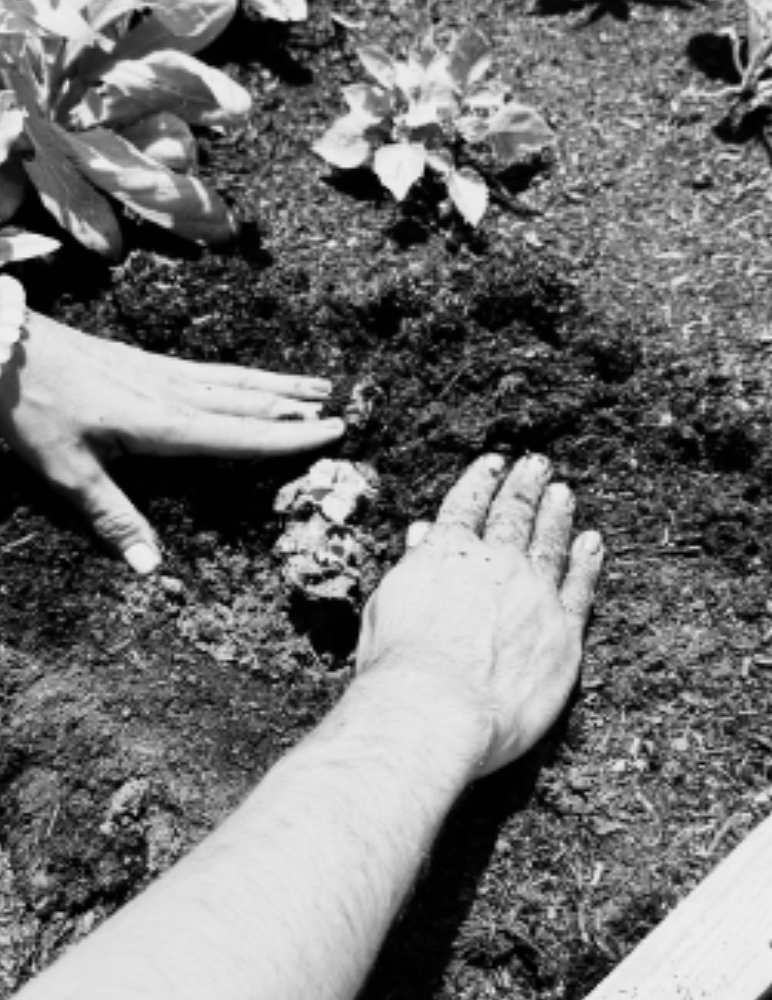
—Warp. Tension adjusted. I began hosting gardening classes with local children to invite an understanding of the importance of gardening and how even the most minor things, such as seeds, can have life (see Figure 10). Seeing the smiles and bright eyes as they finish planting their seeds and gain confidence in their accomplishments has been such a beautiful part of my life.
 [10]
[10]Figure 10. Transplanting Seedlings to the Earth, by Alexander Garcia, June 2025
It may be possible to relearn, rediscover, revitalize, and re-inherit the hylozoism perspective. It is possible that our way forward is to understand better how we got to this current place, then to re-entangle through systems thinking, toward a fractal of movement, together (brown, 2017). Perhaps we have a map back to the beginning, of now, with a new context of time and space, where we may once again be able to reclaim ourselves within a web of community and spirituality, within a web with the more-than-human world. Following the map of transformative justice, emergence, and the conscious action of re-entanglement, there is action centered upon reciprocity beyond the market economy, and toward a network of exchanges that side-step monetary advantage, and instead embrace “the gift,” (Appfel-Marglin, 2011, p. 50) the connection with spirit, the responsibility beyond self, and the representation of our worlds, beyond math and science. Perhaps our enmeshed web can be experienced, danced, drawn, spoken in poetry, sung in songs, and made now within the smallest acts of kindness. Perhaps, it can be planted. If “such collectivities are interconnected, or better said, entangled, and co-create each other,” (Appfel-Marglin, 2011, p. 52) then we must find a multi-modal languaging to reach into this entanglement again and fractal together.
––Weft. We cry as our eyes take in the breath of stars in a dark sky city. On nights when the wind has stopped, and the fire is gone, we witness the beauty of time above our heads and the light that is long ended, reaching us just at that moment.
I have found home in the love of my life, and the friends who circle back and in and around with their laughter and love. The conversations about what is and the acknowledgement of each witness, each heartbreak. We are witnessing the end. Some of us will be part of the rebuild, fight, and hunger for more.
We hold hands and stare at the stars.
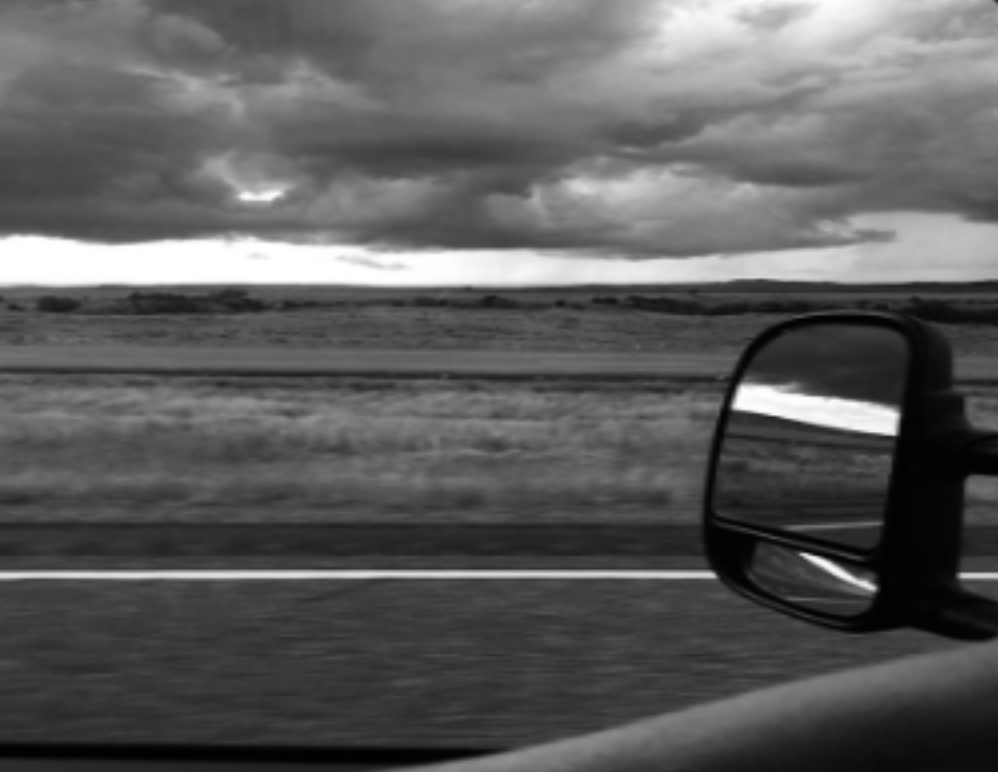
She is telling me a story. A story of the world that falls in tears… I pray the tears will become rain, one day (see Figure 11). The hurt in my chest is unmovable. It is what I carry now.
 [11]
[11]Figure 11. Stormy Road, by Beatrice Szymkowiak, 2015
In a quote of reflection, Orr (2004) stated,
The plain fact is that the planet does not need more successful people. But it desperately needs more peacemakers, healers, restorers, storytellers, and lovers of every kind. It needs people who live well in their places, and it needs people of moral courage who are willing to join the fight to make the world habitable and humane. And these qualities have little to do with success as our culture has defined it (p.12).
This proclamation is directed toward education, as Orr called for these systems to be more, invite more, and challenge us to be more. Indeed, Orr suggested that this is necessary for our survival.
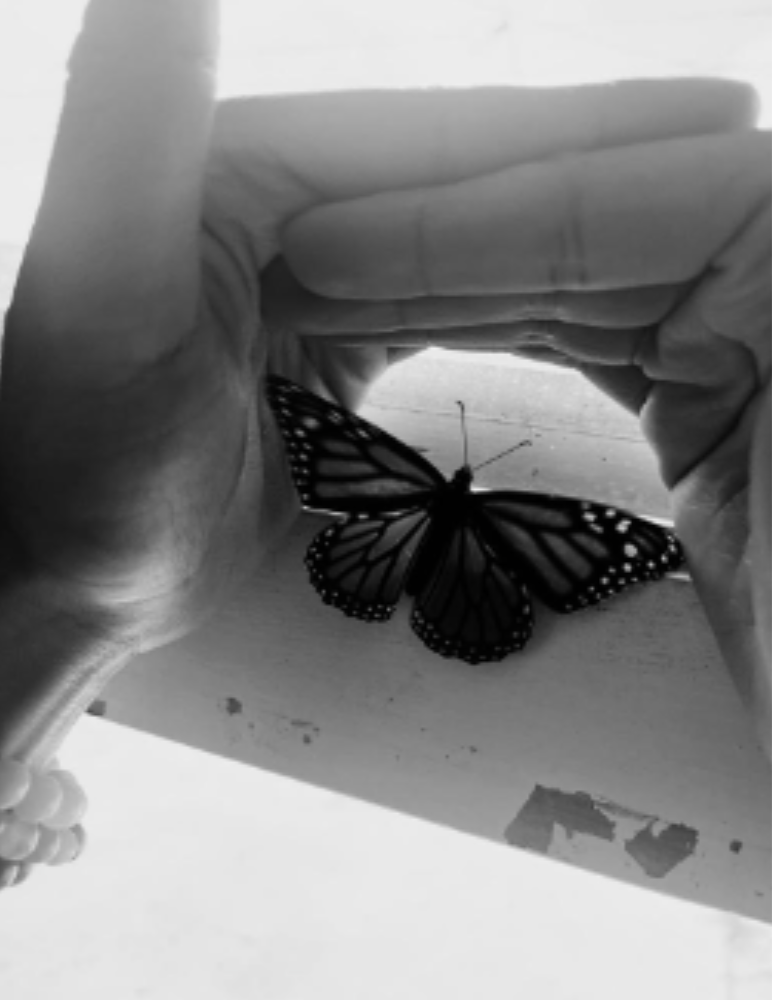
—Warp. I am a storyteller with the more-than-human. I share stories of native species of plants, trees, insects, birds, and how they benefit the local ecosystem, and the harm we humans do to their/our homes (see Figure 12). I do this in Anaheim, California. This urban mega-center is always laying down more concrete and removing natural areas to build attractions that bring in more people, mainly to financially profit Anaheim, which Disneyland essentially owns.
—Warp. Tension Adjusted. What if, rather than laying down more concrete, we nurtured the wild areas of land throughout the city to be oases for endangered wildlife, such as the Monarch, to find sanctuary amid the chaos they must witness? What if the narrative was flipped: Humans searching for homes and food in the midst of absolute chaos, towards their own extinction?
—Warp. We humans are facing an extinction crisis that is not spoken about, but worthy of conversation. A conversation about how we will ruin not just the Monarch butterfly, but the planet and us, entirely.
 [12]
[12]Figure 12. Butterfly Lost Indoors, by Alexander Garcia, 2024
In Orr’s (2004) Earth in Mind declarations for educational change, he suggested six myths about education that perpetuate the landscape where education keeps repeating itself. These myths are based on Cartesian dualism, assume human superiority over nature, and lack reflexivity, knowledge of place, and believe that we are gaining intelligence and success within these regurgitated modes of education (Orr, 2004, pp. 8-12). Orr also proposed six ways to rethink education, and, in these suggestions, education can find inspiration:
- All education is environmental education [it is all connected and through/across all content]
- The goal of education is not mastery of subject matter but mastery of one’s person
- Knowledge carries with it the responsibility to see that it is well used globally
- We cannot say that we know something until we understand the effects of this knowledge on real people and their communities
- The power of examples over words…the need to provide role models of integrity, care, and thoughtfulness
- Institutions, too, must embody ideals “wholly and completely”
- How learning occurs is as important as the content of particular courses. Process is essential for learning [beyond the classroom walls toward multimodal and experiential] (pp. 12-14)
Intersecting Orr (2004) and drawing our attention to the importance of place and land education, Cameron (2001) spoke of the goal of experiential outdoor education as fostering “an inclusive sense of place in students so that their love of wild places can extend to care for all places, even neglected space” (p.28). Wattchow and Brown (2014) advocated that these experiences be place-responsive, and Calderon (2014) pushed for the depth of land education, which amplifies Indigenous, postcolonial, and decolonizing voices about place and speaks to the responsive as well as the sustaining goals that may be embedded in a new educational praxis.
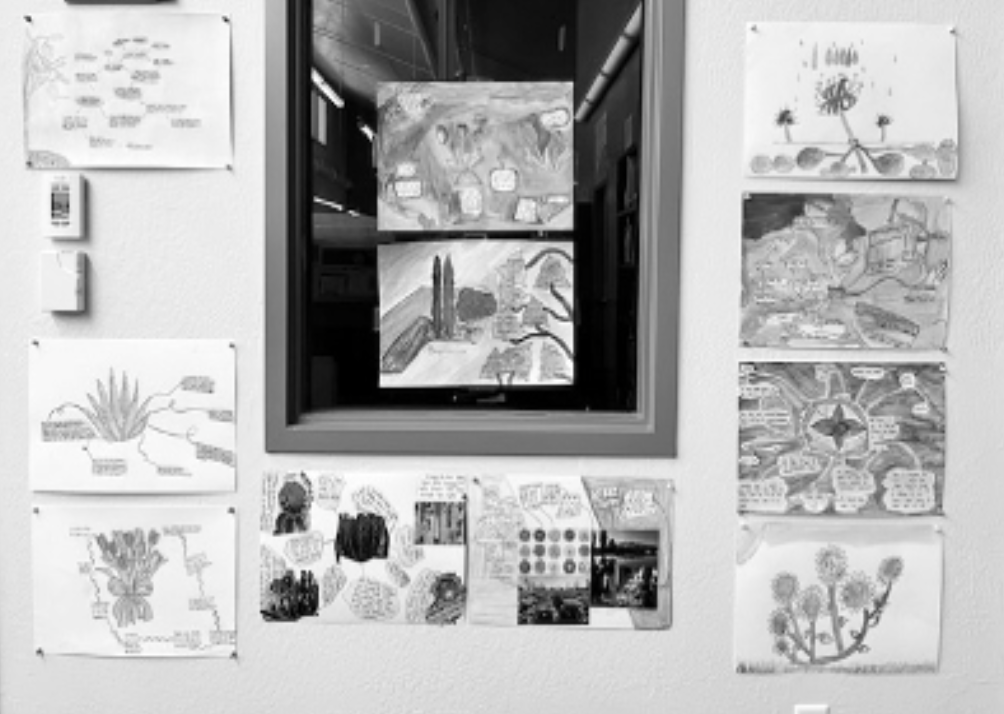
––Weft. Place, for many students, is impermanent (see Figure 13). For Multilingual Learners and Emergent Bilingual students, place can be uprooted, migrated, immigrated, foreign, unspeakable, sometimes liminal, and entangled with politics, war, love, family, language, dream, and story.
 [13]
[13]Figure 13. Plant Narratives, (from ESOL classroom) by Nicole Taylor, 2024
In light of our continued educational structure or system that perpetuates dualistic thinking and promotes education through the hopes of capitalism’s “dream,” Orr (2004) suggested we need to rethink education. He included the voice of American poet, essayist, and environmental activist Gary Snyder (1990), who lamented the disconnect between education and/or the “educated,” and care for the more-than-human world. Instead, it is noted that we are all “investing in the destruction of the world” (Orr, 2004, p.17). Orr also presented a universal wound of education, in which the systems of education have alienated “us from life in the name of human domination” and consistently “fragments instead of unifies, overemphasizes success and careers, separates feeling from intellect and the practical from the theoretical, and unleashes on the world minds ignorant of their own ignorance” (p.17). Many schools have been successful in separating us from each other and the more-than-human world and have left decisions made by “educated” people littered across time, like colonialism, the Holocaust, the atomic bomb, and plastic.
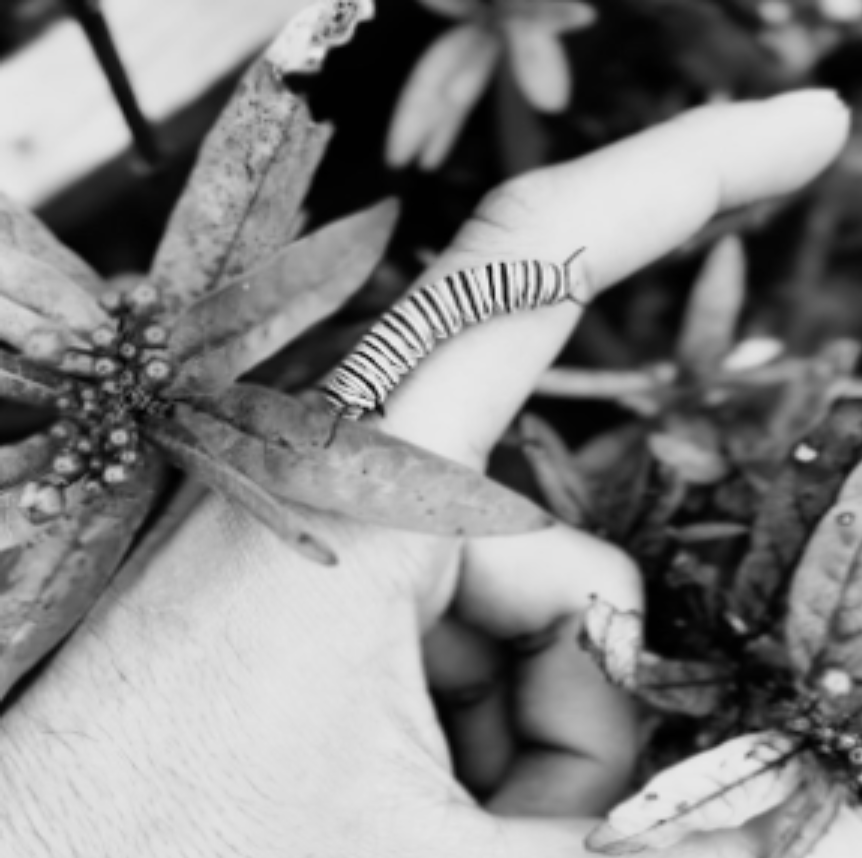
—Warp. Immersing myself in nature has been therapeutic. When I dive into nature to witness, I feel awe for someone or something other than myself. I learn how to maneuver my body around the garden – squat here as I observe a plant, side step there to walk through the narrow walkway, side crawl along the fence as I pull weeds. I count and measure as seeds are sown and seedlings planted. I learn patience and the importance of time and nurture myself and others. My mind can often unwind as I observe the more-than-human life gleaming in the sun (see Figure 14). Nature can provide education and care for us humans and more-than-humans alike. In the garden, for example, I have learned valuable lessons: Viewing fragments, zooming out to look at the whole, critically thinking about how one action could have affected another, and pondering what could be done.
 [14]
[14]Figure 14. The Saved Monarch Caterpillar, by Alexander Garcia, 2025
Orr (2004) offered some hope to the danger of education in “intellectual humility” and an “ecologically solvent land ethic” (p. 21). According to Orr, to counter the dangers, we need to learn how to “think in whole systems…find connections…ask big questions…[and] separate the trivial from the important” (pp. 30-31). The tasks, then, for Orr, are to step outside of Cartesian dualism, honor and highlight ecological intelligence, and education must become comprehensive and ecologically stable.
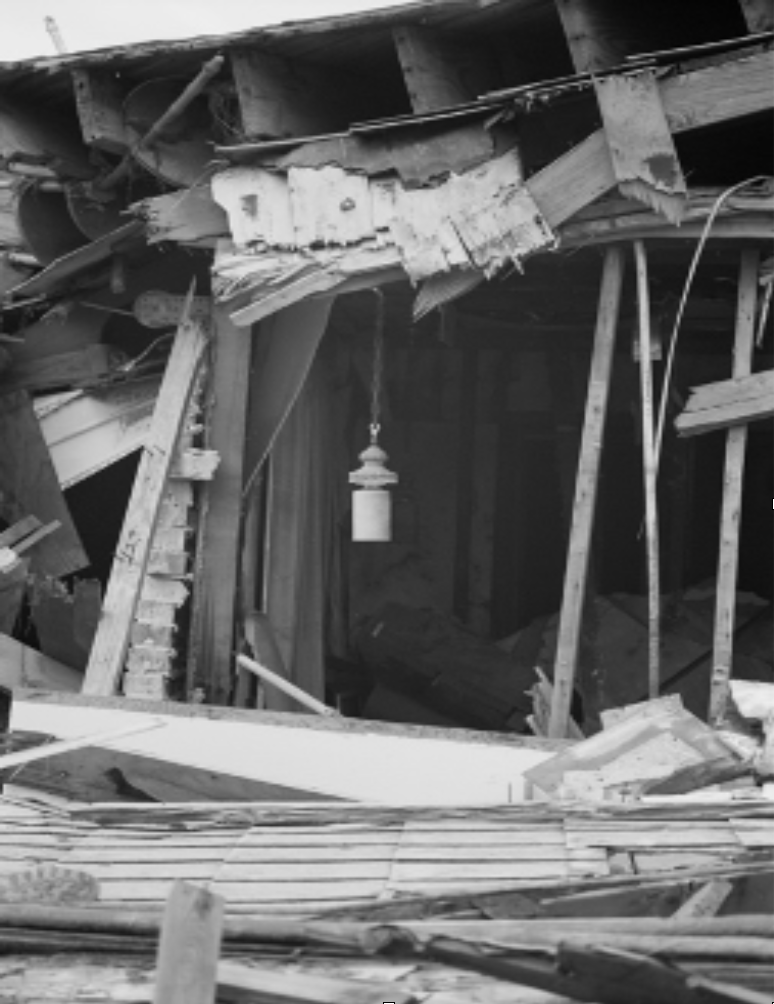
––Weft. I have lived through the hurricane in New Orleans, and then the next hurricane – again (see Figure 15). I have witnessed the before times, and after, when the earthquake hit Haiti, where I stood and saw “Free Aristide” spray-painted on a concrete wall. Men anpil, chay pa lou (Many hands lighten the load), I learned as a Haitian proverb. The Tsunami came through my TV like a black wave of grief when the earthquake trembled beneath the ocean near Japan. Tears trembled, and the weight of loss nested deep in my chest. I did not know anyone, but I saw a black serpent in that wave of water and knew––something.
The fire now licks up over the San Francisco peaks where we hiked not two weeks ago. The wind gusts are so brutal that they spark fire tornadoes through the prairie below.
I was on a plane when the Deep Horizon oil spilled, and when the children were murdered at Sandy Hook. I was also on a plane after I had to put my dog Fagin to sleep. The people in the cabin erupted in applause and tears of joy as we got the news that Obama had won. I was in a classroom full of 5th graders after the other election. Their eyes opened in fear, and I listened. A witness.
 [15]
[15]Figure 15. Lower Ninth Ward, Post-Levee Failure, New Orleans, by Beatrice Szymkowiak, 2005
These shifts embrace patterns—approaches in thinking, questioning, and learning. Capra (2005) suggested that implications for education in this shift would be the inclusion of more art integration and approaches, more transdisciplinary learning across science and other disciplines, and perhaps a more thoughtful community. In addition, the pattern thinking and approaches embrace the patterns identified in nature and align them with a connected human ecosystem. These include “networks…nested systems…interdependence…diversity…cycles… flows…development…[and] dynamic balance” (Capra, 2005, pp. 23-28). These are the patterns that lead to emergence. By shifting to thinking in patterns, we may begin to think about relationships, connectedness, and context.
Hayman, James, and Wedge (2018) showcased walking ethnographies in collaboration with Traditional Ecological Knowledge (TEK) as a possibility for extending biocentric perspectives beyond the Anthropocene toward land agency. Integrating TEK and weaving in the perspectives of Indigenous peoples’ storying of connection with the more-than-human world, we are presented with possibilities beyond dualism and our connections to the land and place. In this, we approach a greater understanding of interconnection and the “marriage” (p. 83) of humans with the land, animals, and experiences of place. According to Hayman, James, and Wedge, this “perspectivism is good…it works on an ontologically plural level without privileging one ontology” (p.83).
—Warp. I was crying to my mom and my boyfriend,
“Why is it so hard to start a garden in the city? I just want to invite people to learn the joy and self-resiliency of gardening and its benefits to the planet.”
It had been about two and a half years of back-and-forth communication with the city of Anaheim to restore a prior community garden, not even start from scratch on a new lot.
My first communication was in November, 2022.
On May 6, 2025, I finally heard a yes to the Anaheim Garden.
Now, I need to assemble a financial forecast to start the garden.
On May 16, 2025, I heard a yes to establishing community gardens with the city of Fullerton and Anaheim.
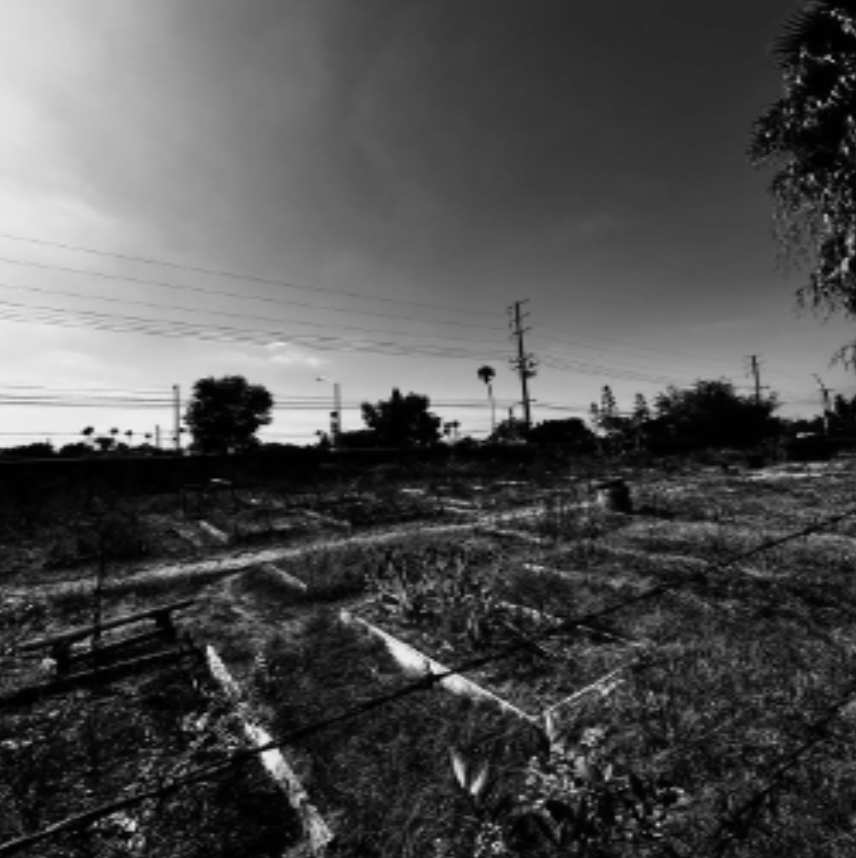
The community gardens will be built with Garcia’s (2025a) Decolonized Community Garden Framework in mind, built by the people, for the people, and managed alongside the people (see Figure 16). These community gardens will be places to grow food, find community, and embrace cultural revitalization. Further, these gardens will act as educational hubs where all generations can unite with the more-than-human world and tell their story.
 [16]
[16]Figure 16. Remnants of the Common Ground Community Garden, by Alexander Garcia, 2024
In reimagining our relationship with the more-than-human world, it is crucial to acknowledge the historical context that has shaped our current perspectives. Again, the idea of “re-entanglement” with nature necessitates a critical examination of the power dynamics that have led to our separation from it. As Garcia (2025b) points out, community gardens, often seen as spaces of harmony and connection, have complex roots in colonial practices, with early forms like allotment gardens in Europe reflecting control of resources and knowledge systems that disregarded Indigenous agricultural practices and replaced the commons. To truly move towards a Planthropocene, as Myers (2020) envisions, we must cultivate human and plant alliances and decolonize our understanding of these alliances. This means actively dismantling the power structures that have historically marginalized certain voices and forms of knowledge, and rethinking in practice our approaches to sustainability, land stewardship, and education away from Moore’s (2016) Capitalocene.
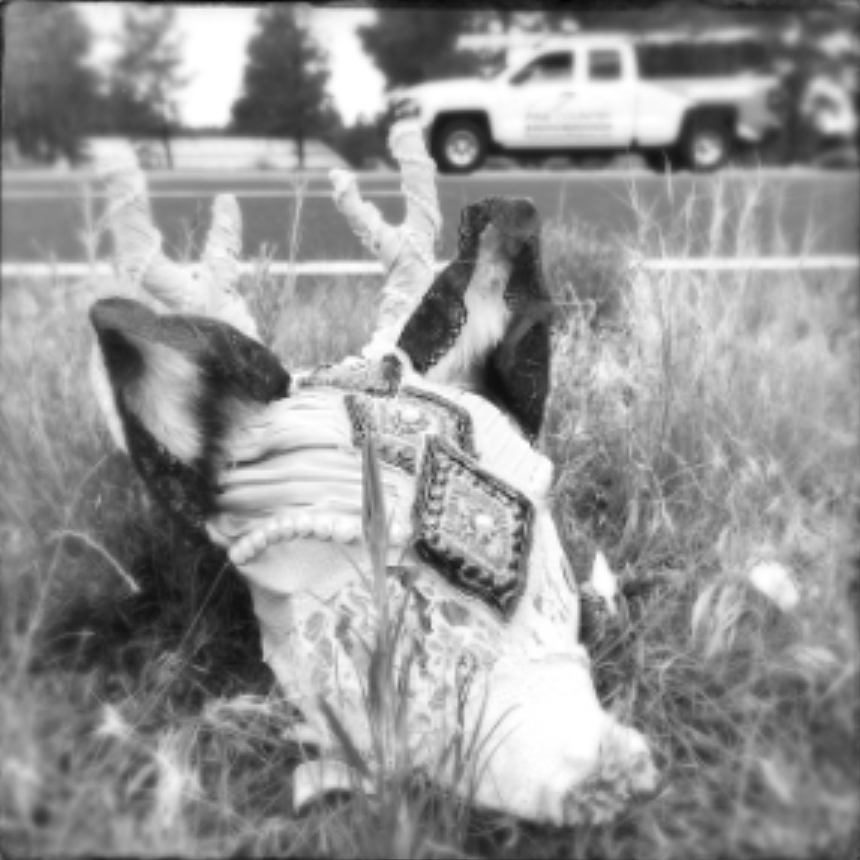
––Weft. Eyes watch through windows. She limps on a broken leg from tree to grass, to under deck, shaded by Trex boards and Palomino Gold. No sound. A pain, discreet. A yellow vest carries a rifle. Fires a single shot. Doe dragged through the backyard, alongside the house, and slung into the white pick-up truck. Blood marks, removal of inconvenience (see Figure 17).
 [17]
[17]Figure 17. Deer Obituary, by Nicole Taylor, 2024
Hayman, James, and Wedge (2018) suggested decolonizing processes found through counter-mapping and earth jurisprudence, offering legal rights to the more-than-human world. This is also a de-gendering of land as feminine in the dualistic colonial worldview, and instead, decentering humans in the form of animality (p. 83). Walking ethnography is a form of “slow-activism” (p. 84) storytelling, inviting embodiment of the more-than-human world through active engagement with perspectivism. It may be possible to experience, imagine, and story “a different rhetoric, providing models for different potential futures” (p. 87).
—Weft. The walking ethnography took me on deer paths that mingle with suburban landscapes and crisscross hiking trails. Each step met new human-built roads, fences, and housing developments. An endless cordoning off of migrations. Each step witnessed the privileging of human space, human movement, and human homes.
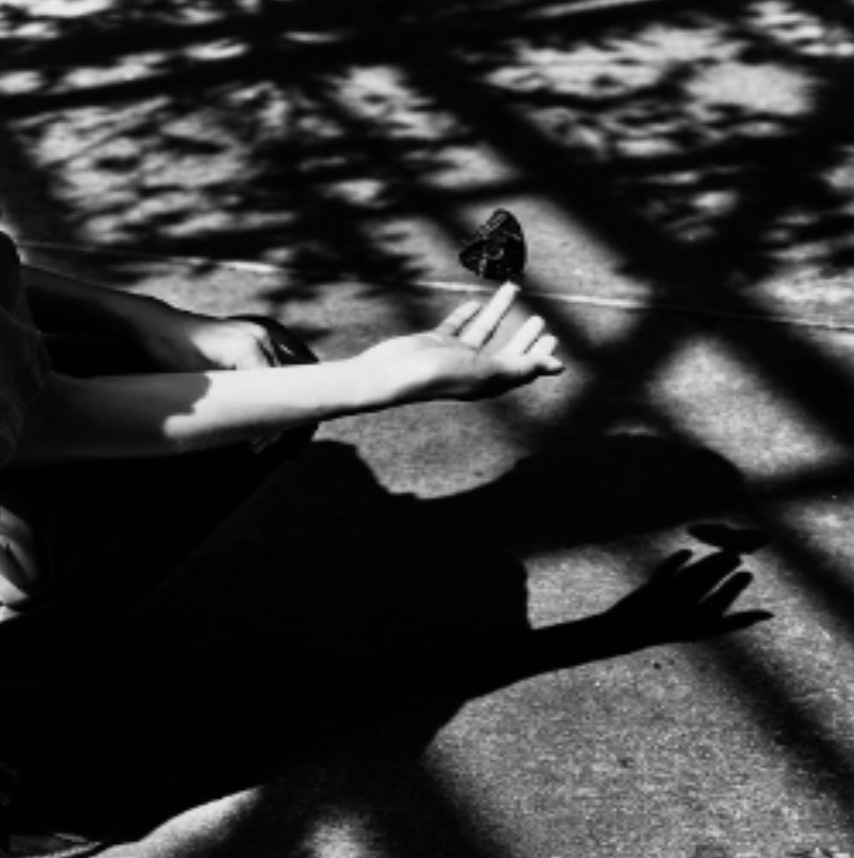
—Warp. Plants, animals, insects, fungi, we may not be so different from the more-than-human after all (see Figure 18).
 [18]
[18]Figure 18. Blue Morpho Finding Support, by Alexander Garcia, 2025
The major themes of dualism and denying our commonality with the more-than-human world can be structured, according to (Plumwood, 2002), through “radical exclusion…homogenization and stereotyping…polarization…denial and backgrounding a pristine nature…assimilation and incorporation…instrumentalism…[and] naming” (pp. 10-14). There are suggestions for countering this “centric structure” (p. 15) of monological – one-way terms – primarily by disrupting top-down and one-way perspectives and embracing kinship, or kincentricity. According to Salmón (2000), this “kincintric ecology” in which “Indigenous people view themselves as part of an extended ecological family that shares ancestry and origins” (p. 1332) may offer pathways toward re-entanglement. By considering nature as kin and in agential terms, we may find a way to engage in future community with the more-than-human world.
––Weft. We have chosen to witness the end. Can we choose again?
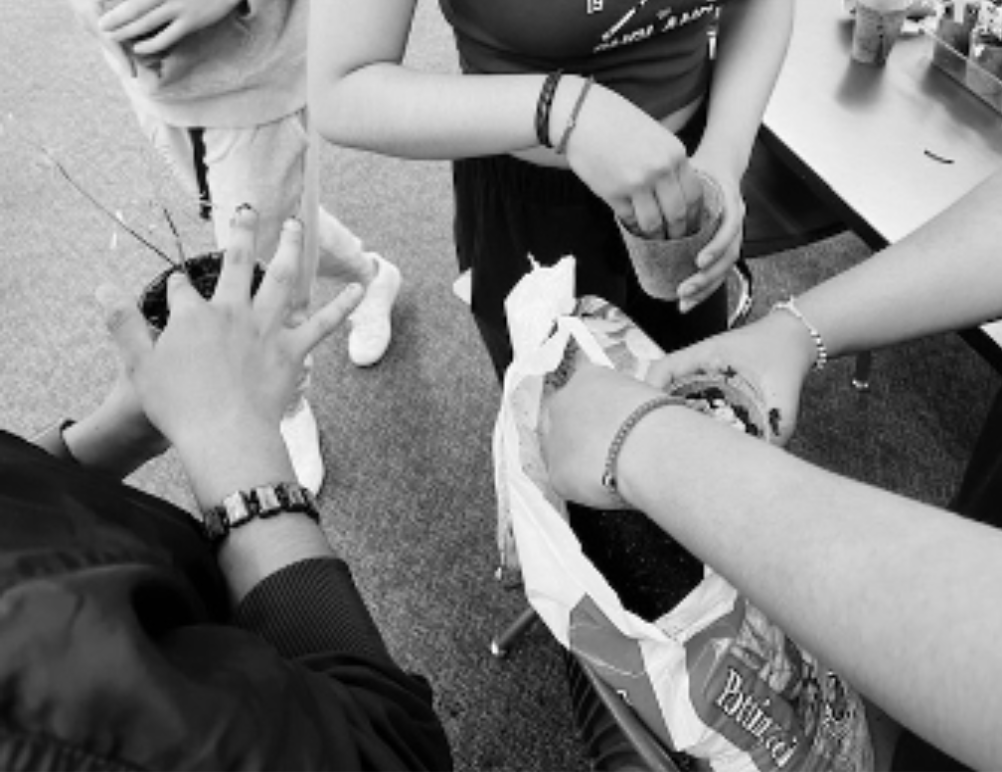
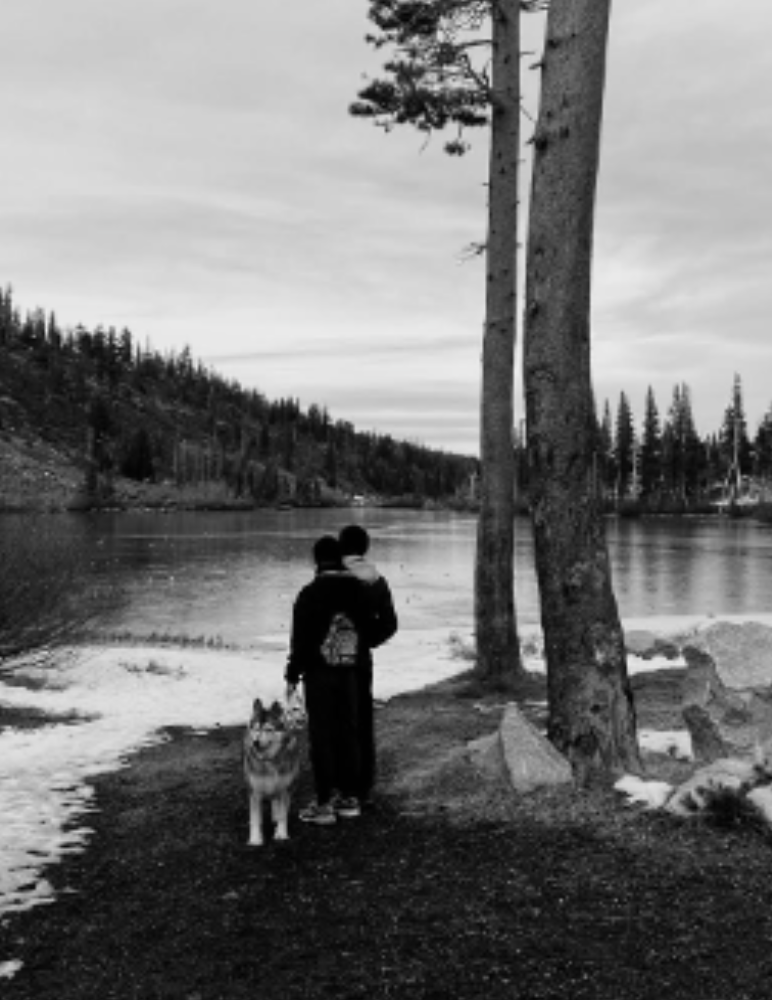
—Warp. Remember our entangled roots. Remember our interconnection, humans and more-than-humans. Feel, embrace, and seek community (see Figure 19). Let’s re-entangle – with (see Figure 20).
 [19]
[19]Figure 19. Students Planting Seeds, by Nicole Taylor, 2024
 [20]
[20]Figure 20. Immersing in Nature, by Alexander Garcia, 2023
According to Appfel-Marglin (2011), the reciprocity and “the gift” (p. 50) in many spiritual exchanges is a performative portal that both entwines humans with the more-than-human worlds and also instills some sense of boundary and responsibility upon the human world in its actions and engagement. As the separation of our human actions from the consequences of our actions becomes more acute, and the denial of fire, water, wind, and earth climate change becomes more impossible to ignore or deny, how might we rediscover the portal again? How might we imagine, dream, dance, and magic our spirit connection with now? Meadows (2005) suggested we dance with systems in humility and as learners, with care (pp. 196-198). Wattchow & Brown (2011) suggested “bringing forth” possibilities with education and the “deepening into place” (p. 169). Orr (2004) suggested “wonder” as our guide (p. 24). Through ecological literacies and reflexivity, perhaps it is a gift we offer that will bring us to a humble reconnection. Maybe, offering water to the garden, introducing seed to soil again, gifting spirits and self, and the more-than-human world, with our attention, responsibility, and care, will bring us to the commons once more. Or perhaps, we must become more-than-human, again.
Twining & Hemstitch: In-Becoming More-Than-Human
––Weft. We froze. The pain inside is bleeding, and we cannot walk on broken legs. The Blue Spruce brings no peace, and the human gaze is blinding. They stare but with inconvenience. They stare and do not see or feel. The underdeck is quiet – until – the shot.
—Warp. We, rooted. You drown in your individualistic ways. You litter our interconnected world, take us for granted. Forget that we are what supports life. When will we unite? When will we finally appreciate all that we have to offer each other?
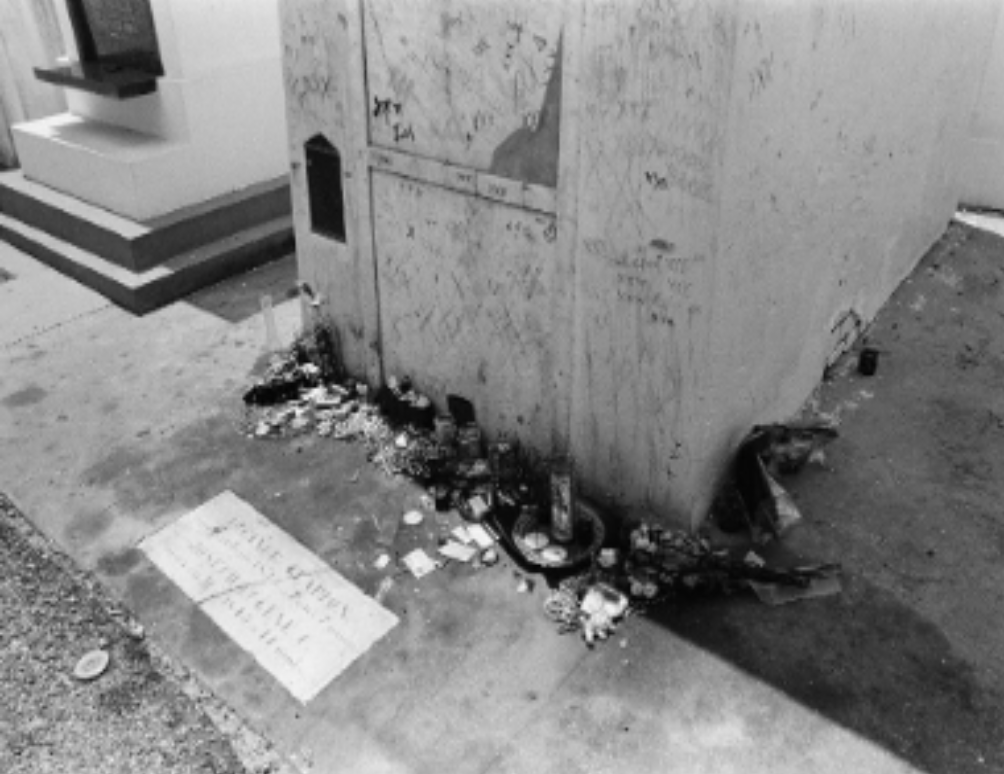
––Twining & Hemstitch. In Voudou, the gateway to the spirit world is guarded and opened by Damballah and Aida-Weddo, the serpent and the rainbow, the bodies that shed skin. To offer respect, one leaves a gift like hard-boiled eggs and draws vèvès with cornmeal. The drums and dance segue to the realm where the human body is ridden by lwa and where spirit and more-than-human are one. Renew, rebirth, to rise again, out of old selves. We dance to turn a hurricane (see Figure 21). We pray and sing to move the spirits in favor of our mundane lives. With candles, rum, sweat, and prayer, we pay respect to the beyond and to those who have passed. We commune, forgive us. And we become one.
 [21]
[21]Figure 21. Marie Laveau Gravesite, Voudou Priestess of New Orleans, by Nicole Taylor, 1998
References
Amazon Conservation Team (2024). Sarayaku: In Defense of Territory. https://www.amazonteam.org/maps/sarayaku-en/ [22]
Apffel-Marglin, F. (2011). Subversive Spiritualities: How Rituals Enact the World. Oxford University Press.
Barnard Center for Research on Women. (2020, March 11). What is transformative justice? [Video]. YouTube. https://www.youtube.com/watch?v=U-_BOFz5TXo&t=4s [23]
Benally, K. (January 6, 2009). News Release: Tribes & Environmental Groups Petition Supreme Court to Protect Sacred Mountain. Save the Peaks Coalition. https://www.indigenousaction.org/news-release-tribes-environmental-groups-petition-supreme-court-in-appeal-to-protect-religious-freedom-environmental-integrity-of-sacred-mountain/ [24]
Bowling, J. (August 1, 2018). In Flagstaff, restoring forests to prevent fire and disaster: The fear in Flagstaff is not just the three-week wildfire, but the thread for years of floods that could devastate the community. The Republic. https://www.azcentral.com/in-depth/news/local/arizona-environment/2018/08/01/arizona-wildfires-restoring-flagstaff-forest-health-prevent-floods/421918002/ [25]
brown, a.m. (2017). Emergent Strategy: Shaping Change, Changing Worlds. AK Press
Cameron, J. (2001). Beyond dualism: Wilderness, outdoor education and everyday places. In Education Outdoors: Our Sense of Place. 12th National Outdoor Education Conference Proceedings. Carlton, Victoria: Victorian Outdoor Education Association: 27-32.
Capra, F. (2005) Speaking Nature’s Language: Principles for Sustainability (p.18-29). In Stone, M., & Zenobia, B. (2005). Ecological Literacy: Educating Our Children for a Sustainable World. The Bioneers Series. Sierra Club Books.
Corbin, A. (July 20, 2009) Sacred Land and Film Project – San Francisco Peaks https://sacredland.org/san-francisco-peaks-united-states/ [26]
Garcia, A. (2025a). A Decolonized Community Garden Framework. Journal of Critical Race, Indigeneity, and Decolonization.
Garcia, A. (2025b). Looking Beyond the Surface: Uncovering Community Gardens’ Role in Resisting Colonial Forces. Journal of Sustainability Education.
Garcia, O. & Kleifgen, J.A. (2019). Translanguaging and Literacies. Reading Research Quarterly, 55(4), pp.553-571 | doi:10.1002/rrq.286. International Literacy Association.
Hayman, E., James, C., & Wedge, M. (2018). Future rivers of the Anthropocene or whose Anthropocene is it? Decolonising the Anthropocene. Decolonizing. Educ. Soc, 6(2), 77-92.
Kapp, W. (1950). The Social Costs of Private Enterprise. Harvard University Press.
Kayumova, S. & Tippins, D. J. (2021). The quest for sustainable futures: designing transformative learning spaces with multilingual Black, Brown, and Latinx young people through critical response-ability. Cultural Studies of Science Education, 16, 821-839. https://doi.org/10.1007/s11422-021-10030-2 [27]
Keller, L. (2018). Recomposing Ecopoetics: North American Poetry of the Self-Conscious Anthropocene. The University of Virginia Press.
Love, B.L. (2019). We want to do more than survive: Abolitionist teaching and the pursuit of educational freedom. Boston: Beacon Press.
Meadows, D. (2005). Dancing with Systems. in Ecological Literacy: Educating Our Children for a Sustainable World. The Bioneers Series. Eds. Stone, M. & Barlow, Z. Sierra Club Books
Martin, C. (2022). May Tomorrow Be Awake: On Poetry, Autism, and our Neurodiverse Future. Harper One.
Moore, J. W. (2016). The Rise of Cheap Nature. in Moore, J. W. Anthropocene or capitalocene?: Nature, history, and the crisis of capitalism. (78-115) Oakland, CA: PM Press.
Myers, N. (October 14, 2020). Growing the Planthroposcene / 204. For the Wild. https://forthewild.world/listen/dr-natasha-myers-on-growing-the-planthroposcene-204 [28]
Navajo-Hopi Observer (November 27, 2018). Indigenous peoples denied access to sacred site as ski area opens with treated sewage. Navajo-Hope Observer. https://www.nhonews.com/news/indigenous-peoples-denied-access-to-sacred-site-as-ski-area-opens-with-treated-sewage/article_ [29]
Orr, D. W. (2004). Earth in mind: On education, environment, and the human prospect. Island Press.
Plumwood, V. (2002). Decolonizing relationships with nature. PAN: Philosophy Activism and Nature. No. 2. pp. 7-30.
Religious Freedom Restoration Act of 1993, Pub. L. No. 103-141, 107 Stat. 1488 (1993). https://www.congress.gov/bill/103rd-congress/house-bill/1308 [30]
Salmón, E. (2000). Kincentric Ecology: Indigenous Perceptions of the Human-Nature Relationship. Ecological Applications – ECOL APPL. 10. 1327-1332. 10.2307/2641288.
Schwaegerl, C. (2021). The Anthropocene: Paul Crutzen’s Epochal Legacy. Anthropocene. https://www.anthropocenemagazine.org/2021/02/the-anthropocene-paul-crutzens-epochal-legacy/ [31]
Snyder, G. (1990). The Practice of the Wild: Essays. North Point Press
Taylor, N. (2024). Rethinking Sustainability through Accessibility: An ADA Garden to Invite the Languaging of Embodied Ecologies. Journal of Sustainability Education Vol. 30, December 2024. ISSN: 2151-7452
U.S.D.A Forest Service (2026). Recent Large Wildfires: Pipeline and Haywire Fires (2022). USDA. https://www.fs.usda.gov/r03/coconino/fire/info/recent-large-wildfires [32]
United Nations (June 2021). In Images: Plastic is Forever https://www.un.org/en/exhibits/exhibit/in-images-plastic-forever [33]
Wagner, P. & Wieland, B.C. (2022). Almanac for the Anthropocene: A Compendium of Solarpunk Futures. West Virginia University Press
Walqui, A. & Bunch, G. (2019). Amplifying the Curriculum: Designing Quality Learning Opportunities for English Learners. Teachers College Press
Wattchow, B. & Brown, M. (2011). A pedagogy of Place: Outdoor Education for A Changing World. Monash University Publishing
Young, A. (October 14, 2020). Dr. Natasha Myers on Growing the Planthroposcene [Audio podcast transcript]. In For the Wild. Episode 204. https://forthewild.world/podcast-transcripts/dr-natasha-myers-on-growing-the-planthroposcene-204 [34]
Young, A. (February 21, 2024). Merlin Sheldrake on Embodied Entanglements [Audio podcast transcript]. In For the Wild. Episode 365. https://forthewild.world/podcast-transcripts/merlin-sheldrake-on-embodied-entanglements-365 [35]