 [1]
[1]
Link to the JSE March 2026 General Issue Table of Contents [2]
Marshall JSE March 2026 General Issue PDF [3]
Abstract: With the outbreak of COVID-19, garment workers worldwide faced increasingly hazardous conditions, especially as companies canceled billions of dollars in orders that left millions without pay. From my home office, I navigated tight budgets and deadlines, witnessing firsthand the gap between sustainability initiatives and lived realities. This experience prompted my transition from an industry practitioner to a sustainability educator, informed by Indigenous and African diasporic ways of being, doing, and knowing. My research explores the role of culture in fashion and sustainability. It moves from learning with Indigenous jewelry designers in the Northwest Coast to following cotton from farm to factory in Egypt. By centering Traditional Ecological Knowledge, it demonstrates how the future of fashion depends on ecological responsibility through relational accountability and regenerative practice.
Keywords: culture, design, ecological responsibility, education, fashion, sustainability
In the winter of 2020, as COVID-19 infections surged worldwide, factories continued to operate, exposing garment workers – mostly women of the global majority – to serious health risks. At the same time, companies canceled billions of dollars in orders, leaving suppliers and more than one million garment workers in Bangladesh – a major manufacturing hub – without pay. From the safety of my home office, I negotiated lower costs and faster timelines on behalf of one of those companies, acutely aware that the sustainability goals I was expected to support were performative. Every adjustment I pushed for came at a price I could not clearly see, but knew was being absorbed somewhere – by a factory manager or garment worker and their family or community. The distance between my computer screen and the sewing floor was deeply unsettling. The tension between rhetoric and reality revealed the fragility of the system I helped maintain and prompted my evolution from product developer to sustainability educator. I felt compelled to move toward what bell hooks calls an ethic of care and relational accountability.
I came to understand that sustainability education in fashion is not simply about teaching practitioners and students to choose better fabrics or calculate carbon footprints. It is about becoming ecologically responsible. To help future decision-makers see the human and more-than-human relationships embedded in the system, I first had to embody that responsibility myself. This realization enabled me to lean deeper into questions of whose labor is hidden, whose knowledge is credited, and whose land bears the burden. Education, through this lens, becomes a site of liberation and systemic change. When practitioners and students are invited to trace supply chains, confront power imbalances, and reflect on their own positionality, they begin to recognize that design is never neutral. It either reinforces extraction or participates in restoration. Becoming ecological responsible means sharpening critical awareness alongside technical skill.
Unraveling this thread led me to investigate the role of culture in fashion and sustainability – both in the context of appropriation and preservation. I began by learning from Indigenous jewelry designers from the Northwest Coast – where I am based – about the social and ecological meaning woven into their design processes. This inquiry expanded to exploring how sustainability is practiced by a Black American fashion designer whose Pan African upbringing inspired collaborations with traditional artisans in Ghana and Mali. During this time, I also began a heritage arts apprenticeship to study quiltmaking with a Black American fiber artist, discovering how deeply rooted the textile tradition is across the African diaspora. These experiences enriched my understanding of how ancestral memory and land stewardship are stitched together between peoples and places.
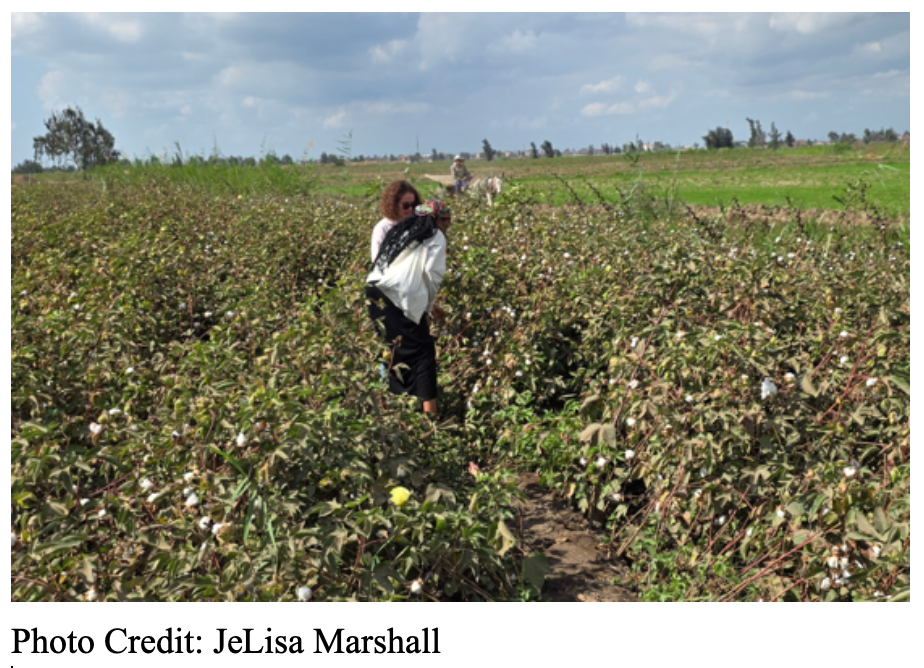
Altogether, these experiences brought me full circle, initiating me into research as a ceremony – a process grounded in relational accountability, as Shawn Wilson beautifully articulates in his scholarship. It laid the foundation for me to examine regenerative design and production with an Egyptian-American fashion label. In this examination, I conducted fieldwork from farm to factory in Egypt, centering Traditional Ecological Knowledge along the cotton-to-clothing value chain. I listened to cotton farmers describe soil as a living relative rather than a raw material. I observed how design decisions were shaped not only by industrial trends but also by generational approaches to care, climate, and craft. These encounters starkly contrasted with the metrics-driven frameworks pushed by companies to define sustainability. They reminded me that the future of fashion depends not on efficiency alone, but on reciprocity.
My work now seeks to amplify plural ways of being, doing, and knowing within sustainability education in fashion. In doing so, I invite the next generation of leaders to design otherwise – engaging ecological responsibility as a lived practice rather than a business objective. Sustainability in fashion will only flourish where awareness and action take root together.