 [1]
[1]
Link to the JSE March 2026 General Issue Table of Contents [2]
Simon JSE March 2026 General Issue PDF [3]
Abstract: The recent rapid shift towards the adoption of electric vehicles and other low-carbon technology has increased the global demand for strategic minerals. Increased demand for these strategic minerals means nations around the world are working to extract them, creating a significant challenge for sustainable development. Eight key educational competencies have been developed to address the types of thinking and challenges found in working to reach sustainable development goals. This paper presents a reality-based simulation to encourage students to practice these competencies within the context of mineral mining. The simulation includes three scenarios of resource development within the simulation that operate at different levels of sustainability; students develop a sustainable solution in the final scenario. This simulation is intended to be a tool to encourage transformative, emancipatory, and collaborative learning. The overall goal of this activity is to help students better understand the complexities involved in the interactions between economic, social, and ecological motivators when dealing with large, landscape-scale resource development projects.
Keywords: Active learning, metal mining, sustainability simulation, sustainability competencies, sustainable development
Introduction:
Sustainable development has been identified as a priority by the United Nations, and it is frequently described as development that meets current needs without compromising the needs of future generations (Bruntland, 1987). The recent, rapid shift towards the adoption of electric vehicles and other low-carbon technology has increased the global demand for strategic minerals, including copper (Cu) and cobalt (Co). With increased demand for these strategic minerals, nations are examining their geologic resources and working to develop them, creating a significant challenge for sustainable development. Mining for strategic metals can drive environmental and social problems in areas where they are mined, but the metals are necessary to facilitate the shift away from carbon-intensive energy technology (Lèbre et al., 2020). This dichotomy is driving conflict in areas around the globe that are rich in strategic metals.
Locations around the world that are rich in strategic metals resources have frequently experienced myriad environmental and social problems associated with mining activity. Degraded ecosystems, and soil quality, reduced water availability and quality, and poor air quality are among the environmental impacts associated with metals mining. Social problems include exacerbation of income inequities furthering social tension, forced migration, child labor and modern slavery (Gross, 2023; Luckeneder et al., 2021; POST, 2022; Samosir et al., 2025). To address these social and environmental problems associated with the wicked problem (Rittel & Webber, 1973) of metals mining, education for sustainable development is necessary (Wiek et al., 2011).
Eight key educational competencies have been developed to holistically address the types of thinking and challenges found in working to reach sustainable development goals (SDGs). These include; systems thinking, futures thinking, values thinking, strategic thinking, an interpersonal competency, integrated problem solving, an intrapersonal competency, and an implementation competency (Brundiers et al., 2021). Developing holistic pedagogical approaches has been recognized as a priority to provide depth and meaning to sustainability education for the SDGs. Games for sustainability learning are one such route to achieve these ends.
Gamification provides guided, controlled progression where players follow their own progress and choice of authentic options, motivating them to progress through the game, learning as they go. Learning the SDGs in a system with scoring points where learners have a say in the outcome does not appear often in education (Réti et al., 2022) and the paucity of research to indicate the long-term efficacy of sustainability games in achieving SDGs has been identified as an important gap in sustainability education (Fernández Galeote et al., 2025). The current paper presents a game-like simulation of metals mining which activates the educational competencies outlined by Brundiers, et al. (2021), except the implementation competency which is beyond the scope of this simulation.
Active learning pedagogies, like games, have been shown to be beneficial to student learning outcomes in sustainability education (Kagawa, et al., 2006; Réti et al., 2022). A four-part framework integrating transmissive, instrumental, transformative, and emancipatory pedagogies provides a map to guide students and educators along this path. The framework builds from prescribed informational learning to work towards self-directed, collaborative inquiry which challenges normative assumptions towards meaningful changes in the status quo (Papenfuss, et al., 2019).
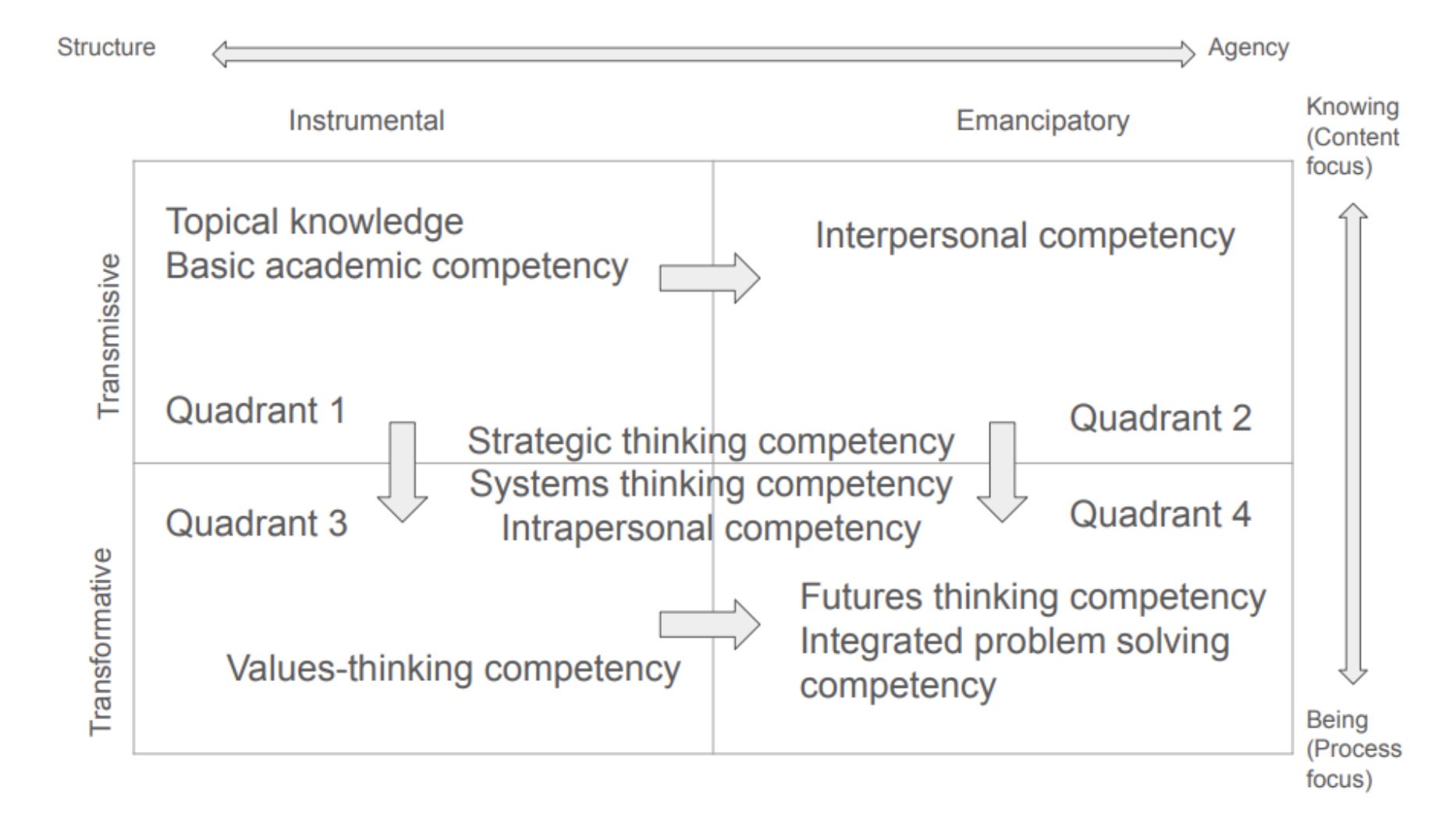
This simulation is intended to be a tool to encourage transformative, emancipatory, and collaborative learning, building on information learned via transmissive and instrumental methods. Building on relevant topical knowledge and basic academic competency from the classroom setting and linking this transmissive and instrumentally-based knowledge (Papenfuss, et al., 2019) to the sustainability competencies outlined in Brundiers et al. (2021) forms the basis for this simulation. The simulation allows students to engage with their base of knowledge by collaborative active interaction, building confidence in their understanding of the sustainability competencies. For example, students will have to think strategically about the system they are engaging in while making values-based decisions, all while interacting with others during the simulation (Figure 1). Transformative and emancipatory learning happens by focusing learners towards “peace, collaboration, responsibility, respect for limits, and interconnectedness” (p. 9), as well as a “constructive deviance” (p. 10) when developing novel sustainable solutions for the simulation (Papenfuss, et al., 2019).
 [4]
[4]Figure 1. The interacting pedagogy framework for sustainability education (Papenfuss, et al., 2019) with the key sustainability competencies (Brundiers et al., 2021), highlighting their interactions.
This figure illustrates, for example, how topical knowledge and basic academic competency can build into emancipatory and transformative pedagogies leading to challenging the status quo, in Quadrant 4. The interconnectedness of these competencies within an educational ecosystem is especially important for the strategic thinking, systems thinking, and intrapersonal competencies, hence their centering in the diagram, but all competencies will overlap the quadrants to some extent.
Simulation Overview
This lesson is structured as an interactive simulation to help students understand some of the competing interests and viewpoints involved in the development of a large-scale natural resource extraction activity, in this case, metal mining. For this simulation there are four primary stakeholder groups interacting with each other and three “banks”. The stakeholder groups include, the mining company, the government, miners (who come from the local area), and non-mining citizens in the area. The three banks represent the three pillars of sustainability: social, ecological, and economic sustainability (Purvis, et al., 2019). Within the simulation, participants will interact with three different scenarios; a “Thoughtful”, “Capitalist”, and “Sustainable” scenario.
The Simulation Framework
In this simulation, participants roleplay various stakeholders and work through scenarios, addressing three models of development in which a multinational mining company shows interest in developing a large open-pit mine targeting strategic metals. These metals will ultimately be marketed globally for the development of batteries for electric vehicles. The company securing and distributing these metals promises higher wages and steadier employment than is usually available locally for community members, all while promising respect for the local environment and cultural history.
The first scenario is described as the “Thoughtful Scenario”, where there is governmental oversight, which implies sustainability, but by the end of the scenario, the system is ultimately unsustainable, reflecting modern mining systems in the developed world. There is usually governmental oversight, coupled with a concern for people and the environment, but in the end, corporate profit is the primary driver of development. As participants work through this scenario, they will demonstrate their ability to use systems, futures, and values thinking competencies during the final step, which carries into the class discussion following each scenario. The first scenario will take at least 35 minutes to complete.
The second scenario activates the same competencies and starts like the first, but eventually descends into the unfettered “Capitalist Scenario” of production as is frequently seen in places in the developing world. Mass ecological destruction and human suffering ensues, promoting robust conversation about the differences from the first scenario and understanding of how different oversight systems promote specific hierarchies and outcomes in society. The second scenario will take at least 20 minutes to complete.
During the third, “Sustainability Scenario”, participants are called upon to develop their own sustainable models, applying concepts learned during the first two scenarios, adopting past successes, and developing novel approaches to the final scenario. Along with the previously mentioned competencies, this activity intends to activate the strategic thinking, integrated problem solving, and interpersonal competencies necessary for developing sustainable solutions. The intrapersonal competency is achieved through participants’ critical analyses of their own personal understandings of their place, emotions, interactions, and feelings within each of the scenarios. The third scenario will take at least 20 minutes to complete.
Objective
The overall goal of this activity is to help students better understand the complicated interactions between economic, social, and ecological motivators when dealing with large, landscape-scale resource development projects. Building practice with sustainability competencies during the simulation will also help students develop a greater appreciation and understanding of the diverse viewpoints of various stakeholders.
During the final scenario of this simulation, students are encouraged to utilize the “membrane” concept for integrated transfer of knowledge and values between stakeholders in sustainability conversations (Widhalm, 2011). During a “membranous” exchange of information, the traditional communication walls or stakeholder silos are made more porous, so collaboration and understanding of various perspectives is enhanced. This is especially important when working within a system in which there are many stakeholders and various power structures and hierarchies, like large-scale mining.
Stakeholder Groups
There are four primary stakeholder groups interacting with each other: local miners, the mining company, the government, and non-mining citizens in the area. The banks also interact with the stakeholders by providing or taking resources during each round. Prior to beginning the simulation, participants should discuss the motivations and limitations of each stakeholder group. This may be uncomfortable for students, as acknowledging that humans’ worst motivations can lead to undesirable outcomes.
Mining Company
For the mining company, the primary motivation is maximizing financial profits regardless of social or ecological concerns. The company is responsible for paying local miners and governmental agencies for their mining work and permitting regulatory work, respectively. They are encouraged to use their capital to work around agreed-upon regulatory structures to increase their profit.
Miners
Local miners’ primary motivation is gainful employment in the mine. Local miners do live in the community though, and are concerned about their social standing and the local environment. Miners’ social standing is usually raised by employment, and mining is frequently seen as a “better” job than traditional agriculture or other locally-available employment. Their financial needs are much less than the mining companies, but the need for social standing and good local ecology is much higher. Even though they work for the mining company local miners still need access to clean water, productive local food sources, and important cultural ties.
Government
For members of the government, the primary motivation is the development of natural resources. This needs to be balanced with the needs of the people and the people’s prosperity cannot simply be measured in terms of money. People also place high value on their social situation and the health of their local environments. Government’s primary focus is supposed to be on the people; however, as a human institution governments are not incorruptible. Students in this role during the simulation will need to consider their own values, experiences and knowledge of how governments can work (for better or worse) to inform how they act during this simulation.
Local Non-Mining Citizens
Non-mining citizens live in the community around the mine, and their motivations are varied. They are concerned with making money, and the mine provides some induced employment in the area to support the miners and the mining operation. This is a diverse group of people, though, and their needs and expectations are highly variable and not always positively-minded towards the mining operation. Ecological and social concerns are also relevant for this group, similarly as the miners.
Banks and Resources
The banks represent the three pillars of sustainability: social, ecological, and economic.
- The Economic Bank represents the global and local economies and provides funding to the other stakeholder groups.
- The Social Bank represents the social component of sustainability. Important components include, but are not limited to, good jobs, connection to their place, a thriving culture, good healthcare, and education. and the Social Bank provides a quantifiable value to these societal needs.
- The Ecology Bank represents the natural capital in the local area such as: clean water and air, adequate soil resources, plant and animal biodiversity. The Ecology Bank can import and export resources (depending on the situation), but unless ecological restoration is specifically called for during an action, ecology units that are used up should be considered as permanently lost during each scenario (see Appendix 1 for details).
Each stakeholder group starts with varying amounts of economic, ecological and social resources that are represented by three differently colored poker chips, each representing one of the three pillars of sustainability.
- Local miners and non-miners start only with ecology chips because most individuals in those populations have little money and live closely with their environments. Their social status is usually not sufficient to enact change at an individual level so these groups start with no social chips. These two stakeholder groups represent the citizens in the area of the mine that are doing the actual work of mining or as non-miners are in such roles as family members, neighbors, and friends. The miners work directly for the mining company and the non-miners are employed variously in the surrounding community in jobs that indirectly support the mining industry, such as manufacturing mining equipment, and the local population.
- The government starts with no resources, but acquires them, and can serve as a liaison, helping to negotiate between competing stakeholder groups while regulating them.
- The mining company starts with the most money and social capital as a group. In this simulation, the mining company represents a large multinational corporate entity that brings capital investment to start the mining operation, runs the mine, and profits from the work.
Implications for Practice
Audience
The intended audience for this simulation is college students; however, high school students may find this activity valuable as well. The activity can be implemented in a variety of class sizes. There are four primary roles during the simulation (mining company, government, miners, and other citizens), so a suggested minimum is four students and an instructor. Larger classes can separate each role into small groups and utilize as many copies of the simulation simultaneously as needed. For example, three students could represent the “Government” and collectively represent that role, which would likely increase conversation and diverse viewpoints during the simulation.
Student and Teacher Preparation
Prior to engaging with this simulation, the instructor should expose students to foundational concepts related to sustainability, such as the three pillars of sustainability (Purvis et al., 2019) and the understanding of the diversity of perspectives that explorations of sustainability can entail (i.e. sustainability is not just a problem of the environment) (Miller et al., 2025).
Instructors may not be familiar with the situational context within this simulation. It is important to familiarize instructors and students with the mining and power systems involved in the utilization of rare earth elements,the rise of electrification around the world, and implications of that shift. Linked resources in the Materials and Technology section of this paper can provide a starting point for exploration of these situational topics.
Simulation Mechanics
There are three scenarios: the “Thoughtful Scenario”, the “Capitalist Scenario”, and the “Sustainability Scenario”. There is limited flexibility for outcomes in the “Thoughtful” and “Capitalist” scenarios as they are in place to help familiarize students with the situation and practice how stakeholder groups interact with each other. Additionally, students can see how resources move in and out of a simulation with a particular framework. The third “Sustainability Scenario” is a chance for students to apply new skills and lessons from the previous models to achieve a sustainable path forward. The detailed procedures are described in the scenario instructions (Appendix 1) for the first two scenarios. Each of the first two scenarios has nine steps in which the banks and stakeholder groups interact and exchange resources as described in each step of the scenario. The final “Sustainability Scenario” utilizes the basic payment and costs from the previous scenarios, but participants must engage in discussion and collaboration between stakeholder groups to hopefully reach a sustainable outcome, balancing the needs and desires of the stakeholder groups while maintaining economic, social, and ecological parameters.
The responsibility of the instructor during the first two scenarios is to ensure that participants correctly complete each step and, depending on the classroom, provide the necessary related historical information, concepts, and content. Assigning students to familiarize themselves with the content information is also possible. The instructor could also operate the banks and essentially act as a “narrator” if the class context allows. The teacher can also mediate disputes that may arise; however, students should be empowered to find their own solutions.
Ethical and Emotional Considerations
This simulation is based in reality and there are ethical and emotional considerations while participating in this activity. The topics addressed during this simulation are centered around serious exploitation of workers and communities, system-scale corruption, greed, and catastrophic environmental harm. Discussion of challenging topics is important to build student awareness of different perspectives, critical thinking and argumentation skills, ultimately improving civic engagement and knowledge (Gert-Jan Wansink et al., 2023).
Throughout the simulation, students should work to set aside their personal feelings to genuinely represent their stakeholder interests. Participants are encouraged to commit to the worldview of whichever stakeholder group they are representing. For example, if a student fervently believes that mining companies should not be allowed to extract resources and they are playing as the mining company, they should set aside their personal beliefs and act in the mining company’s interest, even if it contradicts their personal opinions. This may be challenging for some students and there are opportunities to discuss these topics before, during and after each scenario, as well as in the self reflection (Appendix 3). Viewing complex situations through a variety of perspectives is an integral part of this simulation. Instructors should encourage students to be open and thoughtful in their personal reflections and share any emotional or philosophical discomfort they may encounter during this activity. Instructors should feel empowered to provide support to students as they encounter challenging situations during the simulation.
Materials and Technology
Materials
The materials necessary for this lesson are:
- The included simulation place cards labeled: Social Bank; Economic Bank; Ecology Bank; Mining Company; Government; Miners; and Other Citizens (Appendix 2).
- Each of the three scenarios also has individual instructions and action choices for each stakeholder group (Appendix 1).
- A grading rubric for the simulation and a set of self-assessment questions is also included (Appendix 3).
- Standard poker chips (red, white and blue colors) are also needed to represent value for each of the three pillars of sustainability, but are not included. Other colored chips or counting systems, such as locally available currency, can certainly be used in place of poker chips.
- 100 white, 50 red and 50 blue chips will be needed for each group completing the simulation. Due to the large amounts of white “economic” chips needed, demarcating approximately 10 white chips as having a value of 10 units is necessary to keep the numbers of chips to stay within reason. Additionally, demarcating approximately eight red “ecology” chips and six blue “social” chips as having a value of five units will also be necessary.
Technology
Below are digital resources for additional information on some topics encountered during this simulation and examples for the scenarios.
- Most resource extraction-related repression today occurs in developing countries. Here is an overview article with links to additional resources: (Global Witness, 2024).
- National Public Radio story describing the general conditions of workers, communities and the environment in the Democratic Republic of the Congo. 36-minute listen and/or five-minute read: (Gross, 2023).
- Al Jazeera story describing the conditions in the Democratic Republic of the Congo and many of the challenges faced there in cobalt mining. 18:48 minute video: (Al Jazeera English, 2024).
- Are students skeptical that governmental agencies could be mobilized against miners? Here is an example of U.S. soldiers being deployed against Americans, on American soil during a labor dispute to enforce the will of mining corporations in the early 20th century: (National Park Service, 2021).
Conclusion
This simulation builds from the four-part framework outlined by Papenfuss, et al. (2019) to guide students and educators towards more comprehensive sustainability education. By integrating transmissive, instrumental, transformative, and emancipatory pedagogies with the key sustainability academic competencies described by Brundiers et al., (2021), this simulation is intended to be a tool to encourage meaningful sustainability learning. Following Bloom’s Taxonomy (Anderson, 2001) the learning outcomes from this activity are focused on higher-order outcomes. Students will be able to use their knowledge of sustainability concepts in simulated stakeholder interactions. Students will compare various sustainability strategies within their simulation. Students will critique their simulation for its adherence to sustainability goals. Since this simulation is a fictionalized trio of scenarios, the implementation competency is beyond the scope of this simulation; however, students can take these lessons and apply them to real future contexts.
Vocabulary
Direct job: Employment that exists to fulfill the primary task– in this case, mining.
Indirect job: Employment that exists to supply goods and services for those in the “direct job” category. In this simulation, some of the non-mining citizen roles account for these indirect jobs, like people who work to provide equipment for the miners.
Induced job: Induced jobs are created when the miners spend their extra income on goods and services within their communities. In this simulation, some of the other citizen roles account for these induced jobs. As long as the job did not exist prior to mining and has been induced by the influx of money from the mining operation, it would be considered an induced job. For example, a person who operates a movie theater, or additional dining opportunities for miners and other citizens in the area, they have an induced job.
Permitting: Permitting is the regulatory processes involved in the development of a mining operation. Components may include environmental review, safety planning, and engineering specifications. Typically, the mining company pays permitting fees to governmental agencies for regulatory oversight of the mining operation associated with the mining process.
Dark Money: Money paid for political gains through irregular (often illegal) channels to prevent citizens from knowing where the money is coming from and aids in unaccountable behavior.
Artisanal mining: Mining that is distinct from large-scale mining in that it is usually labor intensive, using hand tools instead of large machines. In artisanal mining, there is usually a lack of safety protocols, environmental protection, and fair wages, as a result of the confluence of corporate greed and lax, or corrupt, governmental oversight.
Acknowledgement
Thanks to Dr. S. Partola, A. Sadler, and two anonymous reviewers whose comments and suggestions greatly improved this manuscript.
References
Al Jazeera English. (2024, September 12). The horror of cobalt mining in DR Congo | The Listening Post. YouTube. https://www.youtube.com/watch?v=eJdktQ97rZ8 [5]
Anderson, L. W., & Krathwohl, D. R. (2001) A taxonomy for learning, teaching, and assessing : A revision of Bloom’s taxonomy of educational objectives. Longman.
Brundiers, K., Barth, M., Cebrián, G., Cohen, M., Diaz, L., Doucette-Remington, S., … & Zint, M. (2021). Key competencies in sustainability in higher education—toward an agreed-upon reference framework. Sustainability Science, 16(1), 13-29.
Brundtland, G.H. (1987) Our Common Future Report of the World Commission on Environment and Development. Geneva, UN-Dokument A/42/427.
Fernández Galeote, D., Gabrielaitis, L., Guillén, G., & Hamari, J. (2025). Play, games, and gamification to support sustainability transitions: a scoping review and research agenda. Environmental Innovation and Societal Transitions, 57, 101025. https://doi.org/10.1016/j.eist.2025.101025
Gert-Jan Wansink, B., Mol, H., Kortekaas, J., & Mainhard, T. (2023). Discussing controversial issues in the classroom: Exploring students’ safety perceptions and their willingness to participate. Teaching and Teacher Education, 125, 104044. https://doi.org/10.1016/j.tate.2023.104044 [6]
Global Witness. (2024). Critical mineral mines tied to 111 violent incidents and protests on average a year. Global Witness. https://globalwitness.org/en/campaigns/transition- minerals/critical-mineral-mines-tied-to-111-violent-incidents-and-protests-on-average-a- year/ [7]
Gross, T. (2023, February 1). How “modern-day slavery” in the Congo powers the rechargeable battery economy. NPR.org; National Public Radio. https://www.npr.org/sections/goatsandsoda/2023/02/01/1152893248/red-cobalt-congo- [8]drc-mining-siddharth-kara
Kagawa, F., Selby, D., & Trier, C. (2006). Exploring students’ perceptions of interactive pedagogies in education for sustainable development. Planet, 17, 53–56.
Lèbre, É., Stringer, M., Svobodova, K. et al. (2020). The social and environmental complexities of extracting energy transition metals. Nature Communications 11, 4823. https://doi.org/10.1038/s41467-020-18661-9 [9]
Luckeneder, S., Giljum, S., Schaffartzik, A., Maus, V., & Tost, M. (2021). Surge in global metal mining threatens vulnerable ecosystems. Global Environmental Change, 69, 102303. https://doi.org/10.1016/j.gloenvcha.2021.102303 [10]
Miller, G.T., Spoolman, S.E., Andrews-Brown, D.M. (2025). Environmental Science. Cengage.
National Park Service. (2021, May 26). The Battle of Blair Mountain (U.S. National Park Service). Www.nps.gov. https://www.nps.gov/articles/000/the-battle-of-blair- mountain.htm [11]
Papenfuss, J., Merritt, E., Manuel-Navarrete, D., Cloutier, S., & Eckard, B. (2019). Interacting Pedagogies: A Review and Framework for Sustainability Education. Journal of Sustainability Education, 20.
POST (Parliamentary Office of Science and Technology). 2022. POSTbrief 45, Mining and the sustainability of metals. UK Parliament.
Purvis, B., Mao, Y. & Robinson, D. (2019) Three pillars of sustainability: in search of conceptual origins. Sustain Sci 14, 681–695. https://doi.org/10.1007/s11625-018-0627-5
Muirhead, N. (2024). The horror of cobalt mining in DR Congo. Al Jazeera English. https://www.youtube.com/watch?v=eJdktQ97rZ8 [5]
Turner, R. A., & Wills, J. (2022). Downscaling doughnut economics for sustainability governance. Current Opinion in Environmental Sustainability, 56, 101180. https://doi.org/10.1016/j.cosust.2022.101180 [12]
Réti, M., Lippai, E., & Nemes, M. (2022). Gamification for sustainability: A possible renaissance of role-playing game mechanics in pedagogy. In P. Vare et al. (Eds.), Competencies in education for sustainable development, Sustainable Development Goals Series, Springer.
Rittel, H.W.J. & Webber, M.M. (1973). Dilemmas in a general theory of planning. Policy Sci 4, 155–169. https://doi.org/10.1007/BF01405730
Samosir, A. G. M., Sutisna, S., & Prakoso, L. Y. (2025). Literature study: Review of the negative impacts of mining activities in various countries on the environment, society, and local economies, and mitigation strategies. Golden Ratio of Data in Summary, 5(3), 87–101. https://doi.org/10.52970/grdis.v5i3.1299
Widhalm, B. (2011). Educators as architects of living systems: Designing vibrant learning experiences beyond sustainability and systems thinking [13]. Journal of Sustainability Education, 2.
Wiek, A., Withycombe, L., & Redman, C. L. (2011). Key competencies in sustainability: a reference framework for academic program development. Sustainability Science, 6(2), 203–218. https://doi.org/10.1007/s11625-011-0132-6
Simon Appendices [14]