 [1]
[1]
Link to JSE March 2026 General Issue Table of Contents [2]
Draegan JSE March 2026 General Issue PDF [3]
Abstract: As two white women of settler-colonial lineage, Kolette (mother) and Rhiannon (daughter) come to this work with a desire to engage and support decolonization and re-Indigenization of the spaces we navigate. Our guiding question: In what ways might non-Indigenous individuals support the decolonizing work of Indigenous communities and individuals? This project is an intergenerational collaborative autoethnography (CAE) that uses a dialectic format to explore specific, complex questions related to building an ethic and engaging a praxis of Indigenous allyship. A foundational aspect of our autoethnographic work is that of Dr. Haunani-Kay Trask, Kanaka Maoli scholar, educator, and sovereignty activist. Trask’s contribution to this exploration is not direct; instead, her life’s work and influence are cornerstone to the scholarly and professional journey of both women.
Data generated during the CAE provide evidence for an Indigenous allyship ethic as well as clear scaffolding for the praxis to guide such efforts. Additionally, findings from the data make clear a preliminary element of ethic and praxis for engaging our own non-Indigenous (i.e., white) community and individuals. Through synthesis of our journaling and subsequent dialogue, these two distinct veins of ethic and praxis became evident: first, a responsibility and process for taking and fostering accountability within our own white community by engaging in conversations about allyship. Second, a process and guidelines for offering our service to Indigenous communities or individuals in ways that cultivate ea and build coalitions among Indigenous and non-Indigenous scholars, activists, and practitioners for the purpose of dismantling settler-colonial structures and systems.
Keywords: collaborative autoethnography, Indigenous allyship, Haunani-Kay Trask, social justice, anti-colonialism, anti-oppression, white accountability
This conceptual discussion provides a critique of settler colonialism within the context of Hawaiian history, politics, and culture for the purpose of identifying an ethic of Indigenous allyship among non-Indigenous individuals. Building on the feminist theory and sovereignty work of Dr. Haunani-Kay Trask and the authors’ own intellectual, scholarly journeys toward allyship, this discussion focuses on cultivating ea (1) and coalition building among Indigenous and non-Indigenous scholars, activists, and practitioners.
Positionalities
Our dialectic includes the voices of three women: a mother, Kolette; her daughter, Rhiannon; and an activist/educator, Dr. Haunani-Kay Trask (3 Oct 1949 – 3 July 2021). Kolette is an educator, who has been working to challenge colonial practices in her teaching and professional spheres for over two decades. She began moving into feminist anti-colonial consciousness during her undergraduate program in Humanities at University of Hawaiʻi, continued that transformative metamorphosis during her master’s program where she first discovered the work of Dr. Haunani-Kay Trask. Trask’s own early scholarly pursuits were unapologetically feminist; however, her post-graduate work focused on Hawaiian Indigenous sovereignty and education. During her master’s program, Kolette wrote about Trask’s sovereignty work being an evolution of feminism beyond the confines of a white middle-class movement. As part of her research, Kolette met with Trask to discuss these concepts.
Rhiannon, Kolette’s daughter, was born in Hawaiʻi. She was just shy of nine years old when Kolette defended her master’s thesis, The Changing Color of Feminism: Haunani-Kay Trask and a Multi-Cultural Perspective (Draegan, 2009). Rhiannon has grown up in a home rich with critical conversations concerning social justice issues and recently completed her undergraduate work with a Bachelor of Science in Sustainability. As Rhiannon looks toward her future and ways to implement meaningful sustainability work that supports re-Indigenization, concerns have emerged regarding her role as a woman of settler-colonial lineage and how she might approach and engage Indigenous communities and individuals without contributing to their ongoing trauma. Kolette is asking similar questions as she works through her Ph.D. dissertation examining anti-colonial strategies within mass consumer tourism in order to erect systems that support social and environmental sustainability. Naturally, rich dialogues between mother and daughter have emerged. As mother and daughter co-authoring this piece, it is our hope to capture the essence of these questions and conversations as we consider how best to act as Indigenous allies responsibly, supportively, and in ways that create community, not continued cycles of harm for Indigenous people and communities.
Trask’s voice exists in these conversations, posthumously and symbolically, as a nexus; she is always present. Kolette and Rhiannon ask specific questions and pursue particular work, directly influenced by Trask. She has inspired an ethic to be better and do better, to leverage energy and knowledge in service of social justice.
Purpose
The overarching question that emerged for us consistently during our discussions was: in what ways might non-Indigenous individuals support the decolonizing work of Indigenous communities and individuals? We wanted to investigate what meaningful allyship work might look like and consider the ways in which such efforts might go wrong in order to avoid enacting further trauma upon others. In this context, we aspire to construct an ethic to serve as a guide for individuals or groups looking to engage in meaningful, respectful, decolonizing, and re-Indigenizing work as well as a praxis model to lead non-Indigenous individuals interested in supporting such work. We understand an ethic to mean, “the principles of conduct governing an individual or a group; a consciousness of moral importance; a guiding philosophy” (“Ethic,” n.d.) and praxis to represent the “customary practice or conduct” (“Praxis,” n.d.).
Conceptual Framework: Understanding & Critiquing Settler Colonialism
Our work as allies must be anti-colonial; building an Indigenous allyship ethic requires an understanding of and challenge to settler colonialism and the systems it propagates. In all its forms, settler colonialism seeks to assimilate or eliminate Indigenous peoples and extract resources (Allard-Tremblay & Coburn, 2023; Bacon, 2019; Carpio et al., 2022; Goodyear-Kaʻōpua et al., 2014; Kauanui, 2016; Pranger, 2023; Silvia, 2017; Wolfe, 2006). In his article, “Settler Colonialism and the Elimination of the Native,” Patrick Wolfe (2006) explained that more than discrete historical events, settler colonial acts are parts of a structure that serve the logic of elimination (p. 388). The logic of elimination “not only refers to the summary liquidation of Indigenous people…” but also, “…strives for the dissolution of native societies… and… it erects a new colonial society on the expropriated land base” (Wolfe, 2006, p. 388). As such, these acts and their consequences are never over or passed by; instead, they undergird and continue to legitimize the settler-colonial society. “Settler Colonialism destroys to replace” (Wolfe, 2006, p. 388).
Considering settler colonialism as a complex structure as opposed to a series of events supports its application as a conceptual framework in building an Indigenous allyship because it negates “the normalization of dispossession as a ‘done deal’ relegated to the past rather than ongoing” (Kauanui, 2016, para. 11). Here we can reject the myth of a settler-colonial reality and expose its systems—its components and elements—then support and engage work to deconstruct them. In her discussion of neocolonialism and Indigenous structures, Trask (1993) identified five areas of colonial cooptation that support the colonial capitalism yoking Hawaiʻi (pp. 103-107):
- self-definitions (imposed systems of identification within the colonial structures result in detrimental legal consequences)
- identity (naming based on Western patriarchal descent erases ancestral names and destroys Indigenous connections to people and place)
- Indigenous ways (cultural aspects become currency in a mass consumer tourism market with the “grotesque commercialization of Native culture” p. 106)
- land tenure and inheritance customs (private ownership of land and water previously held in common use)
- political (a façade of participation in colonial political systems does not equate to Indigenous agency or support indigeneity)
These areas provide a roadmap to anti-settler-colonial systems—cultural, economic, and political—that require dismantling and restructuring. In challenging these systems, we challenge the white supremacist settler policies that provide differential access to mobility, debase Indigenous agency, and lay claims and control over resources (Carpio et al., 2022). Informed by Trask and other Indigenous scholars and activists, we seek to build an Indigenous allyship ethic that cultivates ea (1) and nurtures coalitions for the purpose of dismantling systems of settler colonialism. The conceptual understanding and critique of settler colonialism will build the foundation for the tools and dispositions required for an Indigenous allyship ethic and any subsequent praxis.
Methodology
This project employs intergenerational collaborative autoethnography (CAE) for the purpose of building conceptual theory that supports Indigenous allyship. Our choice for enacting CAE as a methodology in building an Indigenous allyship ethic materialized organically out of our spontaneous conversations on and surrounding the topic as well as the questions that emerged during those conversations. Our ongoing dialogues about ways in which we might engage work as settler allies inherently centered around self-reflection and collaboration (Roy & Uekusa, 2020, p. 384); we were working together to make meaning of our experiences and perceptions with a desire to do meaningful work in our respective fields and lives.
Ethnography is a methodological strategy of qualitative research with roots in sociology and anthropology in which data are collected via observations, interviews, or dialogue and serve to inform conclusions about how societies and individuals function (Burleigh & Burm, 2022; Chang et al., 2012; Hammersley, 2018; UVA, n.d.). Autoethnography is a sub-category of ethnography in which the researcher becomes the data source, engaging in focused, specific, reflexive acts in order to investigate and understand social phenomena. With autoethnography, “researchers examine how their own experience is connected to wider cultural, political, and social meanings and understandings” (Avery et al., 2024, p. 76). Collaborative autoethnography refers to autoethnographic research engaged in by more than one researcher, in concert with each other, and presumes a dialogic element fostering the collaborative collection of data and building of knowledge. By its very nature, data collected through CAE requires intimacy, not objectivity as with other forms of qualitative methods because the researchers themselves are both generating and analyzing the data. In this way, “the researcher is integral to the research process” (Burleigh & Burm, 2022, p. 5).
Duoethnography is a term often used interchangeably with CAE and can include two or more researchers, who work together in meaningful self-study to untangle and disrupt previously held notions of social dynamics (Burleigh & Burm, 2022).
duoethnography differs from other forms of reflection that focus on introspection (i.e., an examination of one’s own conscious beliefs and emotions), duoethnography invites extrospection (i.e., an examination of self through a negotiated consideration and thoughtful observation, with others, of things external to one’s self). This allows learners from diverse cultural and situational backgrounds to understand and appreciate themselves differently within the larger social, cultural, and political contexts in which they are immersed. (Docherty-Skippen & Beattie, 2018, p. e78)
While Docherty-Skippen and Beattie (2018) articulate the major principles guiding duoethnography first established by Sawyer and Norris (2012), they note that “each group of researchers can and will adapt the method to their unique circumstances using its basic principles as a guide” (Norris, 2008 as cited in Docherty-Skippen & Beattie, 2018, p. e78). Whether collaborative auto- or duo- ethnography, key characteristics required of and utilized by researchers include dialogue through narration, stories, and examples, introspection, critical reflexivity, and critical self-study with an aim to changing perspectives (Burleigh & Burm, 2022, p. 1).
CAE is mainly employed as a tool to explore aspects of voice, identity, experience, and belonging (Avery et al., 2024; Choi et al., 2023; Hradsky et al., 2022; Phelps-Ward et al., 2023; Press et al., 2022). Scholars are leveraging autoethnography, specifically CAE, as a powerful research tool across various disciplines such as disability studies (Hislop et al., 2023), education (Docherty-Skippen & Beattie, 2018; Dunbar et al., 2023; Kelly et al., 2024), and psychology (Denshire, 2014). As a methodology, CAE aligns well with a feminist, anti-colonial framework (Carrigan et al., 2023; Dunbar et al., 2023; Rutter et al., 2023) because it creates a more expansive space in which non-traditional—non-Euro-centric white male—forms of research are given credibility as historical texts. As such, these alternate texts challenge the hegemonic, colonial constructs of the academy by establishing authority and agency for historically marginalized voices. Additionally, and for the purposes set forth in this study, being both researcher and subject in the CAE process not only fosters greater reflexivity but also provides ethical undergirding since data are drawn from our explicit voices, preventing the appropriation of any other voices (Rutter et al., 2023). As researchers, we are examining our participation and spaces of potential influence based on our experience and within our sphere of influence. We are not speaking for Indigenous communities or individuals, nor are we purporting what they may want or require. Additionally, we are not placing any undue burden on Indigenous communities to help us make sense of or meaning out of our research and any potential action that grows from such work.
Collaborative Autoethnographic Backdrop: Our Pathways to Emerging Consciousness
Because our experience, both individually and collaboratively, constitutes the basis of our data, we begin by establishing context within this writing and a CAE methodology. We believe it relevant to first draw out our individual, if intersecting, pathways that led us to this point—our pathways to consciousness—then examine points of convergence in order to tease out an ethical way to move forward in our work supporting Indigenous communities. We offer an intimate narrative of key points in our respective journeys, ones we feel significant in our evolution of consciousness regarding issues of social justice. As such, we begin with our stories…
Kolette’s Pathway
Note: The scholarly portion of my pathway to critical consciousness concerning anti-colonialism and concepts of Indigenous knowledge and sovereignty began during my work on my master’s thesis; accordingly, much of the content presented here comes directly from the introduction to that work, published by California State University, San Marcos (Draegan, 2009), some of which has been edited for style and formatting.
In November of 1999, I moved sight unseen 3000 miles across the Pacific Ocean from my long-time home of California to the beautiful paradise of the Hawaiian Islands, Oʻahu to be exact. This move was part of a military relocation; my partner was in the US Navy, and we chose to be relocated to Pearl Harbor Naval Station. I knew nothing of our fiftieth state, other than it was far from everything I knew; this excited and enthralled me. Even with a complete ignorance of the history, economy, and culture of Hawaiʻi, I engaged it with a sense of awe and respect. I was prepared to make Hawaiʻi my home, my community—at least as much of one as a military family can have. Upon arrival, our military brethren greeted us warmly, but there were no hula dancers or tropical flower leis. While awaiting the shipment of our belongings and the preparation of our new home, we were afforded a room at an exclusive military resort hotel right in the heart of Waikīkī. The next four years would be like an extended vacation! Our assigned quarters did not disappoint this expectation. We were a mere two blocks from the beach! Hawaiʻi has a high cost of living, but we had access to military grocery stores, gas stations, and shopping malls, all in close proximity to those beautiful beaches. This military privilege allowed us to shop at a fraction of the price of the regular market.
Once settled, I began to explore my new surroundings. My first ventures were to the usual tourist spots such as Hanauma Bay, an idyllic cove with breathtaking coral reefs. While I enjoyed the beauty and magnificence of Hanauma Bay, I began to develop a sense something was wrong. I learned that while the cove provided protection from the violence of ocean surges, other forms of violence threatened these reefs from which they could not protect themselves, including the bombing of sections to make way for communication cables connecting Oʻahu with the world beyond. I became aware that the massive number of tourists bussed to this pristine snorkeling destination were entirely ignorant to the fact their footsteps were leaving permanent scars on the vulnerable ecosystem as their flippers trampled the delicate habitats.
As I reflected on my experiences, I wondered what made me any different. What I came to learn is that even in my ignorance, I had a sense of respect for the environment and understood the principle of stewardship the Hawaiian people, like other Indigenous populations, have toward the ʻāina. Furthermore, as I came to know the land, I experienced a sort of passive education as I opened myself up to a relationship with the land. I, too, feel and understand such a relationship as essential to my existence as a human being. Through this passive education, an awareness emerged that caused me great discomfort; consequently, I became protective and defensive. After my first few visits to Hanauma Bay, I could no longer return. I became so infuriated by the complete lack of respect and utter disregard displayed by the hordes of tourists. The last time I visited, I left enraged after screaming at a group of tourists walking in flippers across the reef, for they had no conception of the damage they were causing in their quest to have an enjoyable experience. I climbed the long stairs leaving Hanauma Bay in tears, my heart flooded with a sense of loss and death.
As I immersed myself in the land, I also became acquainted with the people. Before moving to Hawaiʻi, I had heard that the Native Hawaiians were racist toward white people. I do not remember the first time I heard the word haole. I do not ever remember being called haole directly; however, I do remember it as a rather matter-of-fact classification. I understood the term identified and designated those who are not Hawaiian, not Native, and specifically white non-Natives. I was, essentially, haole, and I did not have a problem with the term. I was a guest, even if an uninvited one, to these islands, and I understood my position. How ironic that upon my arrival, the MWR (Moral Welfare and Recreation) for the military gave me a little paper card, designating me kama´āina, the Hawaiian term for people of the land or colloquially, “local.” Still, I was oblivious. The only thing I knew was that it gave me privilege. It gave me special discounts and access to tourist attractions. Regardless, the people I encountered were, for the most part, warm and friendly, inviting and gracious. The Hawaiian friends I made welcomed me into their oʻhana and shared their culture with me in a way for which I am eternally grateful.
Nine years after first arriving in Honolulu and five years after having left the islands, the scholarly pursuits of my master’s program led me to this positionality. I harbored a range of emotions from warmth and love to anger and resentment to determination and duty. As I reconciled these contradictory feelings into something manageable, I understood that although I am not Hawaiian, and because I am a part of the system that exploits Hawaiʻi and Hawaiians, I must do what I can to create awareness. I must make others feel the conflicting emotions I feel and hopefully encourage a sense of responsibility in others to use their craft in ways that create change and benefit the Hawaiian people and the future of their culture and land.
Most individuals who live in the U.S. have little to no knowledge of Hawaiʻi’s colonial history. As citizens of one of the strongest, most oppressive imperialistic nations on the planet, we have a duty to educate ourselves. I feel a duty because I understand the enduring traumatic history of conquest. We, those of us who are concerned about universal human rights, about our environment, about diversity and cultural survival, have the obligation to understand and work to change the systems of oppression that exist and thrive at the hands of the culture to which we belong. An Indigenous allyship ethic must take accountability. Furthermore, a feminist methodology in this context focuses on universal human rights beyond gender stratification by concerting efforts that challenge gender-dominant and racially dominant power structures. These two issues, while admittedly different, share a common core in that they present a challenge to notions of authority, particularly coloniality and patriarchy. This is where feminism extends beyond the boundaries of gender issues and becomes a more inclusive ideology that focuses, not only on women’s rights, but on universal human rights. To an even more expansive degree, feminist critique of power structures cannot ignore economic aspects and the stratification supported by capitalism, an inherently colonial system.
Considering my haole status and issues of authority, self-reflexivity and accountability are required as I consider what role I play. When I returned to the U.S. mainland and began my graduate work in Literature and Writing Studies, I realized there exists a great void of Hawaiian literature within the academy. My time in Hawaiʻi nurtured within me a sense of wonder, curiosity, respect, and appreciation for the people, land, and culture, and because of this emerging awareness, I felt compelled to address the void. As I engaged in research and writing, one nagging problem kept emerging: what authority do I have to argue anything for the Hawaiian people? Further, what authority do I have to make any claims about or classify what work Hawaiian women are doing within the sovereignty movement? Part of the answer crystallized in response to the claim presented by Dr. Haunani-Kay Trask that awareness is the first step in decolonization. She refers to the awareness of the Hawaiian people regarding the elements, agents, and extent of their colonization as a decolonization of the mind (2) (Trask, 1993); accordingly, as a non-Native, my hope was that my work would create space among potential allies for awareness to unfold (Draegan, 2009, pp. 1–10).
During the 15 years since completing my master’s work, I have included literature by Hawaiians and instructional content about Hawaiʻi in all courses I teach. Over the two-year period of 2018-2019, I designed and facilitated a travel study program to the island of Oʻahu for students, faculty, and community members (Draegan, n.d.). The process of crafting a meaningful experience for learners that honored Indigenous Hawaiian culture and customs instigated a passion within me, a new direction for my teaching and allyship combined. This passion has become the driving force of my doctoral work and the focus of my dissertation, Respect, Reciprocity, Regeneration: An Anti-Colonial Approach to Consumer Tourism for Social-Ecological Sustainability. This article is a component of my dissertation.
Rhiannon’s Pathway
To properly convey the journey that led me to where I am today—co-authoring this intergenerational collaborative autoethnography—requires humility and vulnerability. I want to step outside of my comfort zone and share parts of my life that express my sensitivity, empathy, and my compassion for social and environmental justice and the range of topics addressed in this autoethnography. I have chosen to share an intimate view of some of the suffering I have experienced, and I feel this expression appropriate since we are discussing historical trauma inflicted on Indigenous populations. I am in no way implying my experiences are equivalent or a comparison to those of Indigenous populations; my aim is to demonstrate vulnerability and humility when discussing topics that are deeply personal to individuals who have experienced or are experiencing historical, systemic, and other forms of oppression. I am a human being who has experienced suffering; therefore, I understand suffering. I want to convey ways in which I have suffered, how I have overcome, and how I want to care for others. If I want to be a caretaker for the Earth, that does not just mean on an environmental level; it also applies at a social level. All organisms, including humans, are connected through socio-ecological systems (3), and I respect the role I play in these complex interconnected systems.
Many of my earliest memories of suffering are centered around my parents’ divorce and the abuse I experienced from my father. My parents divorced when I was 5, and I have copious memories of yelling, anger, confusion, and being fearful of the changes unfolding. I also have memories of my father constantly punishing me, hitting me, and yelling at me for things I did not understand. After the divorce, my father’s role in my life quickly decreased to being completely absent. My father’s abuse and absence in my life have been difficult childhood traumas to overcome. Thankfully, I am extremely fortunate to have an amazing mother and role model in my life who has raised me all on her own. The painful childhood memories of my father are contrasted by memories of my mom that are full of love, joy, and kindness. I have a handful of traumatic experiences, but I have an abundance of beautiful ones that all shape me into the woman I am today.
The latter half of my childhood was also filled with emotional abuse from my stepfather. In my pre-teen and teenage years, I struggled with my mental health as I was developing PTSD, depression, and other health problems from the trauma I was experiencing at home. Despite the great deal of suffering throughout my childhood, I am privileged to have a highly supportive mother in my life who is committed to my growth and fills my life with love. Without her, I do not know if I would be as resilient as I am today. She helped me develop the strength I needed to overcome hardship and emerge as a better version of myself. Resilience is a tool that helps me flourish throughout my life, and I think it is part of the reason why I have resonated so deeply with the principles of sustainability science. Nature also played a huge role in my mental health journey because I find an abundance of love and purpose in my connection and relationship with the Earth. These two factors combined fuel my passion for my studies in sustainability science and conservation. I also have my mom to thank for showing me the plentiful opportunities I had access to in the sustainability field and encouraging me to follow my heart.
In recent years, my studies with sustainability science have intertwined with my mom’s pursuit in sustainability education. We have many insightful and exciting conversations surrounding these topics, and the alignment of our journeys is beautiful. Our conversations about sustainability began to really flourish when we started discussing Indigenous science or Traditional Ecological Knowledge (TEK). I was introduced to TEK in many of my undergraduate courses that sparked my interest. I resonated with this concept because I am passionate about social justice and Indigenous rights, and I also learned how many Indigenous cultures have had rich socio-ecological relationships. For example, tribes throughout North America have utilized the Three Sisters: corns, beans, and squash, which grow together in harmony and thrive when planted together. Another example is that prior to colonization, different tribes throughout North America had sustainable socio-ecological relationships with buffalo and bison, but many species became threatened or endangered when colonists began to hunt them with a disregard for Indigenous culture and the sustainable socio-ecological relationships that had existed for centuries. These types of socio-ecological relationships and Indigenous sciences have been devastated by the historical trauma caused by colonization, but healthy socio-ecological relationships are necessary for resilience and sustainability in the face of anthropogenically (4) produced climate change and the myriad of wicked problems (5) threatening the existence of humanity. To be a resilient and sustainable population, we need to have social justice and equality. For example, protecting Indigenous rights and healing from historical trauma in the U.S. would begin to restore socio-ecological relationships that have been damaged or lost, and thus increase the environmental sustainability and resiliency of the nation.
As my mom and I continue growing our understanding of Indigenous rights and TEK and their applications, our passion for these subjects continues to flourish. We both realize that in moving forward with our education and careers, we want to continue exploring TEK and include it in the work we do with sustainability. When my mom shared her ideas for this collaborative intergenerational autoethnography, I was so excited to be included and given this opportunity. I know how insightful our discussions have been to the both of us, and I am hopeful they can offer insight to others asking similar questions and pursuing congruent work.
Methods
As mother and daughter, we have a substantive history of critical conversation. These conversations became more scholarly in nature as Rhiannon worked through her undergraduate program in Sustainability Science at ASU; additional layers of meaning and points of convergence emerged when Kolette began her doctoral program in Sustainability Education at Prescott College. Whether we were discussing equity in education or sustainable food systems, the concept of Indigenous Knowledges was ubiquitous. Noticing this, we began thinking critically about our role as non-Indigenous people in supporting concepts, movements, and causes based on TEK, led by Indigenous communities or individuals. While it was clear we both believe Indigenous wisdom holds the key to healing social and environmental dis-ease (6) on this planet, we felt lost as to what ways we might appropriately contribute our knowledge, efforts, and energies.
Thus, the purpose of this piece materialized, and we began investigating how we might develop an ethic for Indigenous allyship, a guide for non-Indigenous people who wish to support the work of Indigenous communities and individuals while not infringing on or burdening them with any white fragility (7) (DiAngelo, 2018). Our emergent process aligns with Tham et al. (2020): “key components of collaborative autoethnography include self-writing and reflection along with group meaning-making and theme search…” (p. 349). The process for our CAE work was informed by scholars from a variety of disciplines who successfully enacted their own CAE projects (Allard-Tremblay & Coburn, 2023; Avery et al., 2024; Burleigh & Burm, 2022; Carrigan et al., 2023; Choi et al., 2023; Docherty-Skippen & Beattie, 2018; Dunbar et al., 2023; Hislop et al., 2023; Rutter et al., 2023, 2023).
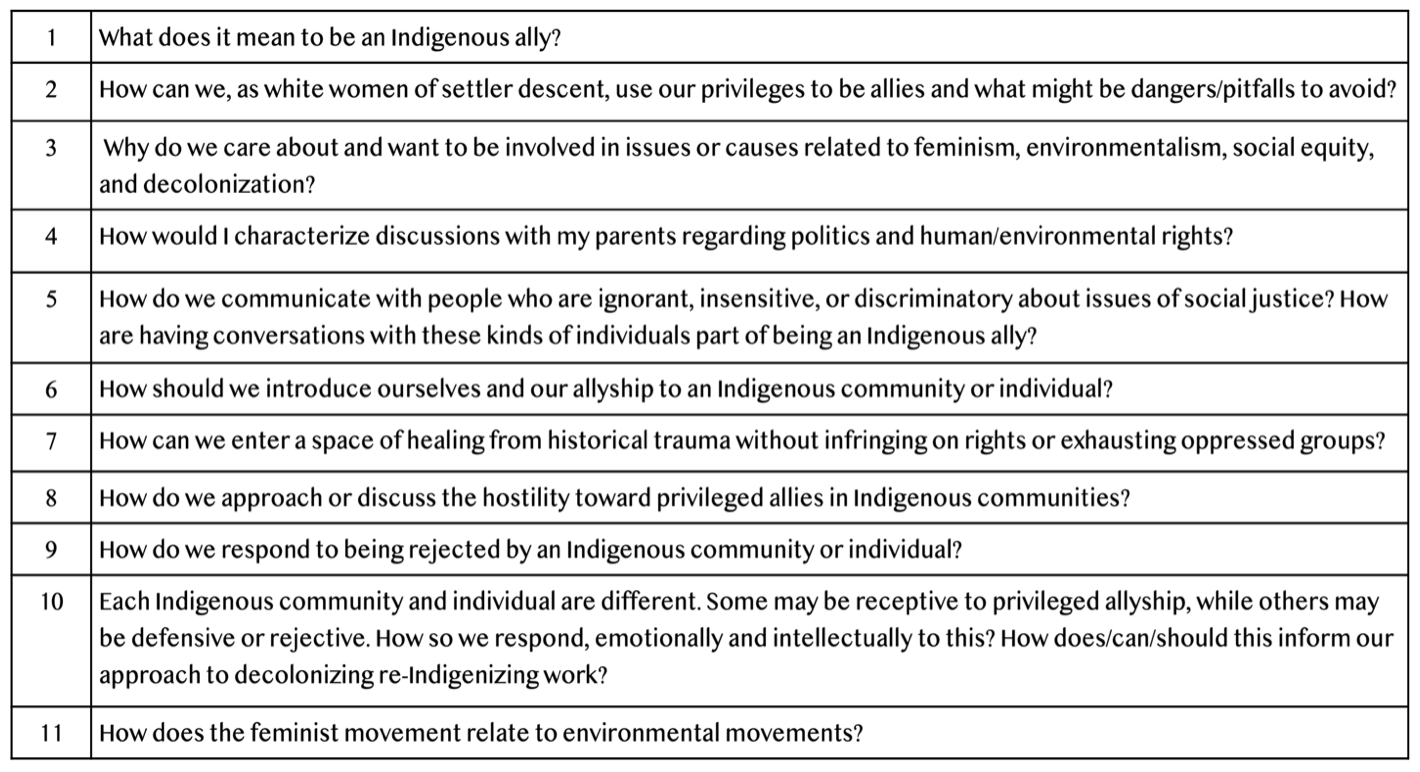
Our intentional collaboration began with discussion and consideration of what questions we might explore to more deeply understand the ways in which we can act as allies; thus, our first operational task was crafting open-ended critical questions (as shown in Figure 1) for exploration in the CAE format to collect data we could analyze for themes and insights. Our beginnings were tenuous, not even sure we should be asking these questions; however, we put primacy in trust and love, knowing that we operated with humility and were guided by our prior research and understanding of Indigenous, colonial politics.
 [4]
[4]Figure 1. Exploring/Journaling Questions
The next step involved individually journaling over a two-month timeframe in response to the eleven questions we composed; we indicated no expectation about what approach to take in our responses or how we should answer them. We then shared our journals with each other for review and met virtually on Zoom to conduct collaborative reflection, discussing our thoughts and responses to what each other had written, interpreting meaning from those dialogues. We chose to have these conversations in Zoom because the application provides a reliable written transcript. We met four times over the course of two weeks; some of our journaling questions were quickly addressed, thus combined in a single session; others necessitated more space and time. Once the transcripts were combined and cleaned, the full document was fifty pages, single spaced. The document was then uploaded into LiquidText for coding and data analysis.
Data Analysis
Our Zoom discussion sessions rendered more than fifty single-spaced pages of transcripts, covering twelve hours of discussion, spread out over the course of two weeks. While we include quotations and examples from our journaling in the Synthesis section, the journals were not included in the coding process because we intentionally wanted to focus on collaborative dialectic meaning making during conversation. Quotations and examples from the journals are incorporated to elaborate on findings from the transcripts of our dialogue, which is appropriate since those are the primary texts we were discussing and are cited accordingly.
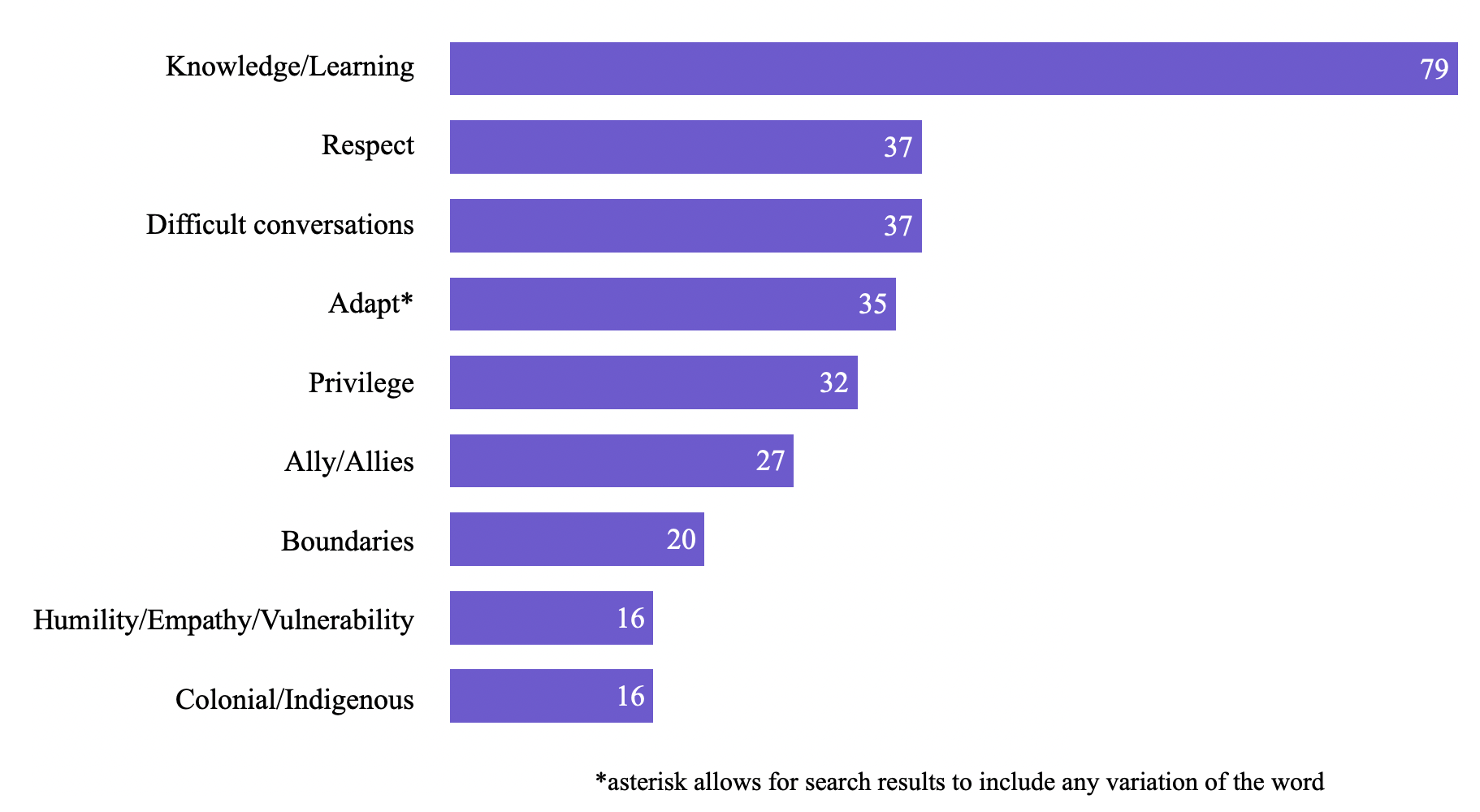
Coding these data sets was done on an iPad using the Tag Manager feature in LiquidText. Tag analysis revealed several strong themes present in our dialogue, most notably “knowledge/learning category” (79 occurrences) with three subcategories: “curiosity” (9), “growth & process” (46), and “responsibility/accountability” (24). Other prominent themes included “respect” (37 occurrences), “difficult conversations” (37 occurrences), “adapt(ability)” (35), “privilege” (32), “ally/allies” (27), “boundaries” (20), and “colonial/Indigenous” and “humility/empathy/vulnerability” (16 occurrences each). Seven other tag categories rendered ten or less occurrences and are not included in the table. While these additional aspects are meaningful, they are not the most salient to the purpose of our study.
 [5]
[5]Figure 2. Data Themes
In addition to tracking code occurrence, both Kolette and Rhiannon separately analyzed and summarized each section of the transcripts for prominent themes and main ideas. We met to share our findings and clarify our understanding of the data.
Synthesis: Building an Ethic and Praxis
The data provide evidence for our original intent of developing an ethic for Indigenous allyship as well as clear scaffolding for the praxis to guide such efforts. Perhaps even more significant, though, is that our findings from the data also make clear a preliminary element of ethic and praxis for engaging our own non-Indigenous (i.e., white) community and individuals. Through synthesis of our journaling and subsequent dialogue, these two distinct veins of ethic and praxis became evident: first, a responsibility and process for taking and fostering accountability within our own white community by engaging in conversations about allyship. Second, a process and guidelines for offering our service to Indigenous communities or individuals in ways that cultivate ea and build coalitions among Indigenous and non-Indigenous scholars, activists, and practitioners.
Ethic & Praxis Overview: A Framework for Allyship
The two main components of our framework function to inform and guide articulate allyship work. In this context, we understand ethic to represent “the principles of conduct governing an individual or a group; a consciousness of moral importance; a guiding philosophy” (“Ethic,” n.d.) and praxis to represent the “customary practice or conduct” (“Praxis,” n.d.).
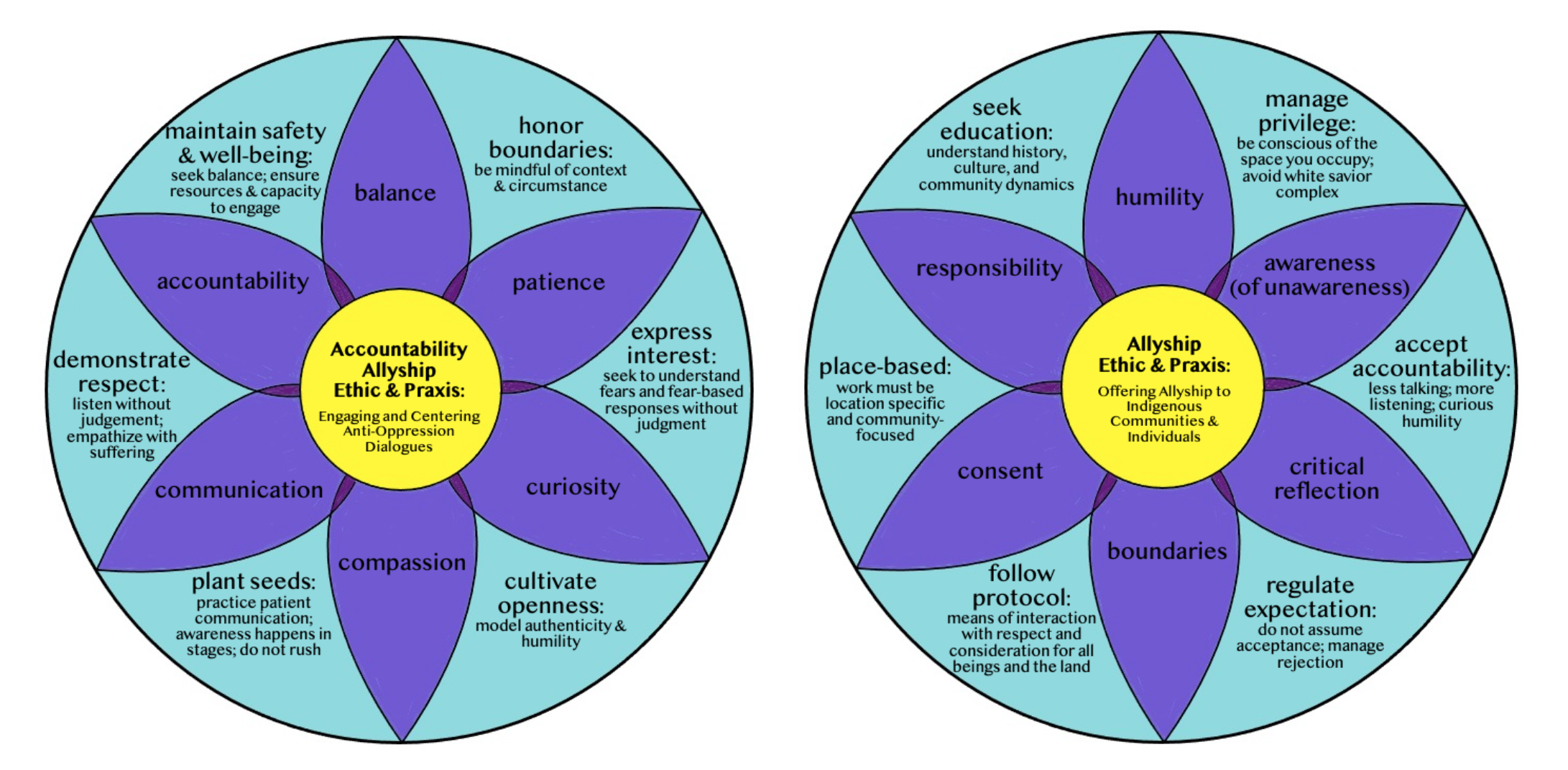
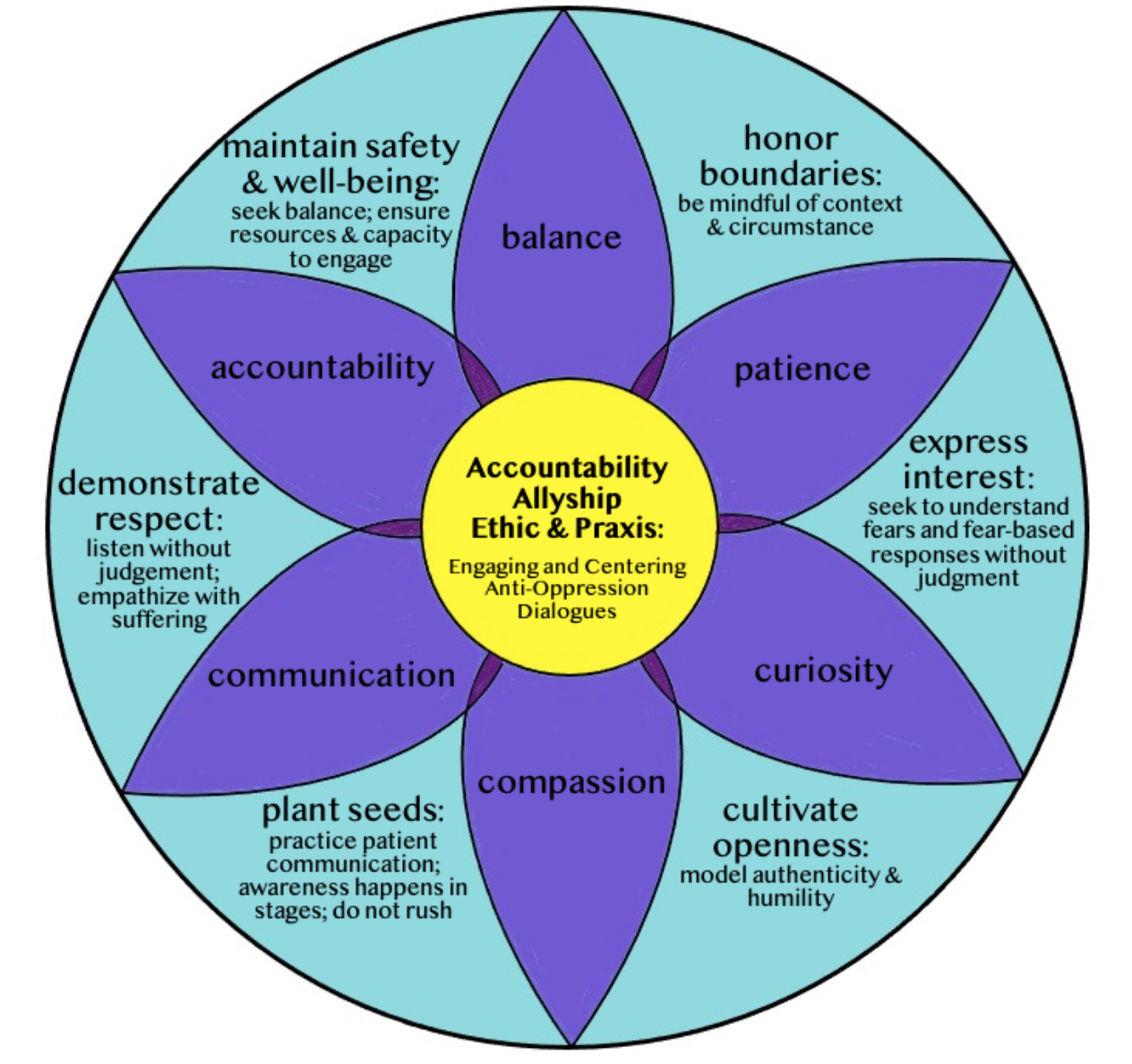
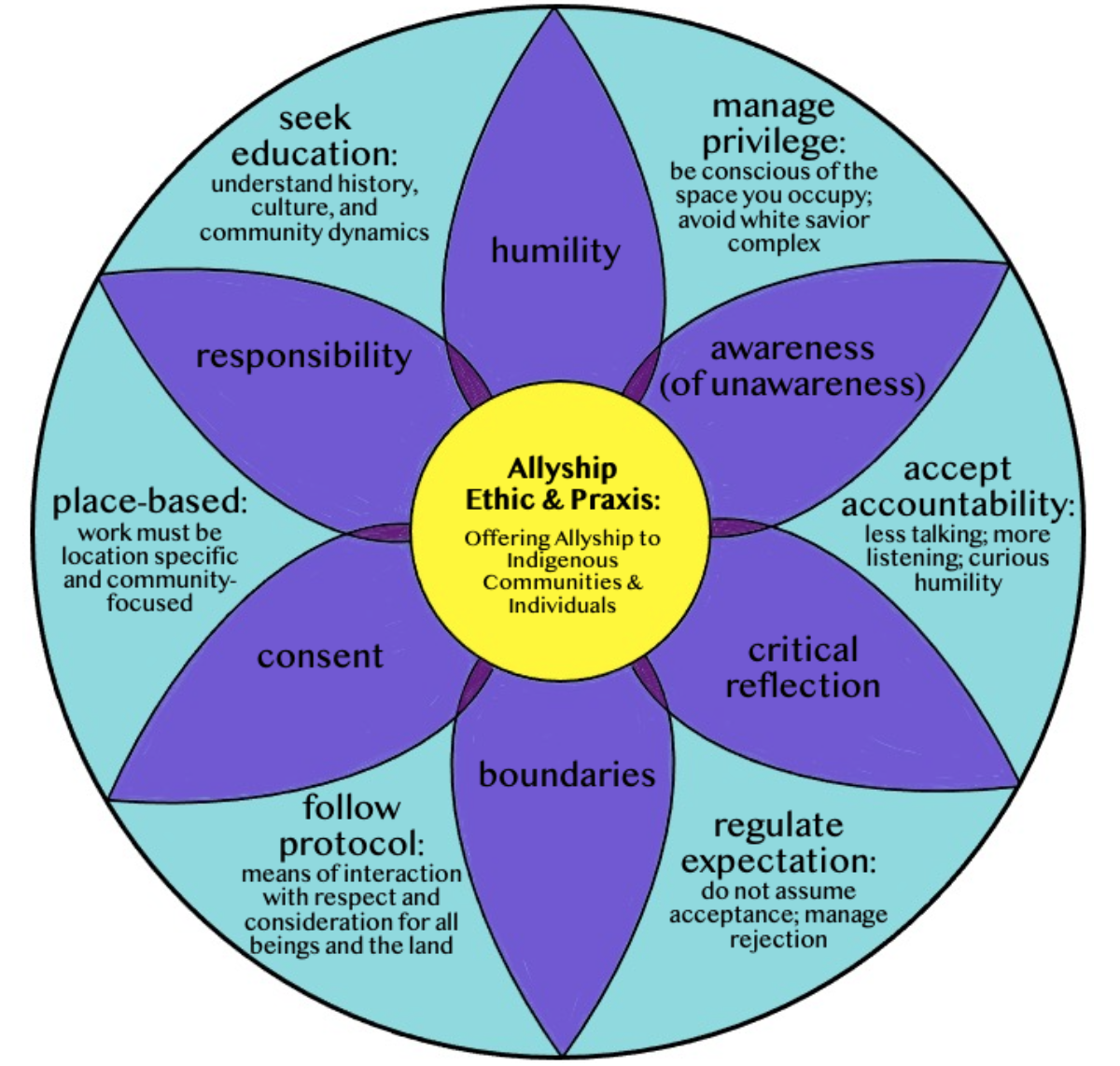
Synthesis of data generated during the CAE process crystalized into a framework represented with a circular, intersecting graphic. Because two veins of ethic and praxis materialized as a result of our discussions, we present two versions of this graphic (shown below combined as Figure 3). Principles guiding conduct (i.e., the “ethic”) are represented in the petal shapes emerging from the center circle, intersecting with each other, and touching the outer circle while the praxis elements that guide conduct fill the space between the ethic elements. The graphic symbolizes the interconnectedness of the various elements. Yellow suggests hope and curiosity, grounding the framework. Indigo signifies integrity and moral principles for the ethic elements while the blue characterizes responsibility of action in praxis. The teal shade of blue embodies calmness and connection to the natural world. A two-dimensional depiction of this complex, interleaving concept has limitations for providing a visual representation of the correlations among various aspects and elements. We aim to articulate and clarify this complexity in the following sections.
 [6]
[6]Figure 3: Dual Framework Overview
Accountability Allyship Ethic & Praxis: Engaging and Centering Anti-Oppression Dialogues
The CAE process revealed an important preliminary element of our developing ethic and praxis for engaging allyship work: the responsibility to participate in anti-oppression conversations with people who actively or passively support oppressive colonial practices, systems, and structures. Such conversations are ones that primarily happen within our white, non-Indigenous communities. Informed by Robin DiAngelo’s (2018) discussion of white fragility, we understand that we must expand our capacity for discomfort, examine our complicity in systemic oppression, and actively work to educate our white counterparts to bring about a more equitable and socially/environmentally just world.
This iteration of our ethic and praxis first emerged during our discussion of Question 4: “How would I characterize discussions with my parents regarding politics and human/environmental rights?” (Figure 1). Outside our direct relationship, both Kolette and Rhiannon have a precarious history engaging such conversations with our parents and other family members. For Rhiannon, this manifests mainly in interactions with her father that were, as she shared in her pathway, permeated with trauma and abuse. Her realization through exploring this question with journaling, discussion, and reflection is that, in relation to her father’s behavior, “Unresolved trauma and/or poor mental health in individuals can lead to irresponsibility with privilege. Individuals who are entirely consumed in their struggles and choose to be blind to anyone else’s struggles or perspectives exhibit narcissism and narcissistic behaviors (8).” Themes that surfaced from data analysis included nurture vs. abuse in childhood; choosing to stay in a victim mentality vs. working through and growing from trauma; the importance of nurturing a child’s curiosity in safe learning spaces, then choosing to lean into curiosity in adulthood.
We began by exploring the impact of the dichotomy that was Rhiannon’s upbringing with two ideologically opposed parents:
When you and my father divorced, and I was in these two very different environments, I got to see the many differences between them side by side. In my household with you, I was in a very safe space, emotionally, not just physically. It was a place for me to express myself freely and to develop my own opinions, and to come into my own person; whereas, with my dad, it was very hostile and judgmental and emotionally abusive where my own individuality and my own intellectual development was kind of stomped on and shunned. And so I know what it feels like to be appreciated versus abused. It’s taught me a lot about how I want to feel and how I want the other people in my life to feel.
It wasn’t just the polarization of how I was treated. It was also the topic of political conversation. You were a lot more liberal and left leaning, and you were passionate about social justice; on the other hand, my dad was very conservative, had a lot of racist tendencies, and was very selfish and irresponsible with his privilege. I saw the effect that had on me and the people in his life, and it’s not something I want to be associated with or be like as my own person. That is not the role model I want to choose. I’d rather choose the one who I see as compassionate and loving and accepting, and to me, more genuine and humane, more responsible with privilege.
As we continued discussing privilege and responsibility, we came to understand that when those in positions of privilege or power are consumed with their own struggles and suffering, they easily choose to ignore or discard anyone else’s perspective or struggles, which has negative interpersonal and intrapersonal consequences. We interpret this exploration as an understanding that ignorant privilege has negative consequences. Investigating this type of posturing further, we noted that such individuals, like Rhiannon’s father, often lack critical thinking skills and are easily manipulated by fears built on their own experiences and pain that are augmented by fear-based responses to perceived personal injustices. We also acknowledged that this type of willful fear-based ignorance is dangerous; Kolette reflected that it is “dangerous for people who benefit from many privileges to be unaware of that because then they are passive bystanders in the world where other people are being subjected to oppression.”
In contrast to Rhiannon’s upbringing steeped in critical conversations about issues related to social justice, Kolette recalled the absence of similar intellectual cultivation during childhood. She pointed out that
When I was growing up and a young person, like in my twenties, I didn’t have an understanding or awareness of any of this stuff, so I wasn’t paying attention to those qualities in my mate when I met your father, and I picked your father. He was a good guy, but we never had conversations about politics or social justice. It just wasn’t part of my sphere of awareness at that point in my life. This is much different in comparison to the time period in which you’ve grown up, as well as the particulars of your home and life environments. Your circumstances have nurtured something in you as a young woman that, at your age, I did not have.
Critical conversations about politics or social issues were not an element in Kolette’s formative years. Kolette did not experience either end of the dichotomy Rhiannon did; hers was more an atmosphere of apathy that, upon reflection, is a common factor in spaces of white privilege and reinforced fragility. As Kolette’s awareness of social justice issues grew throughout the years of her higher education, conversations about such topics became more common with her mother, who demonstrated genuine interest in what her daughter was learning and passionate about. As Kolette conveys the dynamics of her political relationship with her mother, she is aware of the need for accountability—for both herself and her mother as white people—but also has a desire to enact that accountability with compassion, for this mother-daughter relationship is precious and significant. Kolette and Rhiannon’s discussions regarding this quandary (and others like it) and our personal experiences inform much of the content in our Accountability Allyship Ethic & Praxis (Figure 4) and guide how we engage and center anti-oppression dialogues with people for whom we care deeply.
Prominent themes Kolette identified in relation to Question 4 (Figure 1) included curiosity, suffering, fear, and compassion, all of which are present directly or indirectly in our Accountability Allyship Ethic & Praxis framework. When approaching conversations about social justice issues, our dialogue revealed that we need to lead with curiosity about the other person’s perspectives and compassion for their experiences. Practicing compassion, rooted in Buddhist philosophy (Rahula, 1974; The Dalai Lama, 1997), requires that we seek to understand the suffering and fear of others and engage ethical conduct, which “is built on the vast conception of universal love and kindness” (Rahula, 1974, p. 46). In discussing Kolette’s journaling about her relationship with her mother in the context of social justice and political conversations, she recalled:
I think our conversations have definitely changed over the last thirty years. I think my mom and I have both changed individually, not necessarily together, and what I mean by that is I have become more aware of how I say things and present things, and really just more mindful of what comes out of my mouth. When I was in my twenties, there wasn’t much of a filter here, and I’ve gotten more intelligent and compassionate about what and how I choose to say things with more understanding of how they’re received on the other end—what impact my words might have.
And I think that my mother, your grandmother, takes on the concerns and interests of those around her, mostly her children. So when I see she openly engages and is willing to explore concepts like racism, and she’s growing and learning, and she’s supporting anti-racist efforts, I’m happy for it. I see that we are both moving through a process of increased competency, which is movement toward accountability, and we support each other doing so. The growth is a good thing… coming into anti-racist consciousness is a good thing. I am open to and ready for both of our ongoing evolutions in consciousness. And thinking more broadly about the process, our capacities seem to be expanding generationally with you coming into anti-oppression consciousness earlier than I or your grandmother have. It’s beautiful how we all support and hold each other accountable in that learning.
Our coding of Question 4 (Figure 1) and subsequent synthesis of themes informed inclusion of each of the six ethic elements for our accountability framework: balance, patience, curiosity, compassion, communication, and accountability. While our examples were personal and explored prominent relationships in our lives, we believe these are applicable beyond this level of interpersonal relationship, providing a model for how we engage those with whom we do not have personal, intimate relationships.
Our Accountability Ethic & Praxis further crystalized during our discussions of Question 5: “How do we communicate with people who are ignorant (9), insensitive, or discriminatory about issues of social justice? How are having conversations with these kinds of individuals part of being an Indigenous ally?” (Figure 1). In her summation of this question, Rhiannon identified that “these types of discussions are a social art: balancing personal boundaries with a sense of responsibility to have conversations within our white community.” What emerged from writing, discussion, and reflection regarding Question 5 became much of the praxis content in the first iteration of our framework (Figure 4), guided by the ethics unearthed throughout exploration of the previous question. During our discussion, we found it most fruitful to consider hypothetical situations—based on real events—with a specific member of our family who has the particular social and political posturing we were exploring. There have, over the years, been tense episodes with this individual, both personally with each Rhiannon and Kolette, as well as in larger family settings. We felt this individual aptly represented the type of exchanges we were examining. We learned that, while such conversations are necessary, there is potential risk when engaging and centering anti-oppression dialogues with individuals who are heavily mired in and unaware of their white fragility.
With this in mind, we constructed a hypothetical conversation, analyzed its elements, and established the following list of guidelines:
- Prioritize communication that is compassionate, and refrain from expressing judgement.
- Connect a person’s experience with suffering and oppression to something outside of themselves that is related to social justice.
- Build rapport through compassionate communication.
- Use language that promotes mutual understanding. Simplify or recontextualize concepts, theories, and language if necessary.
- Shift initial reaction from defensiveness to curiosity in response to something offensive. Being uncomfortable is part of having these discussions; navigating safe and healthy communication can be difficult.
- Practice patience; trying to rush these discussions may result in creating an unsafe space for discussion. Find the proximal zone (10) in the discussion. Respect the limits of someone’s proximal zone; challenge them, but don’t push them too far out of their capacity.
- Create space for increased willingness to lean into the proximal zone and engage vulnerability. Difficult discussions that challenge someone’s ideological perspectives tend to be more productive in one-on-one or smaller group settings, rather than a large group, like at an all-family gathering or in a classroom.
- Consider personal resources and capacity to engage as well as the individual’s sphere of influence and potential “pay-off.” In other words, what is the value of return?
These guidelines transcribed into the praxis elements of the Accountability Allyship framework (Figure 4).
 [7]
[7]Figure 4. Accountability Ethic & Praxis: Engaging and Centering Anti-Oppression Dialogues
Generally, conversations with individuals who are ignorant, insensitive, or discriminatory about issues of social justice are best approached in the following ways, each represented as a praxis element on the framework:
-
- Maintain safety and well-being: seek balance; ensure resources and capacity to engage. If engagement presents threats to safety or well-being, disengage. While we have a responsibility to hold those within our white community accountable and work to influence their evolution toward socially just attitudes and behavior, putting ourselves in danger will not accomplish our goals and may have serious consequences. Consequences can be to our physical, emotional, spiritual, or intellectual well-being. Additionally, physical, mental, or emotional fatigue can impair effective communication as can our own knowledge gaps. If the timing—for whatever reason—is not appropriate, execute patience to maintain balance between well-being and accountability. This is also the context where value of investment versus return becomes relevant. Consider the person’s sphere of influence and the potential for them to affect change in those spaces and balance that with the expenditure of resources.
- Honor boundaries: be mindful of context and circumstance. Boundaries refer to the capacity and resources we possess to engage such conversations, which relates to maintaining safety and well-being. Boundaries also refer to the opportunities and constraints of kairos (11) that influence conversation dynamics, namely setting, characters, and place. A group setting may not be productive for inviting an individual to occupy openness and curiosity about their own white fragility. While the primary purpose or focus of engaging such conversations is not the comfort and safety of the ignorant, insensitive, or discriminatory person, a successful outcome is dependent to some extent on that individual’s willingness to participate in a way that does not cause further harm to all involved.
- Express interest: seek to understand fears and fear-based responses without judgement. Genuine interest in the fears and curiosity about the concerns of the individual with whom we engage communicates to them that their feelings are valid, which in turn disarms defenses. Disarmament is necessary for the individual to eventually entertain a perspective that differs from—or conflicts with—their established ideologies and worldview. Humans desire to be understood. When an individual feels acknowledged, they are more likely to work at comprehending others and develop a new perception of previously held fears and fear-based responses.
- Demonstrate respect: listen without judgment; empathize with suffering. An individual’s experience of suffering is real to them. Acknowledging the experience of suffering communicates compassion, which engenders trust, openness, and an increased willingness to find common ground.
- Cultivate openness: model authenticity and humility. Contribute authentically to the conversation in ways that exhibit the humility needed to develop understanding. Share experiences of challenge and growth that model white accountability in action.
- Plant seeds: practice patient communication; awareness happens in stages; do not rush. An individual’s pathway to consciousness is not simple and rarely easy. If regular contact and interaction is an element of the relationship, a sustained approach to engagement will be more productive. Multiple conversations over time will support a sustained process as opposed to an isolated confrontation. Even so, changes to disposition may not manifest immediately—if at all—but take time to percolate as an individual considers their culpability with systems of domination and oppression and builds their “capacity to sustain discomfort” (DiAngelo, 2018, p. 113).
Allyship Ethic & Praxis: Offering Allyship to Indigenous Communities and Individuals
Fueled by a strong desire to work toward social and ecological sustainability, we began our journaling and discussion by exploring what it means to be an Indigenous ally as well as why we care about and want to be involved in issues or causes related to social justice (Figure 1, Question 1 & 3). Much of the discussion in relation to our first question functioned to define terms, concepts, and align our approach, intent, and purpose. We identified points of convergence and worked through differing perspectives, ultimately building a more nuanced, complex understanding of core concepts. Initially, Rhiannon disagreed with the following point Kolette made in her journaling: “simply put, doing work as an Indigenous ally means engaging in work that results in systemic power shifts.” Her criticism was that she did not believe it to be simple, which was a semantic misunderstanding easily cleared up, but also one that expanded Kolette’s perspective as Rhiannon explained, “allyship doesn’t have to solely engage with a systemic power shift. It could also look like just standing in solidarity with the community that needs momentum.” Building on this, Kolette explored that “It’s not just momentum, but it gives representation as members of a dominant group in our society for us to stand with and be physically present or offer our voices in solidarity.” While our language was at first clunky, even problematic, we persevered and ultimately convened that allyship work requires we put ourselves physically and ideologically in spaces of risk, even though we still wear a protective cloak of white privilege. This work cannot be “lip-service,” performative, or an act of virtue signaling. Being an Indigenous ally means we must be willing to risk comfort and safety.
Another key element present in both journaling and discussion of Question 1 (Figure 1) is the necessity for adaptability. Rhiannon’s understanding of this concept is steeped in her research related to sustainability science (12). During discussion, she focused on Kolette’s comments of allyship as something, “multi-layered, not static or fixed.” She then expanded our understanding, by explaining:
adaptability is one of the most important things as an ally and as a sustainability scientist. I’ve studied a lot about adaptability and how much of a necessity that has been for all species to evolve and exist and how adaptability in the same way can be necessary for humans to evolve and exist and be sustainable, socially. I think adaptability is never ending, and it’s complex. We can always choose any area in our lives and in our minds that we want to grow and expand upon or change. I like how you worded it that it’s not a fixed definition of what it means to be an Indigenous ally because being an ally means that we are adaptable and open-minded. I love the way our two perspectives on that came together.
We integrate adaptability as a foundational element of the Allyship Ethic and Praxis framework. Rhiannon explored this value in her journaling of Question 2 (Figure 1):
As we learn about our privileges and adapt our allyship, it is important to recognize that in the United States there are many different Indigenous communities that have been affected by historical trauma in different ways; thus, there need to be variable, dynamic, and adaptable solutions that relate to each community or individual. Additionally, it is the responsibility of an ally to educate themselves about the Indigenous community they are contributing to and about the historical and cultural contexts of the community. As allies, we need to be conscious of the space we take, and we should avoid speaking too confidently or with too much certainty because we need to be aware of how our privileges can make us unaware of certain oppressions and colonial dynamics. This is partially why adaptability is so important because we need to present ourselves in ways that express our respect, patience, and willingness to learn and understand. We should also avoid representing or speaking on behalf of the community, instead we should stand in solidarity with the community.
Our use of adaptability as a foundational concept is rooted in sustainability science and applied to social and ecological sustainability within the context of this framework. Discussion of Questions 1 and 2 (Figure 1) revealed points of convergence between our differing backgrounds and scholarly experience but also how our differences, when combined, create an opportunity to develop nuanced understanding of the complexity surrounding both social and environmental sustainability.
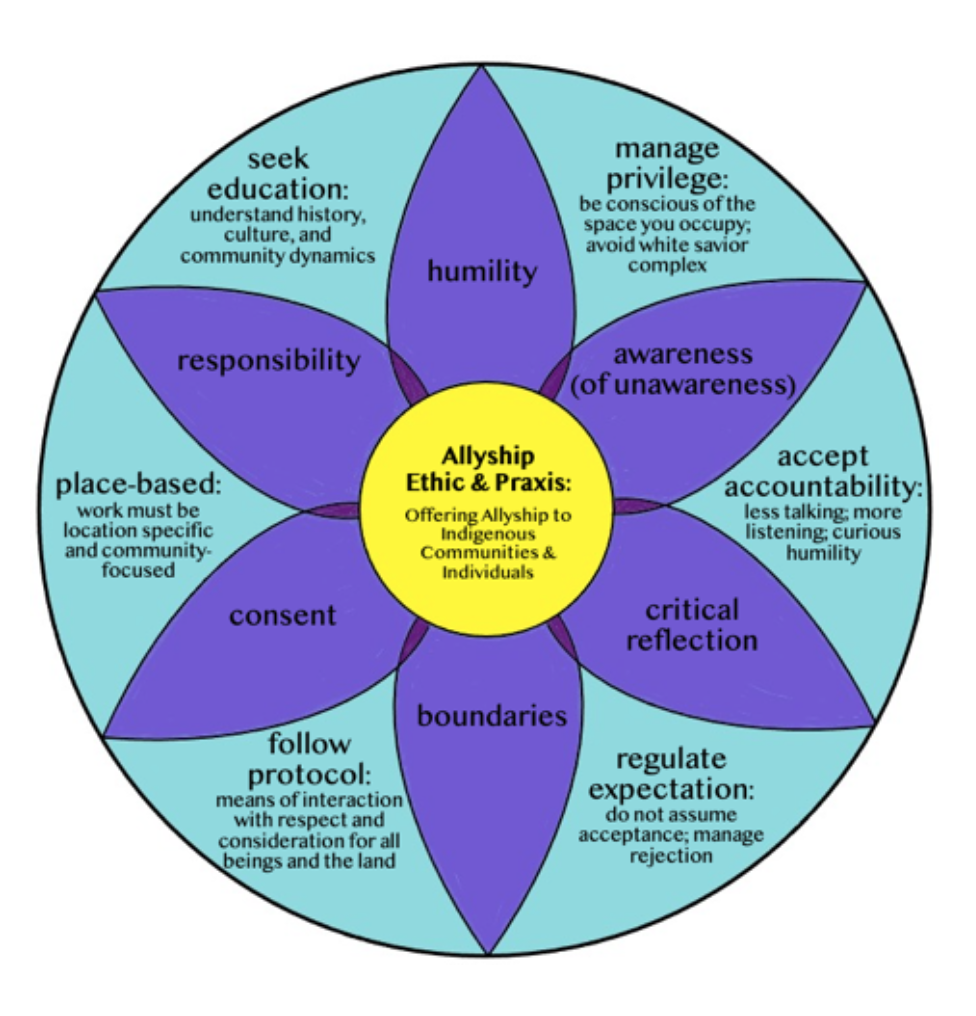
Rhiannon’s summary of our Question 1 discussion articulated dominant themes, which are represented in both the ethic and praxis elements of our second framework: “Developing a healthy understanding of privilege through awareness and education informs a deeper conceptualization of allyship. Denial (or ignorance) of privilege, and the shame/guilt that can come with privilege, is a hindrance to allyship. Education addresses this obstacle.” The themes we identified and the summaries we constructed in Questions 1-3 and 6-11 (Figure 1) inform and manifest throughout the second iteration of our Allyship Ethic and Praxis framework (Figure 5). Our CAE dialogues led us to identify the following six fundamental ethics that undergird allyship work: responsibility, humility, awareness of unawareness, critical reflection, boundaries, and consent. Additionally, our dialogues, specifically in relation to Question 6, “How should we introduce ourselves and our allyship to an Indigenous community or individual” (Figure 1), informed the following guidelines:
- Be mindful of personal intentionality in Indigenous spaces and of the risk of white savior complex (13).
- Make a conscious effort to be aware of boundaries and how they change. Boundaries are not static; they evolve and grow, which needs to be respected. They are multifaceted: personal, political, physical, and emotional. Within a historical context, many boundaries, particularly the political and physical, are colonially imposed, intended to strip Indigenous peoples of agency, voice, power, and livelihood.
- When entering Indigenous spaces, be prepared to avoid ignorance becoming a burden on the community. Seek education on the historical and cultural context before entering the space.
- Be prepared to do hard work, sacrifice, and risk personal comfort.
- Request consent and permission to be present.
- Offer service with humility. Do not show up empty handed. Do not force any help, skillset, or solution onto others.
- Participate continually in critical self-reflection.
 [8]
[8]Figure 5. Allyship Ethic & Praxis: Offering Allyship to Indigenous Communities and Individuals
The findings reveal a process and guidelines for offering our service to Indigenous communities or individuals in ways that cultivate ea and build coalitions among Indigenous and non-Indigenous scholars, activists, and practitioners:
- Seek education: understand history, culture, and community dynamics. Not only do we, as white women, have an obligation to educate members of our white community, we have a responsibility to be knowledgeable regarding the communities to which we desire to offer allyship. Self-education is an act of respect toward those with whom we wish to work because it demonstrates a willingness to put in effort and acknowledges that we do not expect someone else, specifically an Indigenous person, to teach us. Education helps us avoid any missteps in our words or actions and supports an understanding as to how we might navigate a particular community or if doing so is even appropriate. Seeking in-depth education demonstrates humility, supports critical reflection, and helps us identify gaps in our perceptions.
- Manage privilege: be conscious of the space you occupy; avoid white savior complex. An element of education involves understanding the ways in which our privileges impact a community and its individuals. However, these dynamics are not limited to white privilege but encompass the intersectionality (14) of multiple privileges and oppressions, including gender, class, ability, age, and education (15). When embarking on allyship work, awareness of privilege and how it impacts others is essential to prevent enacting further trauma or harm. Acknowledge the value of TEK, and that we do not hold this knowledge. Additionally, we must not engage in behavior or use words that assume we are here with any answers or some unique ability to fix whatever problems or challenges exist. Our function is one of assistance, taking a secondary, supportive role.
- Regulate expectation: do not assume acceptance; manage rejection. Along with managing privilege is the realization that our offer may not be welcome, wanted, or needed. If an offer of allyship is accepted, this does not guarantee every member of the community agrees we should be there or offer any value. Our presence may, in fact, be triggering or offensive to members of the community; individuals have differing boundaries, and our white bodies represent the historical trauma from which communities and individuals still suffer. Respect boundaries; do not refute, combat, or question them. Do not take rejection personally; reflect and regroup. The only control we have is in educating ourselves, demonstrating respect, and acting with humility. If our offer of service is rejected, even if done so harshly, we are responsible for processing that rejection; no one owes us an explanation or is expected to tend to our feelings regarding the rejection. This is an opportunity for critical self-reflection.
- Accept accountability: less talking; more listening; curious humility. Making an offer of service is not an opportunity to validate how much we know or that the offering we bring is valuable. Express curiosity non-verbally and, if invited to do so, verbally. Be present and open to direction. Make a conscious effort to be aware of boundaries and how they change. Historical trauma has involved violating boundaries, especially political and environmental boundaries. Be prepared when entering an Indigenous space to avoid your ignorance becoming someone else’s problem. Educate yourself on the historical and cultural context before entering the space. Be prepared to do hard work, sacrifice, and risk things like personal comfort.
- Follow protocol: traditional Hawaiian means of interaction with respect and consideration for all beings and the land (Protocol for Engagement, n.d.). Education must include understanding and awareness of protocol guidelines for approaching and engaging individuals or communities, which includes nā wahi pana (16). This involves knowing what physical and water spaces are protected and who is appropriate to approach with an offer of allyship as well as understanding what challenges exist and what potential needs may be. Always seek permission to enter physical spaces. Do not come empty-handed. Demonstrate preliminary research and clearly communicate what services and resources are being offered. Conduct should exhibit willingness to adapt based on community feedback. Be open to serving in unexpected ways.
- Place-based: work must be location specific and community-focused. Because each community and individual has varying experience with impacts of settler-colonialism, adaptability and openness are paramount for any offer of allyship. Anti-settler colonial work requires variable, dynamic, and adaptable solutions that relate to the specific community or individual. Place-based work also leads to larger, collaborative work as communities share resources to help, support, and lift each other up. Such collaborative cooperation is feminist, anti-capitalist, and anti-colonial.
Supported by the concept of adaptability, ongoing critical reflection is essential when engaging in allyship work. Feedback from communities and individuals for whom the work supports is an opportunity to reflect, revise, and adapt.
Moving Forward
Our exploration here is meant to be a beginning, an invitation and provocation to engage dialogue regarding actionable strategies for Indigenous allies. This is a call to our community of non-Indigenous folx, who desire to enact such work. This article is not an end piece but a beginning and open invitation to conceive what meaningful, substantive allyship looks like and become cognizant of how efforts may go wrong. While great care, attention, and critical self-reflection is the foundation of this work, we acknowledge that we may still have committed missteps, and we welcome dialogue as continued opportunity to grow and learn and do better.
Engaging this work as mother and daughter has had profound impacts on the evolution of our relationship. We are grateful for the opportunity to collaborate, to learn from and teach each other as scholars bound in an intimate relationship. We see this process as a manifestation of our feminist values of community care and collaboration, and we eagerly invite other voices to join our conversation in hopes of adding diversity and perspective. The concepts explored here have the potential for cross-disciplinary application, and we hope our framework model and the two iterations shared serve other scholars—particularly white scholars—who endeavor to engage anti-oppression, anti-colonial work in their respective fields and do so in ways that promote healing and agency for Indigenous communities and individuals.
Rhiannon was just eight years old when Kolette was completing her master’s thesis and interviewed Dr. Haunani-Kay Trask. During their discussion, Trask described how she believed “it is the wahine—Hawaiian women—who will drive the sovereignty movement because they are natural leaders and have the most to lose from continued colonization” (H.K. Trask, personal communication, April 15, 2009). At the same time, Trask expressed the value in collaboration and solidarity with women beyond Hawaiʻi. It was during this interview that Trask planted the seeds that eventually grew into the frameworks constructed here. Kolette and Rhiannon’s collaboration seeks to weave critiques of settler-colonialism with values of TEK and Indigenous sovereignty in ways that promote social and environmental sustainability for a healthier planet and a just society. The frameworks offered here are a call to action for white scholars and practitioners to honor Trask’s legacy by working toward healing and reparations for Indigenous people.
References
Aikau, H. K., & Gonzalez, V. V. (Eds.). (2019). Detours: a decolonial guide to Hawaiʻi. Duke University Press.
Allard-Tremblay, Y., & Coburn, E. (2023). The flying heads of settler colonialism; or the ideological erasures of indigenous peoples in political theorizing. Political Studies, 71(2), 359–378. https://doi.org/10.1177/00323217211018127
Avery, T., Cody, J., Griffiths, K., Khodai, K., Lenahan, A., Meluso, M., Sanada, Y., Seabough, K., Stanton, R., & Woodall, E. (2024). Digital video as a discussion board: A case study and collaborative autoethnography of experiences. Journal of Business and Technical Communication, 38(1), 66–88. https://doi.org/10.1177/10506519231199487
Bacon, J. M. (2019). Settler colonialism as eco-social structure and the production of colonial ecological violence. Environmental Sociology, 5(1), 59–69. https://doi.org/10.1080/23251042.2018.1474725
Burleigh, D., & Burm, S. (2022). Doing duoethnography: Addressing essential methodological questions. International Journal of Qualitative Methods, 21, 160940692211408. https://doi.org/10.1177/16094069221140876
Carpio, G., Barnd, N. B., & Barraclough, L. (2022). Introduction to the special issue: Mobilizing Indigeneity and race within and against settler colonialism. Mobilities, 17(2), 179–195. https://doi.org/10.1080/17450101.2021.2004078
Carrigan, C., Tanguay, S. K., Yen, J., Ivy, J. S., Margherio, C., Horner-Devine, M. C., Riskin, E. A., & Grant, C. S. (2023). Negotiating boundaries: An intersectional collaboration to advance women academics in engineering. Engineering Studies, 15(1), 9–29. https://doi.org/10.1080/19378629.2023.2169613
Chang, H., Ngunjiri, F., & Hernandez, K. C. (2012). Collaborative autoethnography. Taylor & Francis.
Choi, Y. H., Brunner, M., & Traini, H. (2023). Partial, (in)authentic, and masked: An exploration of power in doctoral students’ identity development as scholars through collaborative autoethnography. International Journal of Qualitative Studies in Education, 36(6), 1056–1072. https://doi.org/10.1080/09518398.2021.1891320
Denshire, S. (2014). On auto-ethnography. Current Sociology, 62(6), 831–850. https://doi.org/10.1177/0011392114533339
DiAngelo, R. J. (2018). White fragility: Why it’s so hard for white people to talk about racism. Beacon Press.
Docherty-Skippen, S., & Beattie, K. (2018). Duoethnography as a dialogic and collaborative form of curriculum inquiry for resident professionalism and self-care education. Canadian Medical Education Journal, 9(3), e76-82. https://doi.org/10.36834/cmej.42981
Draegan, K. (2009). The changing color of feminism: Haunani-Kay Trask and a multi-cultural perspective [Master’s thesis, California State University, San Marcos, California State University, San Marcos]. https://scholarworks.calstate.edu/concern/theses/n296wz587
Draegan, K. & et al. (Eds.). (2019). Central Arizona College rhetoric: English 101-102 (Second, Revised). Fountainhead Press.
Draegan, K. (n.d.). Experiential learning: Oʻahu, Hawaiʻi. Travel Study Programs. Retrieved June 14, 2025, from https://sites.google.com/student.prescott.edu/travel-study-programs/experiential-learning-oahu-hawaii?authuser=0
Dunbar, R., Greeson, K., & Affolter, E. A. (2023). The healing trifecta: A collaborative autoethnography on intersectionality, motherhood, and pedagogy during a global pandemic. International Journal of Qualitative Studies in Education, 1–14. https://doi.org/10.1080/09518398.2023.2181429
Ethic. (n.d.). In Merriam-Webster. https://www.merriam-webster.com/dictionary/ethic
Goodyear-Kaʻōpua, N., Hussey, I., & Wright, E. K. (Eds.). (2014). A nation rising: Hawaiian movements for life, land, and sovereignty. Duke University Press.
Hammersley, M. (2018). What is ethnography? Can it survive? Should it? Ethnography and Education, 13(1), 1–17. https://doi.org/10.1080/17457823.2017.1298458
Hislop, L., Davies, K., & Pryer, S. (2023). Taking power, telling stories: Using collaborative autoethnography to explore transitions to adulthood with and without disability identities. Scandinavian Journal of Disability Research, 25(1), 78–91. https://doi.org/10.16993/sjdr.915
Hradsky, D., Soyoof, A., Zeng, S., M Foomani, E., Cong-Lem, N., Maestre, J.-L., & Pretorius, L. (2022). Pastoral care in doctoral education: A collaborative autoethnography of belonging and academic identity. International Journal of Doctoral Studies, 17, 001–023. https://doi.org/10.28945/4900
Kauanui, J. K. (2016). “A structure, not an event”: Settler colonialism and enduring indigeneity. Lateral, 5(1). https://doi.org/10.25158/L5.1.7
Kelly, B. T., Castillo-Montoya, M., Varghese, R., & Zúñiga, X. (2024). Braids and bridges: A critical collaborative autoethnography of racially minoritized women teaching intergroup dialogue. Journal of Diversity in Higher Education, 17(1), 1–13. https://doi.org/10.1037/dhe0000374
Norris, J. (2008). Duoethnography. In The SAGE Encyclopedia of Qualitative Research Methods (pp. 233–236).
Phelps-Ward, R., Latz, A. O., Turner Kelly, B., & Kortegast, C. (2023). Re-examining and reimagining power in participatory visual methodologies: A collaborative autoethnography. International Journal of Qualitative Studies in Education, 36(10), 2138–2155. https://doi.org/10.1080/09518398.2021.1982049
Pranger, J. H. (2023). Christianity, settler colonialism, and resource extraction. Dialog, 62(2), 138–147. https://doi.org/10.1111/dial.12799
Praxis. (n.d.). In Merriam-Webster. https://www.merriam-webster.com/dictionary/praxis
Press, N., Andrew, M. B., Percy, A., & Pollard, V. A. (2022). Pedagogies of belonging in an anxious world: A collaborative autoethnography of four practitioners. Journal of University Teaching & Learning Practice, 19(4), 1–10.
Protocol for engagement. (n.d.). ʻĀina Momona. Retrieved January 26, 2025, from https://www.kaainamomona.org/keawanui-kamaamola-protocols
Rahula, W. (1974). What the buddha taught (Revised Second). Grove Press.
Ravenscraft, N. K. (n.d.). Hoʻonāʻū—Prolonging an ancestral breath: Wahi Pana. National Park Service. Retrieved April 6, 2025, from https://www.nps.gov/articles/hoonau-wahipana.htm
Roy, R., & Uekusa, S. (2020). Collaborative autoethnography: “Self-reflection” as a timely alternative research approach during the global pandemic. Qualitative Research Journal, 20(4), 383–392. https://doi.org/10.1108/QRJ-06-2020-0054
Rutter, N., Hasan, E., Pilson, A., & Yeo, E. (2023). “It’s the end of the PhD as we know it, and we feel fine…because everything is fucked anyway”: Utilizing feminist collaborative autoethnography to navigate global crises. International Journal of Qualitative Methods, 22, 16094069211019595. https://doi.org/10.1177/16094069211019595
Sawyer, R. D., & Norris, J. (2012). Duoethnography. Oxford University Press, Incorporated.
Silvia, N. K. (2017). The power of the steel-tipped pen: Reconstructing native Hawaiian intellectual history. Duke University Press.
Tham, J. C. K., Rosselot-Merritt, J., Veeramoothoo, S. (Chakrika), Bollig, N. W., & Duin, A. H. (2020). Toward a radical collaboratory model for graduate research education: A collaborative autoethnography. Technical Communication Quarterly, 29(4), 341–357. https://doi.org/10.1080/10572252.2020.1713404
The Dalai Lama. (1997). Healing anger: the power of patience from a Buddhist perspective. Snow Lion Publications.
Trask, H.-K. (1993). From a native daughter: colonialism and sovereignty in Hawaiʻi (Revised). University of Hawaiʻi Press.
UVA. (n.d.). Ethnographic research. Human Research Protection Program (HRPP). Retrieved January 11, 2025, from https://hrpp.research.virginia.edu/teams/irb-sbs/researcher-guide-irb-sbs/ethnographic-research
Vygotsky, L. (1978). Mind in society. MIT Press.
Walker, B., Holling, C. S., Carpenter, S. R., & Kinzig, A. P. (2004). Resilience, adaptability and transformability in social-ecological systems. Ecology and Society, 9(2), art5. https://doi.org/10.5751/ES-00650-090205
Wolfe, P. (2006). Settler colonialism and the elimination of the native. Journal of Genocide Research, 8(4), 387–409. https://doi.org/10.1080/14623520601056240
Footnotes
- Ea is Hawaiian for “breath” and embodies the concept of sovereignty of the lāhui (nation), ʻāina (land), and its people. “Ea is a political orientation and a set of intentional practices that must be done day after day, generation after generation” (Aikau & Gonzalez, 2019, p. 3)
- For an extensive discussion of decolonizing the mind, see Ngũgĩ Wa Thiong´o.
- The complex interconnections that exist among human societies, organisms, and Earth’s biogeophysical cycles.
- Describes something that is dominantly caused by humans.
- Complex issues that are difficult to solve due to being interconnected with other problems. Solving them could worsen the issue or lead to new problems.
- As opposed to a medical disease, which denotes infection, the term dis-ease indicates a system out of balance and harmony with itself and its interrelated partners, something ill at ease or out of alignment.
- White fragility refers to the concept of white people’s discomfort and defensiveness when confronted with racial oppression, inequality, and injustice.
- Worth exploring are the complex correlations that exist between systemic privilege and the prevalence of toxic masculinity in U.S. culture, government, and socio-economic structures.
- For our purposes, the term ignorant denotes a lack of knowledge as opposed to the other two terms, insensitive and discriminatory, which involve a level of willfulness on behalf of the person exhibiting those characteristics.
- Zone of Proximal Development is a widely used educational theory developed by Lev Vygotsky and refers to “the distance between the actual developmental level (of the learner) as determined by independent problem solving and the level of potential development as determined though problem solving under adult guidance, or in collaboration with more capable peers” (Vygotsky, 1978, p. 86)
- Kairos is a Greek word meaning the right or opportune moment to do something. The concept is used in the field of Rhetoric and Composition for identifying situational context and the optimal moment for a persuasive argument. Kairos helps us determine opportunities for and constraints of effective communication (Draegan et al., 2019, p. 317).
- “Adaptability is the capacity of actors in the system to influence resilience. …because human actions dominate in [social-ecological systems], adaptability of the system is mainly a function of the social component—the individuals and groups acting to manage the system” (Walker et al., 2004, p. 4)
- White savior complex refers to the tendency white settler individuals may have to “fix” what they perceive as broken or deficient in or with BIPOC (Black Indigenous People of Color) individuals or communities.
- Intersectionality, a term coined by Kimberlé Crenshaw, refers to “the interconnected nature of social categorizations such as race, class, and gender as they apply to a given individual or group, regarded as creating overlapping and interdependent systems of discrimination or disadvantage.”
- For more on identifying hidden biases and how they function, see Peggy McIntosh’s essay, “White Privilege: Unpacking the Invisible Knapsack.”
- Hawaiian term for the sacred, protected places and locations of land or water. The significance of wahi pana can be personal, communal, cultural, political and/or historical and signifies the interaction between people and place (Ravenscraft, n.d.).